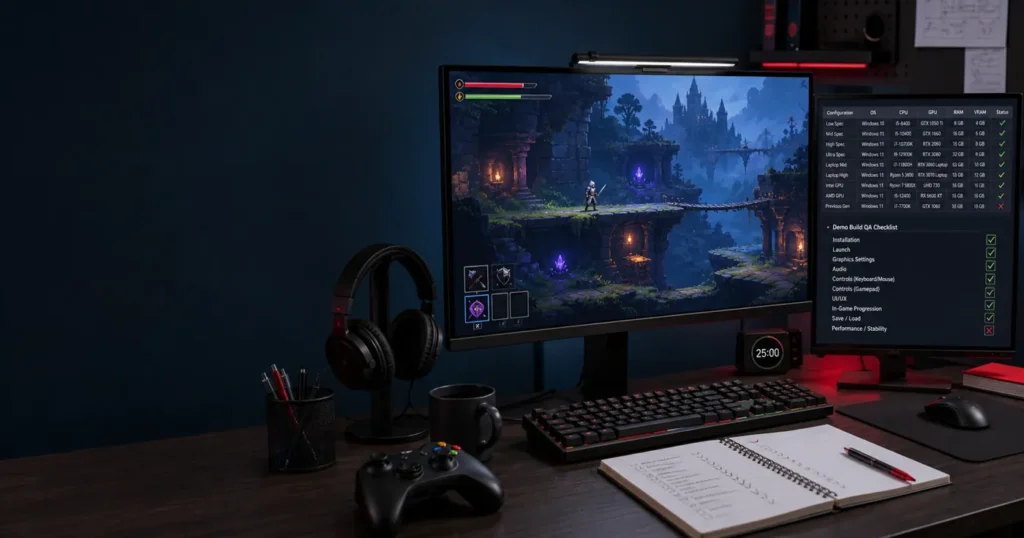
A game can look stable during a short developer check and still fail when a player changes direction, resumes an old save, switches networks, uses a different controller, or stays in the same session for an hour. These are not unusual edge cases. They are normal player behavior, and the risk changes as the build moves from prototype to launch.
After supporting game teams across mobile, PC, Unity, Unreal, multiplayer, casual, and live-service releases, we have learned that QA is most effective when its purpose changes with the development stage. Early checks protect the core idea. Alpha testing connects systems. Beta expands coverage. Release-candidate testing protects launch decisions. Post-launch QA keeps updates from damaging a game players already trust.
This article explains that lifecycle in practical terms. It is intended for studios deciding what to test now, what evidence they need next, and when focused game testing services can add more value than another round of familiar internal checks.
Preparing a playable build or release milestone?
Share your platform, build stage, target devices, and deadline. We will recommend a focused game QA scope around the risks that matter at that stage.

Game QA Has a Different Job at Every Development Stage
Using the same checklist from prototype through launch creates two problems. First, the team spends time testing features that are still being rebuilt. Later, the same checklist can become too shallow for a release candidate that now includes progression, monetization, devices, online services, and stored player data.
| Development stage | Main QA question | Useful coverage |
|---|---|---|
| Prototype | Is the core experience playable? | Controls, responsiveness, core loop, obvious blockers |
| Alpha | Do the major systems work together? | Progression, saves, menus, settings, interruptions, selected devices |
| Beta | Does the game hold up under real player behavior? | End-to-end journeys, usability, compatibility, performance, regression |
| Release candidate | What could block or damage the launch? | Critical paths, fixes, platform behavior, stability, release criteria |
| Store submission | Is the build and package ready for review? | Compliance, metadata, assets, install and update behavior |
| Post-launch | Did the update disturb a trusted player journey? | Change-based regression, liveops, devices, services, production smoke tests |
Prototype: Protect the Core Idea Without Slowing Iteration
During a prototype or vertical slice, the design may change several times in one week. The most useful checks are fast and close to the people building the game. Developers and designers should validate the core loop, controls, camera, feedback, responsiveness, and whether the build can support the next round of experimentation.
A large formal cycle is rarely appropriate here. However, a short independent review can help before a publisher demonstration, funding presentation, festival build, or technical decision. The scope should remain narrow: one important journey, one target setup, or one problem the internal team cannot reproduce.
Alpha: Test How Connected Systems Behave Together
Alpha is where isolated features start becoming a game. Movement now affects combat. Rewards affect inventory. Settings affect rendering. Checkpoints affect progression and saves. A small defect in one system can surface much later in another, which is why feature-level checks are no longer enough.
Useful alpha coverage
- Core progression from a clean start through meaningful checkpoints
- Save, load, pause, resume, retry, and interrupted-session behavior
- Menus, controls, settings, inventory, rewards, and player state
- Known high-risk combinations between recently connected systems
- Selected target devices or hardware configurations
- Clear defect evidence that helps developers reproduce the same state
This is often the first stage where independent QA provides consistent value. External testers do not know the intended shortcut or the order in which a feature was built. They are more likely to follow an unexpected journey, revisit an earlier state, or expose an assumption that has become invisible to the team.
Beta: Move From Feature Checks to Real Player Journeys
By beta, the experience should be sufficiently complete for longer and more varied sessions. The question changes from “Does this feature work?” to “Can different players use the whole product without losing progress, trust, or interest?”
Coverage that becomes more important during beta
- First-time player experience, onboarding, tutorials, and unclear feedback
- Complete gameplay journeys rather than isolated screens or mechanics
- Real-device, controller, resolution, and platform compatibility
- Longer sessions that expose heat, memory, frame-rate, battery, or resource issues
- Purchases, advertisements, subscriptions, rewards, and restoration flows
- Multiplayer invitations, matchmaking, reconnects, synchronization, and recovery
- Regression around fixes and systems changed during alpha
For Android and iOS titles, broader mobile game testing becomes especially important here. A build that behaves well on the studio’s devices may still show layout, permission, touch, thermal, memory, or OS-specific problems on the devices players actually own.
One recent example involved a mobile game that appeared stable until mid-range Android phones ran demanding gameplay for 10 to 15 minutes. The issue was not visible during short checks on higher-end devices. The investigation is documented in our Android game performance case study.
Moving from alpha to beta?
Compare focused gameplay, device, performance, multiplayer, and regression coverage before committing to a larger test cycle.
Release Candidate: Turn QA Evidence Into a Launch Decision
A release candidate should be close to the build players will receive. At this stage, the goal is not to generate the largest possible bug count. It is to identify issues that can block release, damage progression, prevent payment, cause crashes, create platform rejection, or produce a poor first impression.
Release-candidate priorities
- Installation, first launch, updates, clean starts, and returning-player behavior
- Critical journeys from onboarding through normal progression
- Save data, account state, cloud synchronization, and recovery paths
- Purchases and revenue flows where applicable
- Crash, freeze, loading, frame-rate, heat, memory, and stability symptoms
- Supported platforms, devices, controllers, resolutions, and network conditions
- Focused regression of release-blocking fixes and connected risk areas
The report should separate launch blockers from lower-risk defects and include steps, build details, device or hardware information, screenshots or video, logs where available, and the observed result. Clear evidence lets the product team make a release decision without guessing what the tester meant.
Store Submission: Validate More Than Gameplay
A polished game can still face delays when its submission package, permissions, metadata, platform behavior, assets, or required flows are incomplete. The studio should retain ownership of store accounts, legal information, pricing, age ratings, and final submission decisions. QA can support the process by checking the installable package and the player-facing behavior that reviewers are likely to encounter.
Because requirements differ across stores and platforms, the test plan should name the intended store, supported hardware, online features, regional scope, build type, and submission date. A generic compliance checklist cannot replace the requirements for the actual release destination.
Post-Launch and Liveops: Protect Existing Player Trust
After launch, every update carries history. Players already have saved progress, purchases, settings, accounts, and expectations. A new level, event, SDK, engine version, advertisement provider, server change, or hotfix can disturb a journey that worked in the previous build.
Change-based regression should cover the feature being updated, its connected systems, and a short set of business-critical journeys. Frequent releases may justify a tester who maintains product knowledge across builds. Teams can compare fixed milestone coverage with the option to hire game QA testers for ongoing regression, fix verification, multiplayer sessions, and liveops support.
What Good Game QA Evidence Should Contain
QA adds value when the report helps someone act. A defect title alone does not explain whether the problem is reproducible, device-specific, build-specific, or severe enough to change a release decision.
- Build version, environment, device or hardware, OS, and network context
- Preconditions and the exact player state before the problem occurred
- Clear steps that another person can follow
- Expected and actual behavior
- Screenshot, video, logs, crash details, or performance evidence where useful
- Severity based on player and release impact
- Retest result after the development team provides a fix
For example, our closed-beta progress-loss case study shows why account state, local storage, server synchronization, and rejoining behavior must be tested as one player journey rather than as separate features.
Internal Testing and External QA Work Better Together
Internal testing remains essential throughout development. The team can validate new work quickly, inspect technical details, and decide whether a build is stable enough to share. External QA adds a different perspective: independent journeys, wider environments, less familiarity bias, structured reports, and dedicated time for regression.
The right balance depends on build maturity, platform count, update frequency, risk, and budget. A focused package can suit one milestone. Ongoing development may benefit from a dedicated tester. Our guide to outsourcing game QA explains the process and ownership questions to review, while the game testing cost guide covers the factors that change scope and pricing.
Final Takeaway
Game QA is not one final pass before launch. It is a changing set of decisions that should mature with the build. Keep prototype checks fast. Test connected systems during alpha. Expand to real player journeys during beta. Use release-candidate evidence to protect launch decisions. Validate the submission package, then keep regression focused on the players and data already in production.
Testers HUB supports mobile, PC, Unity, Unreal, multiplayer, casual, casino, and live-service game releases with gameplay testing, compatibility coverage, performance investigation, regression, and clear defect reporting. The scope can begin with one milestone and grow only when the product risk justifies it.
Need game QA for an upcoming build?
Tell us the current milestone, platform, target devices, and release date. We will recommend a practical scope and reporting approach.
Frequently Asked Questions About the Game QA Lifecycle
When should game QA begin in the development lifecycle?
Game QA should begin with lightweight checks as soon as a playable build exists. Coverage can stay narrow during prototyping, then expand during alpha, beta, release candidate, store submission, and post-launch updates as the cost of a missed issue increases.
What should be tested during the alpha stage of a game?
Alpha testing should validate connected systems such as controls, progression, saves, menus, settings, inventory, rewards, interrupted sessions, and core gameplay. It is also a useful stage for selected compatibility and performance checks because structural problems can still be corrected before beta.
How is beta game testing different from alpha testing?
Alpha testing focuses on whether the major systems work together. Beta testing uses a more stable and complete build to examine real player journeys, broader device and platform coverage, usability, longer sessions, monetization, multiplayer behavior, performance symptoms, and regression risk.
What does game QA check before release?
Before release, QA should cover installation, first launch, critical player journeys, progression continuity, save data, purchases where applicable, supported devices and platforms, crash and performance risks, compliance requirements, and regression around release-blocking fixes.
Does game QA continue after launch?
Yes. Liveops events, new content, SDK updates, engine upgrades, server changes, hotfixes, and operating-system updates can affect previously stable features. Post-launch QA protects critical journeys and verifies that changes do not introduce regressions for existing players.
Should a studio use internal testers or an external game QA team?
Internal testers are valuable for rapid feature checks and everyday build validation. External QA adds independent player journeys, broader device coverage, structured evidence, and less familiarity bias. Many studios use both, with external coverage increasing near beta, release, and major updates.