Use approved test data
First, we confirm test accounts, role access, environments, and data rules before execution.

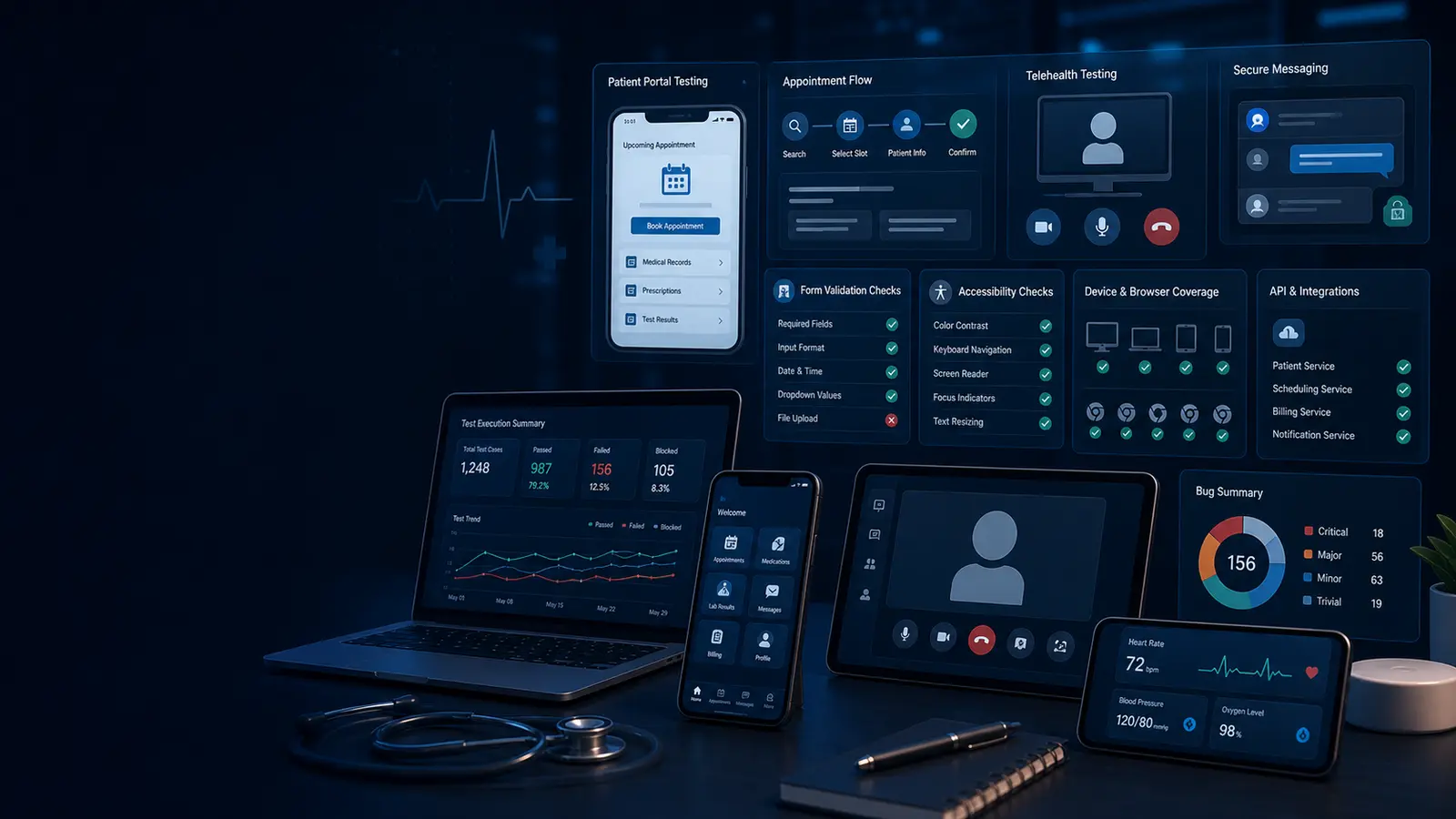
Healthcare app testing services for patient portals, telehealth, appointments, forms, secure messaging, and accessibility
Testers HUB helps healthcare product teams validate critical app and web workflows before release. Our healthcare software testing covers patient registration, appointments, telehealth journeys, medical forms, secure messaging, accessibility signals, device coverage, integrations, and clear QA reports.
What we test
Healthcare products need careful testing because small usability, role, or integration issues can affect trust. Therefore, our healthcare app testing services focus on patient journeys, provider workflows, accessibility signals, device behavior, and privacy-aware reporting using approved test data.
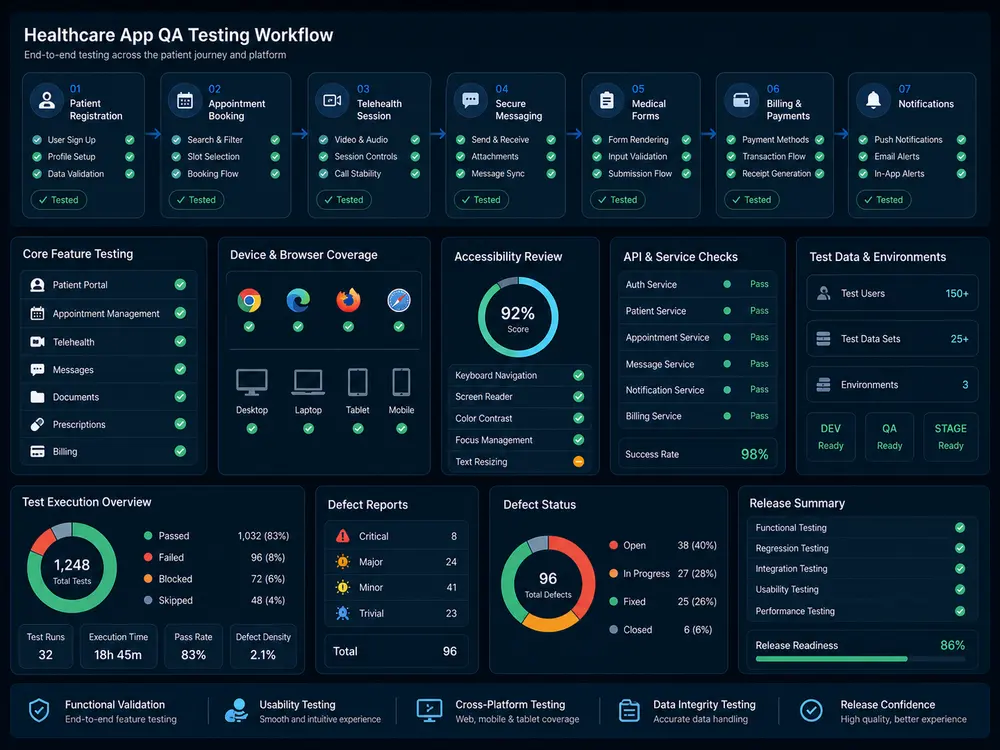
First, we confirm test accounts, role access, environments, and data rules before execution.
Next, we test appointments, forms, telehealth, messaging, notifications, and integrations.
Finally, reports include reproduction steps, evidence, severity, environment details, and retest notes.
Validate registration, login, profiles, appointments, forms, notifications, results views, and account workflows.
Check session flows, waiting rooms, permissions, device behavior, reminders, and post-session states.
Review field validation, conditional logic, required information, file uploads, and error messaging.
Validate patient, provider, admin, support, and restricted workflows with role-specific expectations.
Check readability, contrast signals, keyboard paths, responsive views, browser behavior, and real devices.
Review appointment, notification, document, API, payment, or third-party workflows where test access is available.
Use cases and scope
Every healthcare product has different risk boundaries. As a result, we define scope around approved environments, test data, roles, integrations, device coverage, browser coverage, accessibility signals, and the client’s privacy and security requirements.
Review how roles, platforms, integrations, devices, test cycles, and retesting affect a healthcare QA scope.
Mobile, web, and integration QA
Healthcare journeys often cross an app, browser portal, backend service, and third-party integration. We map those handoffs before testing so the scope follows the real patient, provider, and administrator experience.
Patient and provider workflows across agreed iOS and Android devices, permissions, notifications, interruptions, and release builds.
View Mobile App Testing ServicesBrowser-based registration, appointments, dashboards, forms, role access, responsive behavior, and connected workflows.
View Web App Testing ServicesFunctional checks for data mapping, delayed responses, retries, status changes, notifications, and visible recovery when approved test access is available.
View Human-Led Manual QAThis anonymized planning example reflects the coverage structure used in healthcare QA engagements. It shows representative roles and workflows without exposing client data or claiming fixed project counts.
| Platform | Representative roles | Priority workflows | Typical evidence |
|---|---|---|---|
| Healthcare mobile app | Patient, provider, administrator | Registration, permissions, appointments, reminders, interrupted sessions | Build, device, OS, account state, steps, screenshots or video |
| Patient or provider web portal | Patient, clinician, coordinator, support | Forms, dashboards, role access, documents, messaging, browser recovery | Browser, role, environment, expected and actual behavior |
| API-connected workflow | Approved test accounts and system roles | Status mapping, delayed responses, retries, duplicate prevention, visible recovery | Request context, timestamps, UI state, logs supplied for the engagement |
Connected healthcare mobile QA
Apple HealthKit and Android Health Connect use different permission, data, and platform behaviors. We validate each integration within the real patient journey using approved test accounts and non-production data.
| QA area | Apple HealthKit | Android Health Connect | Evidence reviewed |
|---|---|---|---|
| Authorization | Read and share permissions requested only when needed | Declared data-type permissions and user-granted access | Permission prompts, denied access, settings changes, and revocation |
| Data flow | Expected samples read or written without duplication | Expected records read or written within granted scope | Timestamps, units, sources, duplicates, and empty states |
| Background behavior | Delivery and refresh under agreed device conditions | Background reads, sync timing, and platform restrictions | Foreground, background, offline, terminated, and resumed sessions |
| Recovery | Safe behavior after access or connectivity changes | Safe behavior after permissions are removed | User messaging, stale data, retries, and recovery paths |
High-risk mobile states
A successful first session does not prove a healthcare app is release-ready. We validate permissions, synchronization, reminders, interruptions, and evidence handling across the states real users encounter later.
Validate first request, allow, deny, limited access, later revocation, settings changes, re-request behavior, and recovery when a capability is unavailable.
Check units, time zones, timestamps, duplicates, delayed sync, partial failures, multiple sources, stale data, and recovery after connectivity changes.
Review content, timing, deep links, read state, opt-in and opt-out behavior, foreground and background handling, and expired-session recovery.
Use approved non-production accounts, synthetic or de-identified data, and evidence that avoids exposing unnecessary personal information.
Deliverables and engagement
Before execution begins, your team knows what we will test, what evidence you will receive, and how fixes will be verified.
We document the roles, workflows, devices, platforms, integrations, environments, exclusions, and release priorities included in the engagement.
Each confirmed issue includes reproduction steps, expected and actual results, severity, environment details, and suitable screenshots or video.
We verify fixes and run focused regression across affected patient, provider, permission, notification, and integration workflows.
General mobile QA packages start from $499. Connected-health integrations and sensitive workflows receive a custom scope after review.
Our work covers functional and exploratory QA, real-device behavior, integration workflows, accessibility observations, regression, and evidence-led defect reporting. It does not replace legal or regulatory advice, HIPAA certification, penetration testing, FDA approval, clinical validation, formal medical-device validation, ISO 13485 certification, or HL7/FHIR conformance certification.
Experience based scenario
For a US-based telehealth startup preparing a provider rollout, focused QA can uncover appointment booking issues, unclear intake forms, video permission problems, and role-based access gaps. After fixes, retesting key patient and provider journeys helps reduce launch risk.
Confirm test accounts, environments, roles, and approved data rules.
Validate registration, forms, appointments, messaging, and telehealth paths.
Capture evidence carefully with severity, environment details, and expected behavior.
Confirm fixes across affected roles, devices, and browsers.
Healthcare app testing FAQ
Use these answers to plan realistic healthcare mobile QA coverage and understand the boundaries of the engagement.
Yes. We can test patient, provider, and administrative workflows across agreed iOS and Android devices, operating-system versions, and account states.
Yes, when suitable builds, approved test data, test accounts, and integration access are available. Coverage can include permissions, reads and writes, synchronization, revocation, duplicates, and error states.
No. We provide software QA and privacy-aware functional testing. We do not issue HIPAA certification, legal guarantees, medical-device approval, or penetration-test reports.
Typical scope includes registration, consent, patient and provider roles, appointments, reminders, connected health data, records, reports, subscriptions, recovery, notifications, and interrupted sessions.
General mobile QA packages start from $499. Healthcare integrations and sensitive workflows receive a custom quote based on platforms, roles, devices, data states, release risk, and retesting needs.
Our preferred approach is approved non-production accounts and synthetic or de-identified test data. Data handling and evidence capture are agreed before testing begins.