Validate expected behavior
First, we test whether each important feature behaves according to requirements, acceptance criteria, and business rules.


Functional testing services for web apps, mobile apps, SaaS products, ecommerce, APIs, user flows, and release-ready software
Testers HUB helps teams validate real product behavior before users find the gaps. Our functional QA testing checks user journeys, business rules, acceptance criteria, forms, roles, permissions, API behavior, integrations, regression risks, and defect fixes so every release is clearer and more dependable.
What we validate
A feature can look complete and still fail when data, permissions, integrations, or edge cases change. Therefore, our functional testing services focus on expected outcomes, not only screen-by-screen checks.
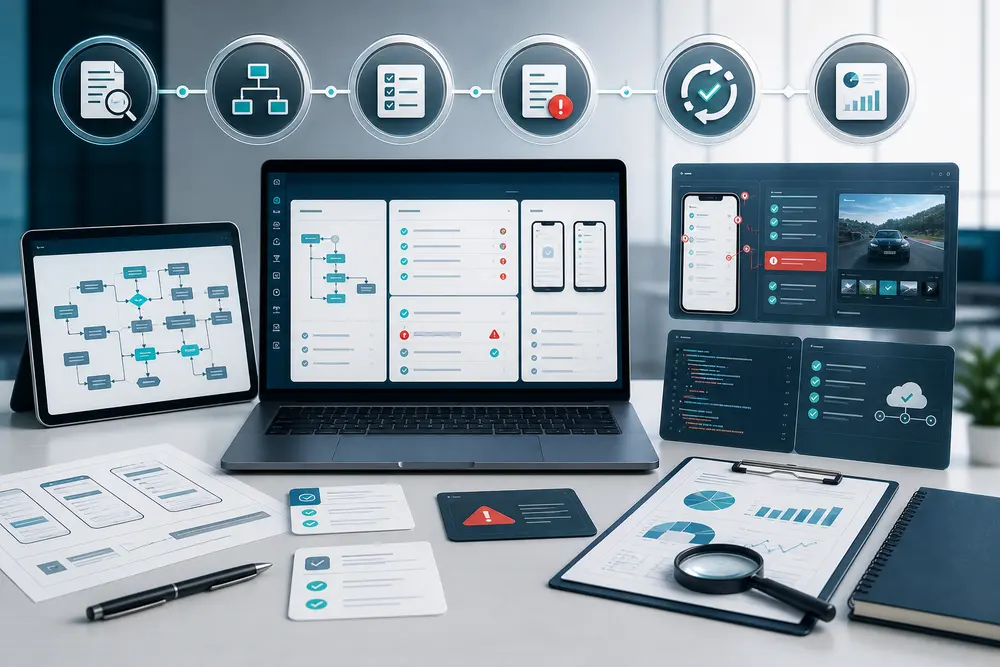
First, we test whether each important feature behaves according to requirements, acceptance criteria, and business rules.
In addition, testers move through realistic paths so broken handoffs, confusing states, and data issues are easier to catch.
Finally, every defect includes evidence, environment detail, severity, actual result, expected result, and retest status where needed.
We test real workflows such as signup, login, onboarding, checkout, booking, subscriptions, dashboards, settings, and account actions.
Functional testers verify calculations, permissions, validations, status changes, limits, eligibility rules, and expected data outcomes.
We check form behavior, required fields, error messages, uploads, search, filters, saved data, edited data, and deleted records.
Where needed, functional QA includes API responses, third-party integrations, front-end data sync, and failure handling.
We validate user roles, admin permissions, access restrictions, workflow approvals, account states, and unauthorized actions.
After fixes or new releases, we retest critical paths to confirm resolved issues stay resolved and core features still work.
Share the product type, core workflows, platforms, integrations, release date, and known risks. Then, we will suggest a practical functional testing scope.
Modern functional QA
Modern products often combine web screens, mobile apps, APIs, admin tools, notifications, analytics, and third-party services. As a result, functional QA needs to validate the whole behavior chain instead of checking one interface in isolation.
We connect requirements to real actions, expected outcomes, and the decisions users need to complete.
When products use AI features, we help validate input handling, output behavior, guardrails, error states, and fallback flows.
Each issue is written with enough context for product, QA, and development teams to prioritize the right fixes.
Why outsource functional testing
Internal teams usually know how a feature should work, but that familiarity can make hidden assumptions harder to notice. Independent functional QA gives your product a fresh review before users, clients, or stakeholders depend on it.
For teams comparing a functional testing company, our approach is practical: understand the feature, test the user outcome, report defects clearly, and retest important fixes before the release decision.
Functional testing process
The process starts with your product goals, user flows, acceptance criteria, platforms, test data, integrations, and timeline. After that, we plan coverage, execute functional checks, report defects, retest fixes, and summarize release risk.
First, we review the product area, user roles, acceptance criteria, workflows, integrations, test data, and known issues.
Next, we define priority flows, positive and negative scenarios, data needs, platform coverage, reporting format, and schedule.
Then, testers validate user journeys, business rules, forms, roles, APIs, integrations, edge cases, and regression areas.
After that, you receive reproducible defects with evidence, environment details, severity, expected behavior, and impact notes.
Finally, we retest important fixes and share a concise functional QA summary for the release decision.
Case study snapshot
Product teams often need independent functional testing when important workflows connect multiple screens, roles, integrations, and data states.
An Australia-based SaaS team needed functional QA before a customer-facing release. First, we reviewed acceptance criteria, onboarding paths, billing states, admin permissions, email triggers, and API-linked data. Then, we tested priority scenarios, reported defects with clear evidence, and retested high-impact fixes before the release window.
Functional testing packages
Functional testing cost depends on workflow count, roles, integrations, API depth, platforms, test data, release urgency, regression cycles, and reporting detail. Therefore, we recommend the right model after reviewing your scope.
Best for launch checks, client delivery, demos, release candidates, or focused validation before a public release.
Best when the same user journey needs to work across web, mobile, tablet, browser, or admin experiences.
Best after bug fixes, sprint releases, hotfixes, integration changes, or updates to critical product workflows.
Best for teams that need ongoing QA across sprints, feature work, product updates, and release cycles.
Tools and reporting
We adapt to your workflow where possible. However, the goal stays the same: clear functional coverage, reproducible defects, useful evidence, and release information your team can act on.
Related QA services
Functional testing often connects with manual QA, automation, mobile app testing, web app testing, and API validation. These related pages help users move to the right service without mixing search intent.
Functional testing FAQs
These answers are written for founders, product managers, CTOs, QA leads, and software teams comparing functional testing services.
Functional testing services validate whether features, user flows, business rules, forms, roles, permissions, APIs, integrations, and expected outcomes work correctly from the user's point of view.
A functional tester checks requirements, acceptance criteria, screens, forms, data behavior, calculations, notifications, error handling, user roles, integrations, API responses, regression areas, and defects that may affect release quality.
Functional testing can be manual, automated, or a mix of both. Manual functional testing is useful for new features, exploratory checks, usability judgment, and changing workflows, while automation can support stable repeatable regression checks.
Yes. Testers HUB can provide functional QA testing for web applications, mobile apps, SaaS products, ecommerce platforms, admin panels, APIs, integrations, and cross-platform user journeys.
Functional testing cost depends on the number of workflows, platforms, roles, test data, integrations, API depth, regression cycles, urgency, reporting detail, and whether you need one-time QA or dedicated functional testers.
Yes. A functional testing scope can include defect retesting, regression checks for critical user journeys, smoke testing before release, and a final QA summary to support launch decisions.
Share your product type, core user journeys, platforms, integrations, timeline, and QA goals. Then, we will recommend a practical functional testing scope and quote.