Start with realistic usage
First, we define user journeys, data needs, environments, peak assumptions, and target performance expectations.


Performance testing services for websites, web apps, mobile apps, APIs, SaaS, and ecommerce platforms
Testers HUB helps teams find speed, stability, and scalability risks before users feel them. Our performance testing services combine load testing, stress testing, API performance checks, bottleneck analysis, and clear reporting so your team can improve response time and release with confidence.
What we test
A page can look fine during a quick manual check and still slow down when real users arrive. Therefore, our performance QA services focus on the workflows, APIs, and platform conditions that matter most to revenue, user experience, and release confidence.
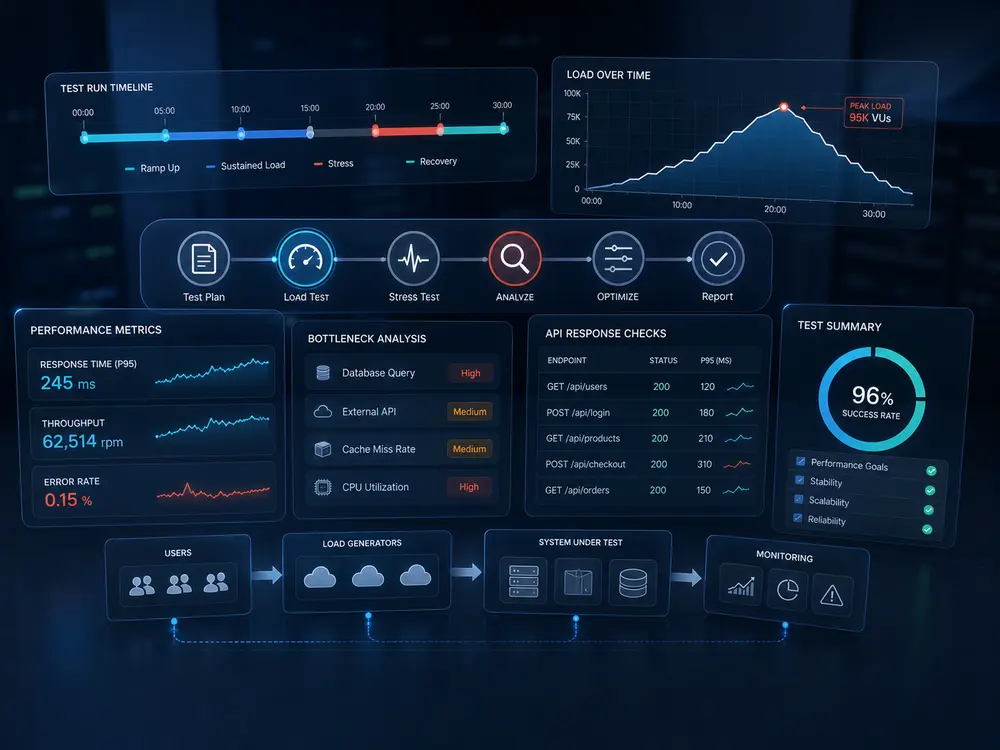
First, we define user journeys, data needs, environments, peak assumptions, and target performance expectations.
Next, we validate login, search, checkout, dashboards, file uploads, APIs, forms, and other high-value workflows.
Finally, we share clear evidence, likely bottlenecks, severity, and retesting notes so developers can act quickly.
Validate response time, throughput, and reliability when expected users access key workflows at the same time.
Understand how far the system can go, where it slows down, and how it recovers when usage exceeds normal capacity.
Check whether application behavior stays predictable as traffic, data, sessions, locations, and transactions increase.
Measure latency, failures, payload handling, authentication, integrations, and backend stability across important API calls.
Review loading behavior, Core Web Vitals signals, browser timing, asset impact, and user-facing speed for priority pages.
Check app responsiveness, backend calls, startup behavior, network conditions, heavy screens, and device-specific slowdowns.
Tools and signals
Some projects need quick page-speed triage, while others need scripted load scenarios and server-side analysis. As a result, we can combine tools such as JMeter, k6, Gatling, Lighthouse, Chrome DevTools, WebPageTest, API monitoring, logs, analytics, and client observability data.
Experience based scenario
For a US-based SaaS team preparing a marketing launch, a controlled performance test can reveal slow dashboard APIs, search delays, and checkout pressure before the release window. After the team fixes the largest bottlenecks, a focused retest gives stakeholders a clearer launch decision.
Agree on user volume, peak scenarios, ramp-up, data setup, and pass/fail expectations.
Execute load, stress, API, and browser timing checks against agreed environments.
Review response time, failures, logs, slow requests, and workflow-level user impact.
Confirm improvements and summarize remaining performance risks before launch.
FAQ
These answers help product, engineering, and marketing teams decide what type of performance QA is needed.
No. We test websites, web apps, mobile app APIs, SaaS platforms, ecommerce flows, dashboards, backend services, and release-critical workflows.
Yes, although the result should be read as environment-specific. However, early testing can still reveal slow queries, heavy pages, API bottlenecks, and risky workflows.
Yes. The report can include performance findings, evidence, severity, likely causes, and practical recommendations for retesting after fixes.
Yes. Teams can request one-time testing before a launch or recurring performance checks for releases, campaigns, and infrastructure changes.