Gameplay-first validation
First, we play through onboarding, core loops, levels, missions, rewards, inventory, menus, UI states, and progression blockers.


Mobile game testing services for Android, iOS, real devices, multiplayer, ads, IAP, and app store readiness
Testers HUB helps game studios, startups, publishers, and indie teams test mobile games across gameplay, controls, devices, screen sizes, OS versions, monetization, multiplayer flows, performance, and regression risk. As a mobile game testing company, we give your team clear defects and practical release confidence before players see the build.
What we test
A mobile game can lose players because of a confusing tutorial, a broken reward, a device-specific crash, slow loading, ad issues, IAP failures, or poor performance on mid-range phones. Therefore, our mobile game testing services focus on the moments that shape retention, reviews, and launch confidence.
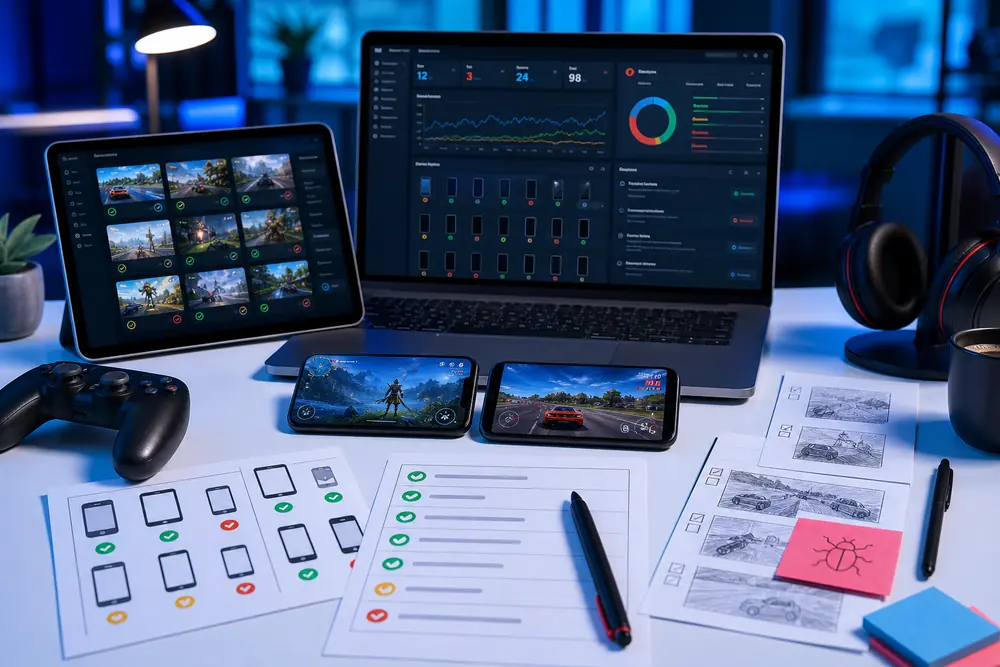
First, we play through onboarding, core loops, levels, missions, rewards, inventory, menus, UI states, and progression blockers.
In addition, we check priority Android and iOS devices, screen sizes, orientation changes, OS versions, install states, and network behavior.
Finally, each defect includes steps, expected result, actual result, build, device, OS, screenshots or video, severity, and retest status.
Mobile game QA coverage
The final scope follows your game build, supported platforms, target players, release stage, and agreed device access.
We validate tutorials, controls, menus, missions, levels, rewards, achievements, inventory, player progression, save states, and game logic.
For Android game testing, coverage can include phone models, tablets, OS versions, permissions, installs, crashes, screen sizes, and store build behavior.
For iOS game testing, we review iPhone and iPad behavior, TestFlight builds, gestures, orientation, app lifecycle states, notifications, and App Store readiness.
For connected games, we test matchmaking, lobbies, invites, reconnects, session recovery, chat, leaderboards, latency-sensitive flows, and synchronization.
Also, we check rewarded ads, interstitials, in-app purchases, subscriptions, wallets, reward states, purchase recovery, and monetization regression risk.
Next, we look for load delays, frame drops, freezes, memory issues, battery drain, heating, network interruptions, and crash patterns.
Share your Android/iOS build, target devices and release date. Include any multiplayer, ads or purchase flows you need checked. We’ll recommend the QA scope, device mix and effort before testing starts.
Mobile-specific risks
Players switch networks, rotate screens, leave the app mid-session, receive calls, watch ads, retry purchases, and play on devices with different memory, GPU, and battery behavior. Because of that, mobile game QA needs more than a simple gameplay pass.
We agree a practical matrix from devices we can actually access, then check supported Android and iOS versions, chipsets, GPU and memory conditions, screen sizes, refresh rates, storage, battery state, heat, and network behavior. We do not claim unverified device coverage.
We check incoming calls, notifications, background and foreground changes, app termination, screen locks, Wi-Fi and cellular switching, network loss, low battery or storage, supported rotation, and accessory disconnects. The key result is whether the player returns to the correct game state.
We follow in-app purchases, cancellation and failure paths, restoration, rewarded and interrupted ads, premium currencies, subscriptions, reward delivery, and duplicate-entitlement prevention from player action to final account state.
Why outsource mobile game testing
Internal teams know how the game should work. However, independent mobile game QA testers often find the issues that new players notice first: unclear onboarding, unreliable controls, broken progression, reward gaps, crashes, or confusing store flows.
Genre coverage
Different mobile genres create different QA risks. A hyper-casual game needs fast session checks and ad flow validation, while an RPG needs deeper progression, inventory, economy, and long-session coverage. Therefore, the test scope adapts to your genre and player journey.
We check onboarding, simple controls, level flow, rewarded ads, difficulty curve, restart behavior, device performance, and retention-critical loops.
Coverage can include character states, quests, rewards, inventory, matchmaking, economy loops, save/load behavior, and long-session stability.
For sports and racing games, QA validates input timing, collision behavior, camera views, online sessions, performance, and device responsiveness.
We review game rules, round flow, reward delivery, UI clarity, wallet-related states, transaction-adjacent behavior, and regression risk.
Testing focuses on level unlocking, hints, scoring, accessibility cues, touch targets, session recovery, and age-appropriate usability where relevant.
Finally, multiplayer and liveops QA covers lobbies, invites, reconnect cases, chat, leaderboards, event updates, content drops, and release regression checks.
Mobile RPG and gacha QA
Testers HUB tests mobile RPG and gacha games across Android and iOS, including combat, quests, progression, inventories, summons, pity counters, virtual currencies, purchases, limited-time events, cloud saves and release regression. Coverage follows the rules supplied by your studio and uses controlled player accounts on agreed devices.
Damage, cooldowns, status effects, targeting, interruptions and battle-state recovery.
Levels, quests, unlock conditions, XP, milestones and player-state dependencies.
Characters, equipment, materials, success conditions and resulting attributes.
Item grants, deductions, caps, duplicate prevention and free-versus-paid balances.
Eligibility, displayed rules, single and multi-pulls, guarantees and counter persistence.
Start and end times, daily resets, missions, rewards, eligibility and post-event states.
Purchase completion, cancellation, entitlement delivery, restoration and interruptions.
Guest conversion, linking, cloud conflicts, device migration and update continuity.
Android and iOS builds, supported OS versions, screens, memory conditions and networks.
Risk-based checks after content, SDK, economy, event and platform changes.
Gacha banner and pity-system testing
| Test state | Coverage | Evidence recorded |
|---|---|---|
| New account | Eligibility, tutorial restrictions and first pull | Starting balance, banner state and result |
| Near guarantee | Below, at and above the supplied pity threshold | Counter before/after and granted item |
| Single vs multi-pull | Counter increments, discounts and inventory delivery | Currency deduction and item ledger |
| Banner boundary | Start/end time, app resume and already-open screen | Server time, device time and availability |
| Cross-device account | Counter, history and entitlement synchronization | Account, build and device states |
We validate configured odds, guarantees and reward rules against the studio specification. Statistical randomness certification requires a separately designed engagement and is not implied by standard functional QA.
Economy and reward validation
LiveOps event regression
2026 platform release check
For 2026 Android submissions, we can include target API 36 build checks, third-party SDK behavior, background recovery, purchases, notifications, saved progression and supported-device regression. iOS coverage is scoped around the current build, supported versions and App Store workflows. Platform requirements can change, so this dated callout is reviewed before each engagement.
Core gameplay, progression, monetization, devices, and release-critical regression for alpha, beta, soft launch, or release candidates.
A targeted Android and iOS check for a defined compatibility, performance, layout, or interruption concern.
Repeatable validation of critical journeys and recent fixes across frequent development or release builds.
Recurring coverage for events, banners, offers, configuration changes, content updates, and hotfixes.
Retained product knowledge and consistent QA support for ongoing games with frequent releases.
Share the build, game rules, target devices, event cadence and release date. We will recommend a focused QA scope without promising unsupported coverage.
QA process
The process is designed for active mobile game teams. You share the build, genre, Android and iOS priorities, device list, test accounts, multiplayer needs, monetization flows, known risks, and timeline. After that, we test, report, retest, and summarize launch risk.
First, we review genre, platforms, devices, builds, accounts, ad or IAP needs, multiplayer scope, and release goals.
Next, we define gameplay paths, device coverage, test data, multiplayer sessions, regression priorities, tools, and reporting format.
Then, testers validate controls, gameplay, UI, devices, installs, performance, crashes, ads, IAP, multiplayer flows, and release-critical states.
After that, you receive reproducible issues with screenshots or video, build, device, OS, severity, steps, and expected behavior.
Finally, after fixes, we retest important issues and share a concise mobile game release-readiness summary.
Before testing starts, we can review your device priorities, platform coverage, monetization flows, multiplayer risk, and launch timeline.
Case study snapshot
These examples reflect the kind of practical mobile game testing support we provide when studios need independent QA before launch, updates, or player-facing releases.
A UK-based mobile sports game team needed independent QA before releasing Android and iOS builds. First, we reviewed gameplay flows, tutorial behavior, scoring, device compatibility, and ad-related states. Then, we reported reproducible issues with clear screenshots, videos, device details, and retest notes so the development team could prepare a stronger release.
For a mobile RPG battleground release, the QA scope covered character progression, device behavior, reward states, gameplay blockers, and launch-critical regression checks.
For a mobile card game, testing focused on round behavior, wallet-adjacent states, session recovery, rules, UI clarity, and regression checks after updates.
Mobile game testing packages
Mobile game testing cost depends on genre, device coverage, Android and iOS scope, multiplayer complexity, monetization flows, test cycles, and reporting detail. Choose a screen-based mobile package below. Starter, Standard and Advanced each include one full end-to-end cycle on 2–4 selected real mobile devices in total, not per platform. We agree the Android/iOS mix and gameplay scope before work starts. Retesting, fix verification and regression are separately planned and charged. Monthly QA coverage is prioritized within the agreed hours.
Best for indie games, soft launches, early playable builds, MVPs, and small-scale casual games.
Best for indie studios, mid-stage games, pre-launch builds, soft launches, and regional releases.
Best for feature-rich games, monetized games, scaling titles, and teams approaching a wider launch.
Best for live games, frequent updates, content-driven titles, development sprints, and continuous QA support.
Compare our broader game QA plans for indie prototypes, PC and multiplayer builds, and dedicated studio support. The screen-based Android and iOS plans are listed above.
Tools and environments
We select tools based on your engine, build flow, platform requirements, and reporting workflow. However, the goal stays practical: useful evidence, reproducible defects, and clearer release decisions.
Mobile game clients and feedback
Proof matters when choosing a mobile game QA partner. These client examples show practical support for studios that needed clearer reports, stronger compatibility coverage, and better player-ready builds.






We engaged Testers HUB to QA test the Android and iOS versions of a mobile game. The defect reports received were up to mark, and I would highly recommend them.
Testers HUB's expertise in mobile game testing was a game-changer for our Android game. Their team ensured compatibility across multiple devices and delivered useful defect reports.
Testers HUB's QA expertise helped our mobile RPG battleground game launch smoothly, with critical bugs fixed and exceptional player feedback.
Related mobile game QA resources
Compare broader game QA coverage, pricing guidance, dedicated tester options, and practical articles before choosing the right support for your build.
Mobile game testing FAQs
These answers are written for founders, producers, product managers, game studios, publishers, agencies, and indie developers comparing mobile game QA services.
Yes. Coverage can include combat, quests, progression, inventory, currencies, summons, pity counters, purchases, limited-time events, cloud saves and release regression on agreed Android and iOS devices.
We create controlled accounts below, at and above the supplied threshold, record starting counters and currencies, execute single and multi-pulls, and compare the result with your documented guarantee rules.
Yes. We record starting balances, execute agreed earning and spending paths, then reconcile deductions, grants, caps, inventory delivery and transaction history.
We can compare displayed odds and functional outcomes with the configuration and rules you provide. Standard functional QA does not certify mathematical randomness or regulatory fairness.
Yes. Event testing can cover eligibility, start and end boundaries, server-time and timezone behavior, daily or weekly resets, mission progress, reward claims and ended-event states.
Yes. The device matrix is selected from your audience, supported OS versions, screen sizes, hardware risks and release priorities. The agreed models are listed before execution begins.
Yes. We can test save continuity, interrupted writes, app updates, account linking, device changes, cloud conflicts and recovery behavior using controlled accounts.
Yes. We validate guest progress before and after linking, duplicate-account risk, purchase and inventory continuity, logout states and recovery paths.
Yes, when suitable sandbox accounts and builds are available. Coverage can include completion, cancellation, interruption, entitlement delivery and restoration.
Yes. For 2026 Android releases, the scope can include target API 36 builds, SDK behavior, background recovery, notifications, purchases, saves and regression on agreed supported devices.
Yes. Studios can use a recurring event-regression scope or a dedicated tester for weekly or biweekly banners, missions, rewards, configurations and hotfixes.
No. We validate behavior against supplied rules and configurations. Statistical randomness certification requires a separate, appropriately designed specialist engagement.
Cost depends on platforms, devices, player states, economy complexity, banners, event cadence, purchase flows, builds per cycle, retesting and reporting. Current game testing packages start from $399, while ongoing QA starts from $999 per month.
Yes, subject to scope and availability. A dedicated or recurring engagement helps preserve product knowledge across frequent builds and LiveOps cycles.
Starter, Standard and Advanced include one full end-to-end test cycle. Fix verification, retesting and regression testing are separately planned and charged. For monthly QA, these activities are prioritized within the agreed hours and scope.
Share your genre, Android and iOS coverage, build access, real-device needs, multiplayer scope, monetization flows, release timeline, and testing goals. Then, we will recommend a practical mobile game testing scope and quote.
Casual and puzzle game QA evidence
Use controlled Android test accounts to trace ads, purchases, rewards, progression and recovery. Every row is scoped to the approved build and game rules.
| Test state | What to verify | Evidence to record |
|---|---|---|
| Rewarded ad completes | Reward is granted once after the approved test ad completes. | Reward before/after plus screenshot or video. |
| Ad closes, fails or is interrupted | Recovery and entitlement follow the documented rule. | Ad state, network/background condition and result. |
| IAP succeeds, declines or stays pending | Payment state, entitlement and customer message agree. | Purchase state, entitlement and safe evidence reference. |
| Pending purchase completes later | Reward is delivered after the approved state change without duplication. | Initial state, later state and entitlement history. |
| Level or booster state after relaunch | Progress, balance and inventory persist after the app restarts. | Progress before/after, relaunch state and build. |
| Same reward is triggered twice | Duplicate reward or balance increase is prevented. | Starting balance, repeated action and actual result. |