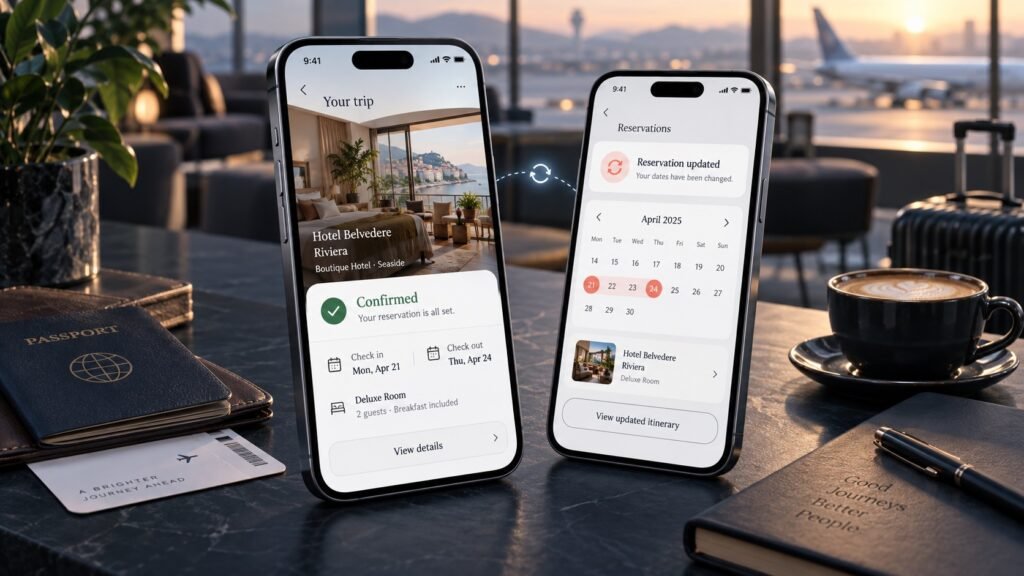
Travel booking app testing checks whether travelers can create, retrieve, modify, and cancel reservations reliably across mobile devices and changing conditions. Beyond payment success, QA should verify booking status, notification links, session recovery, itinerary dates, and synchronization after interruptions.
This checklist is for TravelTech startups, booking platforms, and mobile product teams preparing an iOS or Android release. It uses hotel reservations as the main example. Adapt the expected results to your supplier contracts, cancellation rules, supported markets, and product design. The scenarios are illustrative testing guidance, not findings from a completed client project.
What should you define before testing a booking app?
Agree on what each reservation state means: pending, confirmed, modification requested, cancelled, and refund pending. Identify which system owns the authoritative status and how quickly connected screens should refresh. Payment authorization, supplier acceptance, and an app confirmation screen may represent different events.
Prepare approved test accounts, disposable reservations, supplier sandbox access where available, supported devices, and known booking policies. For each test, record the build, device, OS, account state, reservation reference, network condition, and timestamp. Use sanitized screenshots and permitted logs; remove guest details, authentication tokens, and payment information from shared evidence.
Broader pricing and supplier coverage is discussed in our booking engine QA guide. The following mobile booking app testing scenarios focus on the transitions where a seemingly successful journey can become inconsistent.
What happens when availability or pricing changes during booking?
1. The selected room becomes unavailable
Setup: Open a room offer in an approved test environment. Remove its remaining availability through a second permitted session or supplier fixture.
Action: Continue from the stale results screen and attempt to reserve the room.
Expected result: The app revalidates availability and explains that the offer is no longer available. It must not display a confirmed reservation that the booking system cannot fulfill. Returning to search should preserve useful criteria.
Evidence: Capture the original offer, availability change, submitted request where accessible, and final reservation status.
2. Price or cancellation terms change before submission
Setup: Select an offer with a known total, currency, taxes, and cancellation policy. Change the offer through a controlled fixture.
Action: Proceed using the older selection.
Expected result: Material changes are clearly presented before commitment, with the acceptance required by the product rules. Search, review, and booking records should not silently disagree about the accepted offer.
Evidence: Record old and new totals, policy versions, displayed currency, and the offer attached to the reservation.
Can a timeout or retry create a duplicate reservation?
3. Booking succeeds but the response times out
Setup: Arrange a controlled response delay after the booking system accepts a request.
Action: Wait for the app timeout, then reopen booking history or use its recovery action.
Expected result: The app resolves the uncertain outcome against the authoritative booking status. A timeout must not automatically become a definitive failure message inviting another purchase. Pending states should explain what the traveler can safely do next.
Evidence: Compare the app message, server-side reservation reference, history entry, and eventual confirmation.
4. Repeated taps or retries submit the same booking
Setup: Use a bookable test offer and introduce a slow connection.
Action: Tap the submission control repeatedly, retry after a delay, and reopen the app.
Expected result: One intended booking does not become multiple reservations or unintended charges. A disabled button alone is insufficient evidence: check the resulting records. Recovery should distinguish an existing reservation from a genuinely new request.
Evidence: Preserve request correlation information where permitted, reservation counts, payment test records, and the visible retry sequence.
What happens when the session expires?
5. The session expires while guest details are entered
Setup: Enter test guest details in a multi-step flow and expire the session using a permitted test mechanism.
Action: Continue to the next step.
Expected result: The app requests authentication clearly. It preserves or clears fields according to the agreed privacy and recovery rules, explains necessary re-entry, and revalidates any expired offer before submission.
Evidence: Compare fields and offer state before expiry, after sign-in, and at final review. Check that credentials or sensitive data do not appear in error messages.
6. Reauthentication loses the intended reservation
Setup: Open a reservation link while signed out. Prepare two authorized test accounts with different bookings.
Action: Sign in with the owning account, then repeat with the other account.
Expected result: The owner reaches the intended reservation. The other account receives an appropriate access response without exposure of booking details. Navigation context must not bypass authorization.
Evidence: Record the destination and access result for both accounts, using redacted identifiers.
Do booking notifications open the correct current information?
7. A notification opens the wrong reservation or screen
Setup: Create two distinguishable reservations and generate an update for one.
Action: Open the notification with the app foregrounded, backgrounded, and not running. Repeat signed in and signed out.
Expected result: Each supported path reaches the correct authorized reservation or a clear recovery screen. Back navigation remains usable. Android’s official deep-link guidance explains routing into app content; QA must still validate the specific destination and account state.
Evidence: Capture the test notification identifier, app state, destination, and reservation reference.
8. An old notification opens a changed or cancelled booking
Setup: Retain an earlier confirmation notification, then modify or cancel the reservation.
Action: Open the old notification after the later update has completed.
Expected result: The destination retrieves current status and clearly identifies the change. Stale message text must not cause the app to restore obsolete details or offer actions that no longer apply.
Evidence: Compare the original message, change timestamp, authoritative status, and opened screen.
9. Notification permission is denied or revoked
Setup: Test fresh denial and removal of previously granted notification permission on supported devices.
Action: Trigger a booking update and return to the app manually.
Expected result: Reservation information remains accessible through the app’s supported channels. The product does not claim that a push alert was seen merely because an event was generated. Any alternative channel must follow actual preferences and product requirements.
Evidence: Record permission state, update generation, in-app status, and applicable fallback behavior separately.
Can travelers modify or cancel reliably?
10. A reservation modification fails midway
Setup: Start with a confirmed stay and an allowed date or room change.
Action: Interrupt the connection during the modification, then reopen the reservation.
Expected result: The app resolves whether the original booking remains, the change completed, or the request is pending. It must not combine old dates with a new total or invite a conflicting change without explaining status.
Evidence: Compare original and requested values, supplier response where accessible, price adjustment, and final history.
11. Cancellation occurs near the policy cutoff
Setup: Define the cancellation deadline, its timezone, and whether the cutoff is inclusive. Use a controlled test clock or suitable test data.
Action: Submit immediately before, at, and after the boundary.
Expected result: Eligibility and fees follow the agreed policy consistently. Cancellation status and refund status remain distinguishable. Do not infer that money has been returned from a cancellation success message.
Evidence: Capture policy text, authoritative timestamps, calculated fee, and both status records.
Does the reservation remain consistent across devices and timezones?
12. Two devices show conflicting reservation states
Setup: Sign into the same test account on two supported devices and open one reservation.
Action: Modify it on the first device, then refresh or attempt an action from the second.
Expected result: Both devices converge on the authoritative state within the agreed refresh behavior. Stale actions are rejected or reconciled clearly rather than silently overwriting a newer change.
Evidence: Record both screens, update order, timestamps, and the final stored reservation.
13. A device timezone change alters the itinerary
Setup: Book a hotel stay whose check-in is defined as a destination calendar date.
Action: Change the device timezone and reopen confirmation, history, and modification screens.
Expected result: The selected hotel date retains its intended meaning. Timed events should display the timezone required by their own contract; do not apply one rule to hotel dates and flight timestamps.
Evidence: Compare selected and displayed values across zones. Our travel booking date-consistency QA Lab illustrates a controlled date-serialization risk, not a complete production booking test.
Can travelers recover after going offline or updating the app?
14. An offline itinerary contains stale information
Setup: Cache a reservation on one device, disconnect it, and change the booking through another approved session.
Action: View the offline itinerary, reconnect, and reopen it.
Expected result: Cached information is distinguishable from current confirmed status. The app refreshes after reconnection and handles unsupported offline actions clearly. If offline access is not supported, the message should explain that limitation.
Evidence: Capture offline labeling, last-refresh information where provided, and the reconciled online state.
15. An app update affects existing reservations
Setup: On the previous supported version, create a confirmed booking and a separate pending change.
Action: Install the release candidate as an upgrade, keeping application data, then sign in if required.
Expected result: Reservations remain retrievable, pending actions are reconciled safely, and settings follow the migration rules. Repeat relevant notification entry paths. A fresh-install pass cannot substitute for testing existing-user data.
Evidence: Record both versions, pre-update state, migration behavior, and final reservation history.
Which checks belong in every travel app regression cycle?
Use release impact to prioritize travel app QA. Run the critical booking journey on agreed supported iOS and Android devices, then expand coverage around changed integrations, OS behavior, account states, and previously failing conditions.
| Risk | Priority coverage | Release evidence |
|---|---|---|
| Duplicate or missing reservation | Timeout, repeated submission, status recovery | Authoritative records agree with the app |
| Wrong account access | Reauthentication and notification destinations | Ownership checked before details appear |
| Incorrect changes or fees | Modification interruption and cutoff boundaries | State and policy calculations verified |
| Misleading trip information | Old notifications, offline data, timezone changes | Current and cached information distinguished |
| Existing-user regression | App upgrade and multi-device refresh | Reservations and pending states preserved correctly |
Record Pass, Fail, Blocked, Not tested, or Not applicable for every planned case. A blocked supplier sandbox does not justify a passing result. After a fix, repeat the original failure and nearby transitions on the identified build; document remaining gaps before the release decision.
When should you hire independent mobile app testers?
Independent QA is useful when a booking provider, authentication flow, notification integration, or data migration changes, or when the team needs additional device coverage before release. Testers HUB’s mobile app testing services can support an agreed scope across user journeys, interruptions, and regression.
Before you hire mobile app testers, share supported platforms, booking rules, build access, test environments, and the release date. Agree which checks reach the real integration in a permitted environment and which use controlled responses. Request reproducible defects, sanitized evidence, coverage records, and a retest summary.
What affects travel app testing cost?
Travel app testing cost depends on reservation workflows, supplier integrations, devices, operating systems, markets, account types, and test-data preparation. Multiple cancellation policies and asynchronous booking states add scenarios even when screen counts stay unchanged.
Scope initial testing, fix verification, and regression explicitly. Clarify whether retesting is included and how additional builds are handled. A useful quote identifies coverage and exclusions rather than promising a universal price for every booking platform.
Travel booking app testing FAQs
Is payment confirmation enough to prove a reservation is complete?
No. Check the booking system’s reservation status, supplier acceptance where applicable, and customer-facing details. Payment and reservation states should be reconciled according to the product workflow.
How should QA test a booking notification when the user is signed out?
Open it while signed out, complete authentication, and check the destination. Repeat with a different test account to verify that the link does not expose another traveler’s reservation.
Should an offline itinerary be treated as current information?
Only to the extent the product can substantiate its freshness. QA should check cached-state labeling, supported offline actions, and refresh behavior when connectivity returns.
Which checks should be repeated after an app update?
Repeat retrieval of existing reservations, pending changes, authentication recovery, notification links, and critical booking actions. Include upgrades from supported earlier versions, not only clean installations.
Plan independent QA for your next travel app release
Preparing a travel booking app release? Share your reservation workflows, iOS and Android coverage, integrations, and release date. Testers HUB can recommend a focused independent QA scope for booking, changes, notifications, and recovery.