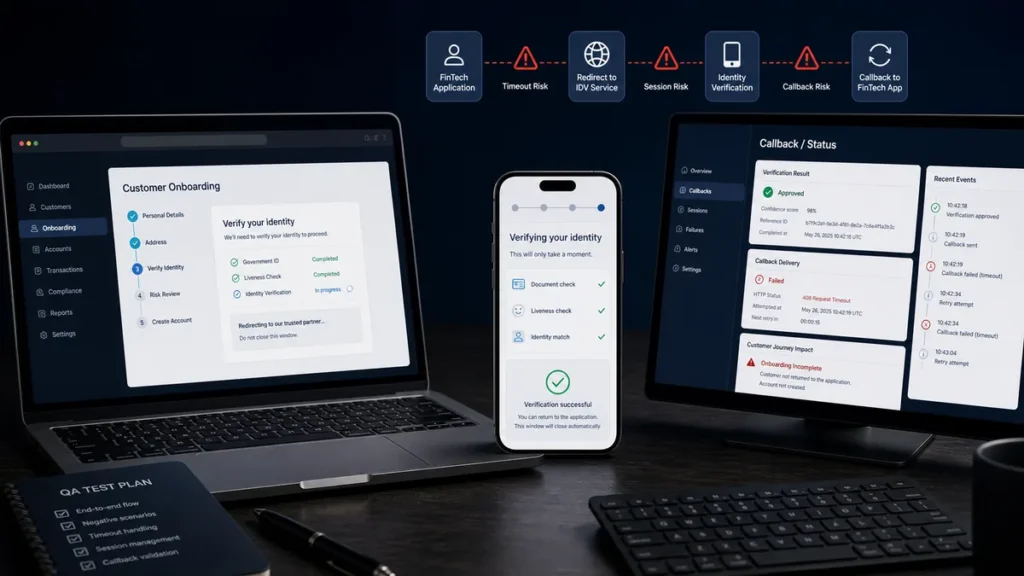
A KYC provider can return a successful identity result while the customer still gets sent back to login, loses the application session, sees a pending status, or cannot continue onboarding. That gap is why KYC testing must cover the complete FinTech journey rather than only the external verification screen.
Recent users have reported KYC loops after completing OTP steps across both mobile and desktop browsers. FinTech product discussions describe the same integration risk from the builder’s side: third-party redirects, session timeouts, and drop-off during onboarding. These examples reinforce a practical QA rule: provider success is not product success until the callback, customer state, backend status, and next screen agree.
FINTECH KYC QA
Built a KYC flow that needs independent validation?
Share the onboarding journey, provider, platforms, target browsers and devices, approved test accounts, and release date. We will recommend a focused scope and clear quote.
Why KYC Testing Is More Than Testing the Provider
The identity provider owns document capture, liveness, identity matching, or another configured verification step. Your FinTech product still owns the customer account, application ID, session, callback handling, status mapping, error messages, retry rules, and next onboarding screen.
A provider’s test may pass while the application remains wrong. For example:
- The provider shows Verified, but the product remains Verification Pending.
- The callback succeeds, but it is attached to the wrong application ID.
- The user returns from the provider and is asked to sign in again.
- A cancelled journey creates a second verification session instead of resuming the first.
- The mobile app opens the callback in a browser instead of returning to the correct app screen.
Map the Complete KYC Journey Before Testing
Record the expected state at each step. Include the customer account, application ID, provider session, FinTech session, provider result, internal status, visible screen, retry option, and any notification or CRM update. This state map becomes the foundation for functional checks, exploratory testing, and regression.
Eight KYC Failure States FinTech Teams Should Test
1. The user cancels verification
Confirm that the user returns to the correct application, keeps entered details, sees an accurate incomplete state, and can resume without creating a conflicting session.
2. The verification session expires
Test both provider and product timeout rules. The next action should be clear, safe, and connected to the existing customer application.
3. KYC succeeds but the callback fails
The product needs a controlled reconciliation path. A blind retry must not create duplicate verification, overwrite a newer state, or leave the user permanently pending.
4. KYC fails
Validate provider-to-product status mapping, the customer message, support path, eligibility for retry, and any review state required by the client.
5. The user presses browser back
Back navigation must not reveal stale steps, reopen a completed provider session, or generate duplicate customer applications.
6. The user switches browser or device
Confirm whether the journey should resume, restart, or block safely. Test the agreed account and application continuity rules.
7. The network drops during verification
Interrupt the handoff, provider screen, upload, and callback. The customer should receive a recoverable state rather than an unexplained spinner or duplicate submission.
8. The user repeats verification
Repeated links, old tabs, resend actions, and multiple callbacks should not create conflicting identity states or attach a result to the wrong account.
Browser and Mobile KYC Testing
Cross-domain state, cookies, in-app browsers, deep links, and app lifecycle behavior make KYC handoffs particularly sensitive to platform differences. A practical scope may include Chrome on Windows, Safari on macOS, Edge, Firefox where required, Safari on iPhone, and Chrome on Android.
On mobile, add permission behavior, app backgrounding, device rotation, interrupted uploads, link handling, and the return from browser or provider app to the correct screen. Broader mobile app testing services can cover device, OS, layout, interruption, notification, and release-build risks around the same onboarding journey.
OTP Scenarios That Need More Than a Happy Path
- Correct, incorrect, and expired OTP
- Resend and multiple OTP requests
- Using the old OTP after a resend
- Delayed SMS and delayed autofill suggestion
- Copy, paste, mobile autofill, and manual entry
- Changing the phone number mid-journey
- Repeated attempts, throttling, and clear recovery
OTP verification is often where account, application, and provider sessions become linked. Test the values used in the next request and ensure an old OTP or stale tab cannot move a different application forward.
Redirect and Callback Testing
Test the complete paths for success, failure, cancellation, timeout, provider unavailability, and network loss. For each route, verify the user identity, product session, application ID, provider reference, mapped status, next screen, backend state, retry option, and customer message.
| Provider result | FinTech status | Expected customer experience |
|---|---|---|
| Success | Verified | Continue onboarding |
| Pending | Pending | Explain the next step |
| Failed | Failed | Show the approved retry or support path |
| Cancelled | Incomplete | Resume verification safely |
| Timeout | Incomplete | Restart without duplication |
| Provider unavailable | Unchanged | Retry later with retained application state |
| Callback missing | Unknown or pending | Reconcile safely before continuing |
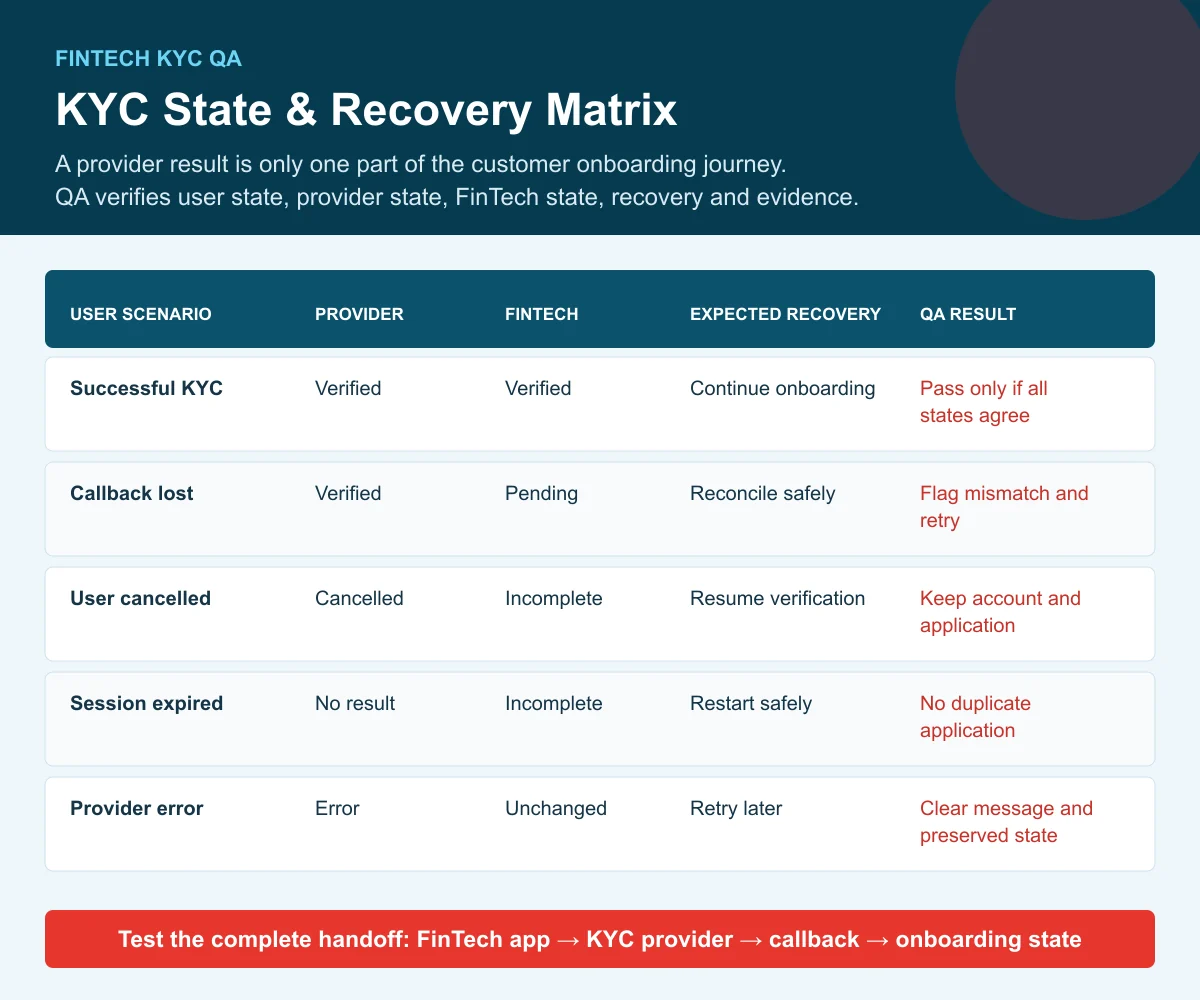
Do Not Stop at the Success Screen
Website or app: success displayed.
Backend: customer still marked Verification Pending.
QA result: Fail. The complete onboarding state is inconsistent.
This simple reconciliation check separates a provider demo from production-ready KYC integration testing. When evidence is available, compare request and callback references, timestamps, customer and application identifiers, status history, and the final screen. Use approved test data and avoid exposing unnecessary personal information in screenshots or videos.
Sandbox Versus Production QA
Use provider-supported sandboxes, simulated outcomes, test identities, and approved non-production data whenever available. Official identity-verification documentation from providers such as Yoti and Okta describes sandbox flows for simulated or test verification outcomes. These environments are useful for approvals, rejections, pending states, document failures, timeouts, provider errors, and repeated verification.
A sandbox still needs product-level testing. Confirm that your own application sends the right identifiers, receives the expected callback, maps statuses correctly, preserves the customer journey, and records evidence. Production validation should follow the client’s approved access, privacy, and data-handling process.
Manual Testing Versus Automation
Stable API response mappings, mocked OTP states, known callback payloads, repeatable onboarding smoke tests, and backend status validation can be good automation candidates. Human-led manual QA testing remains valuable for browser redirects, confusing errors, unexpected navigation, session recovery, mobile usability, interrupted journeys, and exploratory combinations.
Automation should make known regression faster. It should not remove the need to observe whether a real customer understands what happened and can recover without support.
What Should a FinTech KYC QA Company Deliver?
- A scope mapped to onboarding states, platforms, browsers, devices, providers, and approved test data.
- Coverage for OTP, redirects, callbacks, sessions, backend status, retries, and failure states.
- Defects with starting state, environment, steps, expected result, actual result, identifiers, timestamps, severity, and permitted evidence.
- Retesting of fixes and risk-based regression around connected account and onboarding workflows.
- A summary of verified fixes, open issues, blocked checks, exclusions, and remaining release risk.
Testers HUB provides functional, integration-workflow, exploratory, browser, mobile, and regression QA. We do not present this work as penetration testing, legal advice, regulatory certification, or a formal compliance audit. Review our broader fintech testing services for finance and banking product coverage.
What Affects KYC Testing Cost?
The main cost factors are the number of platforms, KYC providers, onboarding paths, identity result states, browsers and devices, APIs, approved test accounts, integration complexity, and retest cycles. A focused scope normally prioritizes customer journeys and failure states that could block onboarding, create inconsistent identity status, or increase support demand.
For broader planning, review our guide to software testing cost and pricing. If the KYC journey is browser-led, related website testing services can cover responsive behavior, browser compatibility, session recovery, forms, and integration handoffs.
FINTECH KYC QA
Request a practical FinTech KYC QA scope
Share your onboarding flow, KYC provider, platforms, browsers, mobile builds, approved test identities, and release timeline. We will recommend the priority scenarios to validate before launch.
KYC TESTING FAQ
Questions FinTech teams ask before release
What is KYC testing in a FinTech app?
KYC testing validates the complete identity-verification journey inside the FinTech product, including account creation, OTP, provider handoff, redirects, callbacks, status mapping, recovery, backend updates, and the next onboarding step. It is broader than confirming that the identity provider returns a successful result.
How do you test a third-party KYC integration?
We map every handoff between the product and provider, then cover success, pending, failure, cancellation, timeout, network loss, repeated attempts, missing callbacks, browser back actions, and safe recovery. The product UI, provider result, backend status, and customer account must remain consistent.
Can KYC flows be tested without real customer identity data?
Yes, where the selected provider supports a sandbox, simulated outcomes, test identities, or approved non-production data. The client should provide the permitted accounts and data-handling rules. Functional QA does not require exposing real customer data when a suitable test environment is available.
Should KYC testing cover both mobile apps and websites?
Yes when onboarding is available on both. Browser cookies, cross-domain redirects, in-app browsers, deep links, mobile permissions, backgrounding, and app resume behavior can produce different results even when both channels use the same provider.
What affects the cost of KYC testing services?
Cost depends on the number of platforms, identity providers, onboarding paths, result states, browsers and devices, APIs, approved test accounts, integration complexity, and retest cycles. A focused scope should prioritize the highest-risk customer journeys instead of treating every combination equally.
Does functional KYC QA replace security or compliance assessment?
No. Testers HUB can validate functional, integration, usability, browser, device, recovery, and regression behavior. This work does not replace penetration testing, legal advice, regulatory certification, or a formal compliance audit.
Sources and further reading
- User report: KYC redirect loop after OTP across browser and device attempts
- FinTech developer discussion: redirects, timeouts, and onboarding drop-off
- Yoti identity-verification sandbox documentation
- Okta identity-verification integration and sandbox testing guidance