Compare mobile QA partners for your US or UK release by asking about device availability, reporting, working hours and included retest cycles. This guide explains selection criteria; it is not an independent ranking of providers. For Testers HUB’s delivery scope and an estimate, explore our mobile QA services.
What Top-Rated Mobile App Testing Companies Usually Provide
Top-rated mobile app testing companies usually provide more than basic bug checking. They offer structured mobile app testing services, real-device coverage, manual and automation support, usability testing, performance checks, security-aware QA, clear reporting, and retesting after fixes.
If you are comparing providers in the USA, UK, or globally, look for proof of relevant experience, client reviews, sample reports, communication quality, device coverage, and pricing transparency. For platform-specific releases, confirm that the team provides both Android app testing services and iOS app testing services.
Enterprise teams should also ask about NDA readiness, role-based access, staging environment handling, API coverage, performance risks, and whether they can hire mobile app testers for dedicated release support.
What Makes a Mobile App Testing Company the “Best”?
The best mobile app testing company doesn’t just find bugs — it guarantees consistent quality across devices, networks, and operating systems. Such a company combines real-device testing, strong QA expertise, and transparent communication. Moreover, it ensures faster releases and smooth collaboration across teams.
A leading QA company typically offers:
- ✅ Real-device validation for iOS and Android platforms
- ⚙️ Functional, regression, and usability testing using the latest tools
- 🌍 Cross-region support for both startups and global enterprises
- 💬 Clear reporting and communication channels
- 💰 Flexible models such as hourly, weekly, or fixed projects
In short, the best QA company doesn’t just check functionality — it ensures user confidence with every release.
🚀 Looking for a QA team that delivers both precision and speed? Explore our Mobile App Testing Services and see how we ensure seamless performance across devices.
Why Do Businesses in the USA and UK Outsource Mobile App QA?
Businesses in the USA and UK outsource mobile app QA to save time, lower costs, and improve test coverage. Outsourcing also provides access to specialized testers who can validate apps 24×7 across time zones. This ensures continuous progress even when internal teams are offline.
Here’s why outsourcing works so well:
- 💸 Cost-efficiency: No need to hire or maintain in-house QA teams.
- ⚡ Faster releases: Continuous testing cycles reduce development delays.
- Device coverage matched to the project: An external QA provider can supplement your internal devices. Confirm the models and OS versions included in the proposed testing scope.
- 🧠 Diverse expertise: Access to testers experienced in gaming, eCommerce, SaaS, and fintech apps.
By outsourcing QA, teams not only improve quality but also accelerate time-to-market — a major advantage in today’s fast-moving mobile ecosystem.
How to Evaluate the Right Mobile App Testing Partner
Selecting the right QA partner is a critical step in your app’s success. Therefore, it’s important to evaluate more than pricing — you should consider expertise, scalability, and communication.
Here’s a quick comparison:
| Criteria | In-house QA | Outsourced QA |
|---|---|---|
| Cost | Staffing, equipment and tooling costs depend on your team setup. | Fees depend on the agreed scope, engagement model and testing cycles. |
| Device access | Coverage depends on your internal inventory and any external device services. | Coverage depends on the provider’s inventory and the devices included in your agreement. |
| Capacity | Depends on team availability and competing priorities. | Additional capacity is subject to provider availability and agreed lead times. |
| Expertise | Reflects your team’s product and testing experience. | Assess relevant experience through sample reports, discussions and supporting evidence. |
| Availability | Follows your team’s working arrangements. | Working-hour overlap, handovers and response times must be agreed. |
For Testers HUB, the overall inventory is 30+ real physical devices. The number of devices used for an individual project depends on its agreed scope. Ask for the proposed device and OS list before comparing quotations.
When assessing a QA partner, always review:
- Proven client success stories
- Domain-specific QA experience
- Reporting standards and test documentation quality
- Flexibility to adapt to your project’s needs
Choosing wisely ensures fewer risks and smoother collaboration during every release cycle.
Need help choosing the right QA approach for your app? Check our flexible Mobile Testing Packages designed for startups and enterprise-level applications.
For UK-specific considerations such as postcodes, +44 phone numbers, GBP transactions and daylight-saving behaviour, see our mobile app testing guide for UK startups. For detailed release preparation and deliverables, refer to our Pre-Release Testing Support guide.
Testers HUB’s Mobile App Testing Approach for USA and UK Teams
Testers HUB provides independent mobile QA support for teams serving customers in the USA, UK and other markets. Coverage is planned around the product’s workflows, supported platforms, target users and release priorities.
Testers HUB provides mobile app testing using 30+ real physical devices, with the device and OS coverage selected according to each project’s requirements.
The inventory count does not mean every testing package includes all devices. Your proposal should specify the selected models, OS versions, testing activities and planned cycles.
An engagement can include:
- Manual and exploratory checks of agreed user journeys.
- Compatibility checks on selected real devices.
- Defect reports with reproduction steps, device details and supporting evidence.
- Fix verification and regression checks where included in the scope.
- Communication and reporting milestones agreed around your team’s schedule.
Explore our Mobile App Testing Services for release coverage, or review how to hire mobile app testers for project-based or ongoing support.
How We Help Businesses in the USA and UK Deliver Bug-Free Apps
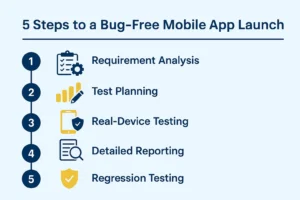
Every successful app begins with a structured and thorough testing approach. At Testers HUB, we follow a proven QA framework that ensures both functionality and user satisfaction.
Our process includes:
- Requirement Analysis: Understanding client goals and core functionalities.
- Test Planning: Designing coverage matrices and test cases for all scenarios.
- Real-Device Testing: Executing tests on diverse Android and iOS devices.
- Detailed Reporting: Sharing clear defect reports with screenshots and logs.
- Regression Testing: Rechecking fixes to confirm complete resolution.
Because we focus on both usability and performance, clients receive apps that feel responsive, stable, and ready for real-world challenges.
🇺🇸🇬🇧 Partner with QA professionals near you. Connect with our local mobile testing experts in the USA or UK and start your next test cycle this week.
What Industries Benefit Most from Mobile App QA?
Every app benefits from testing, but some industries demand deeper validation due to complexity or compliance requirements.
- 🛒 eCommerce: Ensuring checkout, payments, and order tracking work flawlessly.
- 🎮 Gaming: Validating frame rates, performance, and control responsiveness.
- 💳 Fintech: Testing secure transactions and compliance with financial standards.
- 🏥 Healthcare: Verifying privacy, HIPAA compliance, and real-time accuracy.
- ☁️ SaaS: Checking browser compatibility, scalability, and integration reliability.
Across these industries, a strong QA partner prevents crashes, reduces complaints, and helps apps maintain long-term stability.
Mobile App Testing Services Near Me (USA & UK Focus)
We proudly serve startups and enterprises across both continents.
📍 In the USA: California, New York, Texas, and Florida
📍 In the UK: London, Manchester, Birmingham, and Leeds
Because of our timezone overlap, our QA teams can test overnight for US clients while providing same-day responses for UK partners. This 24×7 workflow keeps projects on track and releases on schedule.
👉 Looking for a reliable QA team near you?
Conclusion: Choose a QA Partner That Builds Lasting Confidence
In the competitive world of mobile apps, even a single glitch can lead to user frustration or negative reviews. Therefore, working with a reliable QA partner isn’t just about bug detection — it’s about ensuring consistent performance and long-term user satisfaction.
At Testers HUB, we help startups and enterprises across the USA and UK release stable, responsive, and high-performing mobile applications. Our team tests every feature on real devices, under live conditions, to guarantee a smooth experience before launch.
Additionally, our QA process continues even after release — helping you maintain app quality through ongoing updates and regression cycles.
FAQs – Mobile App Testing Companies in the USA & UK
Q1. How much does mobile app testing cost in the USA or UK?
Testing typically ranges between $15–$40/hour, depending on app type, number of devices, and testing depth.
Q2. What are the benefits of hiring a specialized mobile QA company?
You’ll gain access to experienced testers, better coverage, and a faster release cycle while reducing overall costs.
Q3. Does Testers HUB test on real devices?
Yes. Testers HUB provides mobile app testing using 30+ real physical devices, with the device and OS coverage selected according to each project’s requirements.
This is the overall inventory, not the device allocation for every package. Confirm the device models, operating-system versions and testing rounds included in your quotation.
Q4. Do you offer both Android and iOS testing?
Absolutely. Our QA experts handle both platforms, maintaining consistent functionality across operating systems and devices.
Q5. How long does it take to test a mobile app completely?
Typically, full testing takes 1–3 weeks, depending on complexity, features, and required test coverage.