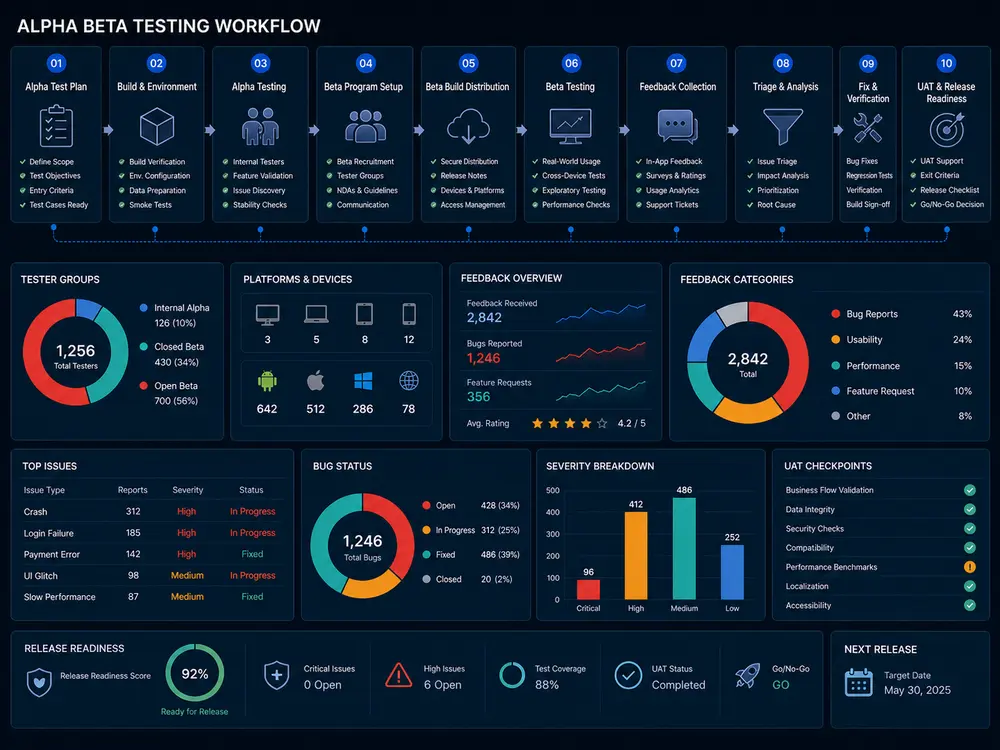
Your build is nearly ready, the launch date is approaching, and the team needs an independent answer to a practical question: what still needs attention before users receive it?
Pre-release testing support is useful when developers are finishing changes but nobody has enough time to check the complete user journey across the agreed platforms. This guide explains how to scope that support, what your QA team needs to start and how to handle findings without assuming unlimited testing can fit into launch week.
What is pre-release testing support?
Pre-release testing support is a scoped QA engagement on a build intended for an upcoming launch or update. Testers check priority workflows, identify reproducible defects and report coverage, blockers and remaining risks. Fix verification and regression are planned separately or included explicitly in the agreed hours and scope.
Our Alpha/Beta Testing Services can support this release-stage work alongside controlled alpha checks, beta feedback review and UAT support. You do not need a public beta program to request a focused pre-release QA pass.
When should you bring in external QA?
- Your first usable build is approaching an MVP or public launch.
- A major update changes onboarding, payments, permissions or another critical journey.
- Your internal QA team needs extra execution capacity before a release.
- Developers have checked individual features, but complete cross-role or cross-platform journeys remain untested.
- A regional rollout, redesign or migration changes how existing users access the product.
Start the conversation when a testable build and release scope are available. Leave room for investigation, fixes and agreed follow-up testing. If the build is still changing heavily, plan earlier feature validation rather than treating it as a stable release candidate.
Pre-release QA, alpha, beta and UAT: which do you need?
| Approach | Main purpose | What to agree |
|---|---|---|
| Alpha testing | Controlled checks on an early usable build | Implemented workflows, known limitations and build stability |
| Beta testing | Feedback from selected users in relevant usage conditions | Participants, feedback channels, devices and triage responsibilities |
| Pre-release QA pass | Independent checks on the intended release build | Critical journeys, environments, available effort and release risks |
| UAT support | Evidence against business acceptance scenarios | Business rules, acceptance owners and sign-off criteria |
These activities can overlap, but they are not interchangeable. Beta feedback does not prove every critical flow was tested. A completed QA pass does not replace the product owner’s release decision. Participant recruitment, specialist assessments and extra environments need explicit scope.
What should be tested first when launch is close?
Start with the journeys whose failure would prevent users from receiving the product’s core value. Agree priority from your actual business model rather than treating every screen as equally important.
- Access and onboarding: installation or entry, signup, login, account recovery and first successful use.
- The main transaction: booking, purchase, submission, saved progress or another core outcome, including confirmation and resulting data.
- Roles and permissions: the right person sees the right information, and changes appear correctly in related portals.
- Failure and recovery: interrupted requests, denied permissions, empty states, retries and useful error messages.
- Priority environments: agreed browsers, real devices and OS versions, with install/update checks where relevant.
- Changed areas: the new feature and nearby journeys at risk from the change.
For Android and iOS builds, scope real-device mobile app testing. For browser-based releases, agree the browser and responsive combinations through website testing support. Security assessments, load testing and specialist accessibility audits are separate activities unless expressly included.
What happens after you share the build?
- Confirm access and scope. Agree the build, platforms, user roles, critical flows, test data, priorities and exclusions.
- Check build readiness. Confirm installation or environment access and basic workflows. Escalate blocking access or stability problems before deeper testing.
- Execute the agreed pass. Combine functional checks with exploratory testing of realistic user behavior and edge conditions.
- Report and triage findings. Share reproducible steps, expected and actual behavior, severity, environment and screenshots or video where useful.
- Plan the next build. Confirm which fixes need retesting, what related regression is required and what fits within the remaining allocation.
- Summarize release risk. List completed coverage, blocked or untested areas, outstanding defects and verified fixes.
Does one end-to-end cycle include retesting?
Not automatically. An end-to-end cycle checks the agreed journeys on the supplied build. Retesting verifies a reported fix on a replacement build; regression checks whether changes affected other behavior. Both require additional effort and must be planned.
Where a fixed package specifies one full end-to-end test cycle, retesting and regression are separately planned and charged. In an hourly or ongoing engagement, they use the agreed QA allocation. The accepted proposal determines the exact terms.
Compare testing engagement options or use the QA cost calculator as a starting point. Screen counts alone do not capture role combinations, integrations, device coverage or replacement builds.
How much time should you allow before release?
There is no reliable universal number of days. The testing window depends on usable build access, workflow complexity, platform coverage, tester availability and time for your developers to investigate findings. Separate the QA execution estimate from the total calendar time needed for fixes and follow-up checks.
Illustrative planning situation, not a client case study: a startup has a booking app and a fixed launch date. A sensible initial scope could prioritize account access, booking creation, payment state and confirmation on selected devices. If booking is blocked, QA reports the blocker and continues independent checks where possible. A corrected build then needs an agreed verification window; it does not make the original test results apply automatically to every changed flow.
What should you prepare for a pre-release QA estimate?
- Product type, build or staging URL and intended release date.
- Android/iOS distribution access or supported website browsers.
- User roles, approved test accounts and synthetic or authorized test data.
- Critical workflows, business rules and acceptance criteria.
- Target devices, OS versions and any regional requirements.
- Known issues, recent changes and expected replacement builds.
- Available developer contact, working-hour overlap and reporting channel.
- Requested execution effort, retesting and regression expectations.
Use approved access-sharing channels and agree confidentiality before exposing sensitive systems. Avoid providing production credentials or real customer records in an initial inquiry.
What will you receive?
A useful handover contains the agreed coverage and execution status, evidence-led defect reports, blocked checks and a final risk summary. If fix verification was included, it should distinguish verified fixes from issues merely marked fixed by development. The report should say what was not tested as clearly as what was completed.
Can pre-release testing guarantee a successful launch?
No. A scoped test pass provides evidence about the tested build and conditions, not a guarantee of zero defects, store approval or business success. Your product team makes the release decision using the findings, remaining risks and acceptance criteria.
Need independent checks before your next release?
Share your product, build stage, target platforms, critical workflows and launch date. We’ll recommend a practical pre-release scope and confirm the testing window and availability before committing.