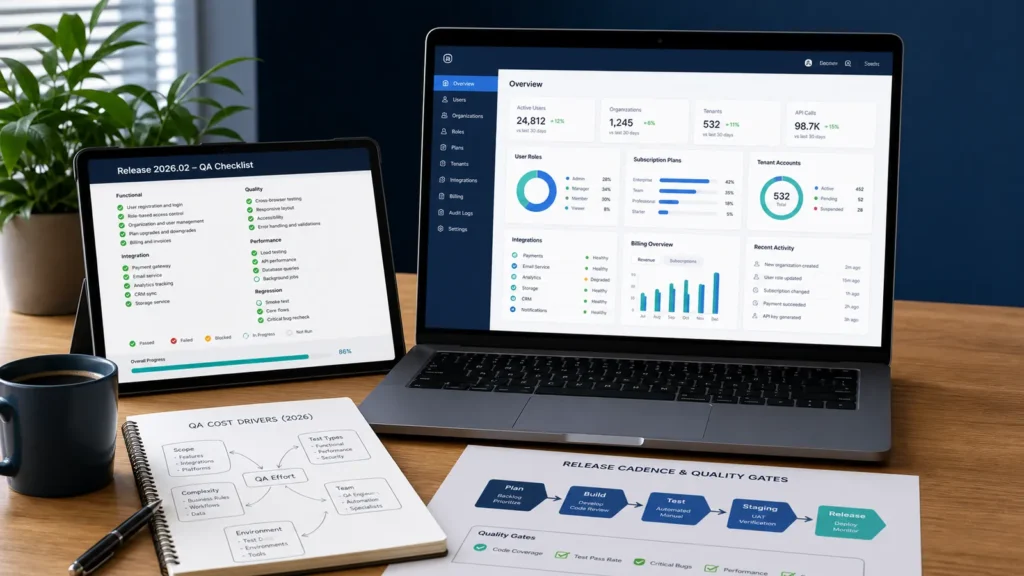
B2B SaaS testing cost in 2026 depends less on the number of pages in a product and more on the number of workflows, roles, plans, tenants, integrations, and release risks that need to be validated. A five-screen SaaS tool with complex permissions and billing can require more QA effort than a larger application with one user type and simple workflows.
That is why a useful estimate begins with product risk, not a generic market-rate table. At Testers HUB, we scope B2B SaaS testing services after reviewing the customer journey, admin controls, environments, subscription logic, integrations, browsers, and release timeline. We use current approved Testers HUB pricing in this guide and do not present unsupported industry averages as fact.
Need an exact SaaS QA cost estimate?
Share your roles, plans, tenant model, integrations, target release, and regression needs. We will recommend a practical fixed-scope, sprint, or dedicated QA engagement.
Quick Answer: What Does B2B SaaS Testing Usually Cost?
Testers HUB currently offers three practical ways to plan SaaS QA:
| Engagement | Current Testers HUB pricing | Best fit |
|---|---|---|
| Fixed-scope SaaS QA | Custom fixed quote after workflow review | A defined feature, integration, billing change, migration, or release candidate |
| Recurring regression QA | Scoped per sprint or release | Teams shipping frequently with repeatable customer and admin workflows |
| Dedicated SaaS QA tester | Typically $15–$25 per hour | Ongoing execution, regression maintenance, defect follow-up, and release support |
For simple planning, the dedicated hourly range can be converted into an illustrative working budget. For example, 40 approved QA hours at $15–$25 per hour equals $600–$1,000. Likewise, 80 hours equals $1,200–$2,000. These are arithmetic examples based on the current Testers HUB rate, not universal SaaS market averages or a final quote.
Fixed-scope and sprint-based work can be more efficient when the required workflows are clear. However, the quote is confirmed only after the team understands the product states, access, test data, environments, and reporting expectations.
One-Time Release Testing vs. Ongoing SaaS QA
One-time release testing works well when a SaaS team has a clear deadline and a stable build. The scope may cover a new onboarding flow, subscription update, integration, redesigned dashboard, or release candidate. In this model, both teams agree on the workflows, environments, browser coverage, defect format, and retest allowance before testing begins.
Ongoing QA is different. SaaS products often release every week or sprint, which means old workflows must remain stable while new code is added. Therefore, ongoing manual QA for SaaS usually includes new-feature testing, risk-based regression, fix verification, exploratory checks, and release summaries. Over time, the tester also learns which tenant states, plans, roles, and integrations are most likely to break.
If your product ships frequently, a dedicated tester or recurring sprint arrangement can reduce repeated onboarding time. On the other hand, a focused fixed scope is usually cleaner when you need independent validation for one specific release.
What Determines SaaS Testing Services Cost?
1. Number of User Roles
Role-based access testing expands quickly. An owner, admin, manager, member, guest, and support user may see different menus, data, exports, billing controls, and settings. Moreover, changing a role during an active session can expose defects that a fresh login does not show.
For that reason, the estimate should include both the number of roles and the actions each role can perform. A permission matrix makes this clearer and prevents the team from testing only the happy path.
2. Subscription Plans and Billing States
Plans can affect feature access, account limits, trials, upgrades, downgrades, renewals, invoices, coupons, taxes, failed payments, cancellations, and reactivation. Each state adds combinations that must be checked across customer and admin workflows.
Subscription billing testing also needs a safe gateway sandbox, approved test cards, sample invoices, and agreed rules for webhooks and retries. Without those inputs, QA time is lost waiting for usable test data.
3. Multi-Tenant Architecture
Multi-tenant SaaS testing must confirm that users can access the correct workspace without exposing another tenant’s data. Important cases include tenant switching, shared resources, invitations, exports, search, reports, account ownership, support tools, and internal admin access.
Because tenant isolation is a high-risk area, it should not be reduced to one login check. The scope needs at least two separate tenant datasets and carefully controlled role combinations.
4. APIs and Third-Party Integrations
SSO, payment gateways, webhooks, CRM systems, storage providers, email services, analytics tools, and public APIs can all change the QA estimate. Testing may need valid responses, failures, retries, duplicate events, delays, rate limits, expired credentials, and permission enforcement.
When integrations are release-critical, combine workflow testing with focused API validation instead of checking only the user interface. This is especially important when a dashboard appears successful even though a background sync has failed.
5. Browser and Device Coverage
A browser-based SaaS product may need Chrome, Safari, Firefox, and Edge coverage across desktop, tablet, and mobile views. The right matrix depends on actual users and product requirements. Testing every combination is rarely necessary, but ignoring Safari, responsive layouts, or touch interactions can leave expensive gaps.
6. Release Frequency and Regression Depth
Frequent releases increase the value of a maintained regression pack. However, regression cost also depends on how many critical customer and admin journeys must be repeated, whether automation already exists, and how much exploratory testing is still required.
A stable risk-based pack keeps SaaS regression testing cost under control. It prioritizes workflows that protect revenue, tenant data, account access, and daily customer work rather than repeating every low-risk check in every sprint.
Freelancer vs. In-House Tester vs. SaaS QA Company
| Option | Potential advantage | Important consideration |
|---|---|---|
| Freelance QA tester | Flexible support for a narrow task or short release | Coverage, availability, tools, backup capacity, and reporting standards depend on the individual |
| In-house QA tester | Deep product context and daily collaboration | Recruitment, onboarding, management, tooling, and continuity remain with your team |
| SaaS QA company | Structured process, wider coverage, replacement capacity, and scalable support | The partner still needs clear access, priorities, test data, and product context |
The cheapest hourly option is not always the lowest-cost release. For example, incomplete permissions coverage or vague defects can create extra developer investigation and repeated test cycles. Therefore, compare the usable deliverables and risk coverage, not only the rate.
Teams that want an external testing partner can review our SaaS web app testing case study, which shows how long-session and multi-tab behavior exposed a problem that short internal checks had missed.
Sample B2B SaaS Testing Scope
A focused release scope may include:
- Customer sign-up, login, password reset, verification, and workspace creation
- Owner, admin, manager, member, guest, and restricted-user permissions
- Tenant creation, switching, ownership, shared resources, and data isolation
- Trial, subscription, upgrade, downgrade, failed payment, renewal, cancellation, and invoice workflows
- Team invitations, expired links, acceptance, removal, and role changes
- Dashboards, filters, reports, imports, exports, notifications, and audit logs
- APIs, webhooks, SSO, payment gateways, email, storage, and CRM integrations
- Chrome, Safari, Firefox, Edge, responsive behavior, and agreed device coverage
- Critical regression, defect retesting, and release-readiness summary
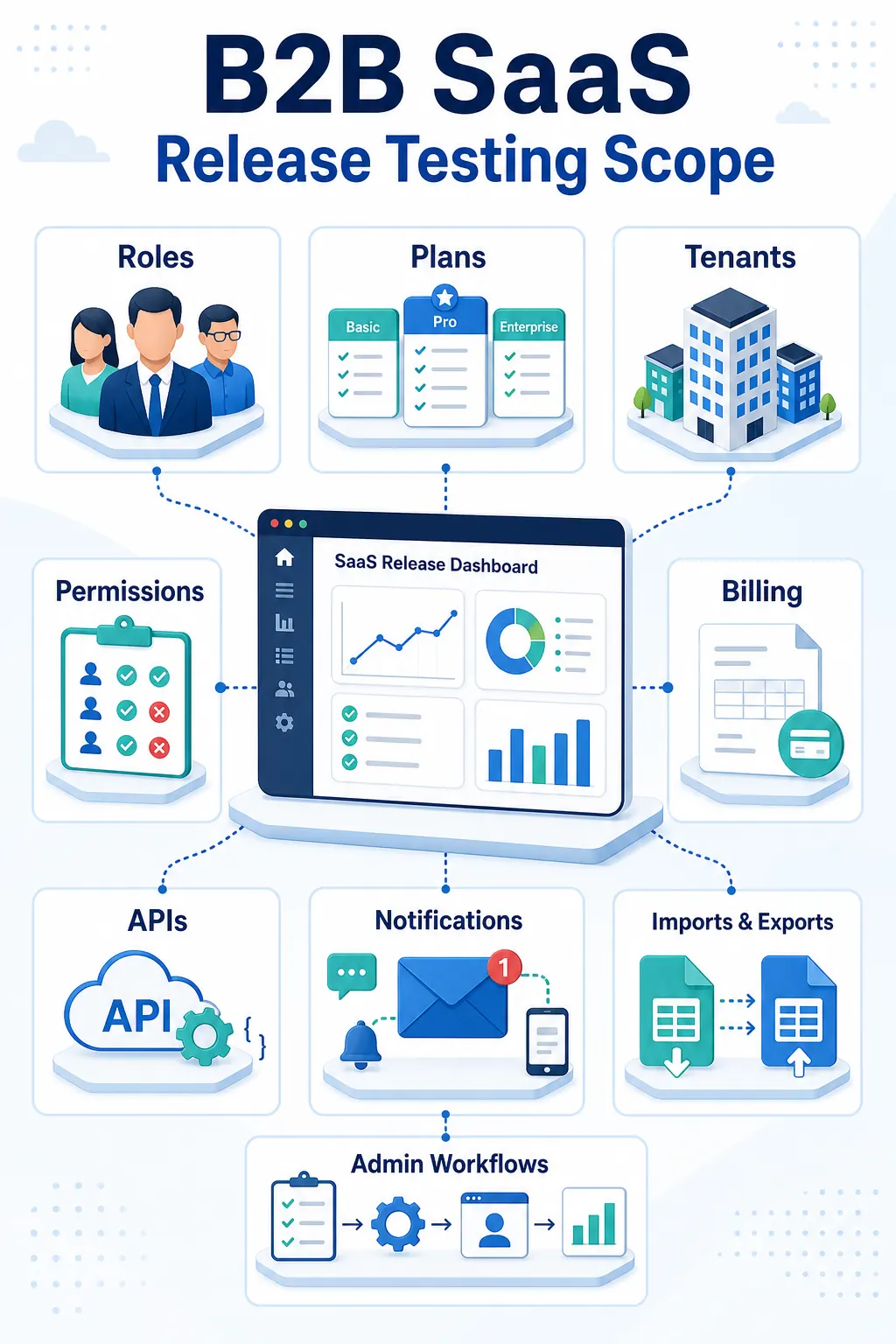
Download the B2B SaaS Release Testing Scope Template
Use the editable workbook to map roles, plans, tenants, permissions, billing, APIs, notifications, imports and exports, admin workflows, ownership, status, and release evidence.
What Deliverables Should Be Included?
A credible SaaS QA quote should explain what the client receives. Depending on scope, useful deliverables include:
- A workflow and risk map covering customer, admin, billing, tenant, and integration areas
- Test scenarios or an agreed execution checklist
- Defect reports with reproducible steps, expected and actual results, severity, environment details, screenshots, video, logs, or request evidence
- Retest notes confirming which fixes passed, failed, or remain blocked
- A release summary that separates launch blockers from lower-risk observations
- Open risks, excluded coverage, and recommendations for the next regression cycle
Clear deliverables also make vendor comparisons easier. Two quotes may look similar until one includes retesting, evidence, cross-browser coverage, and a release summary while the other only provides a raw bug list.
How to Reduce SaaS QA Cost Without Reducing Critical Coverage
First, prioritize revenue, access, tenant isolation, billing, permissions, and high-usage workflows. These areas usually deserve deeper coverage than low-risk settings or rarely used pages.
Second, prepare test accounts and data before execution begins. Role accounts, tenant datasets, billing sandboxes, API keys, sample imports, and expected results reduce avoidable setup time.
Third, use a practical browser and device matrix based on customers rather than testing every possible combination. Keep a small core matrix for every release, then rotate secondary coverage when risk or usage justifies it.
Finally, maintain a reusable regression pack. A structured pack lets testers focus each sprint on changed areas and critical dependencies while preserving important customer journeys. If you are still estimating the broader project, the software testing cost calculator can help organize early inputs before an exact quote.
When Should You Hire a Dedicated SaaS QA Tester?
A dedicated tester becomes useful when product knowledge and continuity matter more than a one-time release check. Common signs include:
- Your team releases every week or sprint
- New features regularly affect existing roles, plans, or tenant states
- Billing, integrations, APIs, or feature flags create recurring regression risk
- Developers spend too much time repeating manual checks
- Support tickets reveal issues that internal testing did not reproduce
- The regression pack is growing and needs ownership
- Defects need consistent retesting and release follow-up
With dedicated support, Testers HUB’s current approved hourly range is typically $15–$25. The exact plan still depends on expected hours, overlap, responsibilities, access, and reporting cadence. Teams with a defined release can instead request a fixed quote, while recurring releases can be scoped per sprint.
Testers HUB SaaS QA Engagement Options
Testers HUB supports B2B SaaS products through fixed-scope release QA, recurring regression per sprint, and dedicated SaaS QA testers. Coverage can combine manual functional testing, exploratory testing, role and permission checks, tenant isolation, subscription billing, APIs, integrations, cross-browser validation, regression, defect reporting, and retesting.
We serve product teams in the USA, UK, UAE, India, Australia, and worldwide. If your SaaS product also needs deeper browser-based workflow coverage, review our web app testing services. For broader budget planning, see software testing cost and pricing.
Plan your next SaaS release with a clear QA scope
Send the roles, plans, tenant model, integrations, browser coverage, and release date. We will recommend the engagement model and provide an exact Testers HUB quote.
Healthcare SaaS Testing Cost Factors
Healthcare SaaS testing cost depends on more than the number of screens. Patient, provider, reviewer, administrator, and support roles can move the same record through different states. Integrations, approved test data, long forms, documents, notifications, and audit history also increase the combinations that need evidence-led QA.
| Healthcare SaaS cost factor | Why it changes QA effort | Useful scoping input |
|---|---|---|
| Roles and permissions | Each role can view, edit, approve, export, or restrict different information. | Role list and permission matrix |
| Status-driven workflows | Draft, submitted, review, additional-information, approved, denied, cancelled, and reopened states need transition checks. | Workflow diagram and status rules |
| EHR, FHIR, and connected APIs | Authentication, mapping, delayed responses, retries, partial failures, and API-to-UI consistency require focused validation. | Approved test environment, endpoints, and sample payloads |
| Documents and long forms | Uploads, validation, autosave, timeouts, duplicate submission, downloads, and role visibility add risk. | File rules, form rules, and representative test files |
| Privacy-aware evidence | Defect reports must remain useful without exposing unnecessary sensitive data. | Approved accounts, synthetic records, and evidence rules |
| Release regression | Frequent changes can affect patient, provider, admin, integration, notification, and reporting workflows together. | Release cadence and current regression checklist |
For a practical estimate, share the roles, workflows, integrations, browser coverage, environments, release date, and approved test-data rules. Our healthcare web application testing services section explains the workflow coverage, while the healthcare application testing page covers broader mobile and connected-product needs.
One-Time Healthcare Release QA vs. Dedicated Support
A focused fixed scope works best for a defined portal release, workflow change, integration, or release candidate. Per-sprint regression is more practical when teams ship regularly and need repeated validation of patient, provider, administrator, and connected-system journeys. A dedicated QA tester is useful when the regression pack, defect follow-up, and test-data setup require continuous ownership.
| Engagement | Best fit | Typical planning inputs |
|---|---|---|
| Focused fixed scope | One release, feature, integration, or workflow change | Critical journeys, roles, browsers, environments, and retest allowance |
| Per-sprint regression | Regular product releases | Stable regression pack, release notes, changed areas, and risk priorities |
| Dedicated QA support | Ongoing execution and defect follow-up | Sprint cadence, collaboration model, reporting tools, and expected weekly capacity |
| Manual QA with automation support | Stable repeatable flows plus exploratory risk | Automation candidates, environments, data reset, and maintenance ownership |
Example healthcare SaaS estimate inputs
A useful request might include three user roles, one patient portal, one provider queue, an administrator workflow, two browser families, one approved test environment, a connected API sandbox, synthetic records, document-upload rules, and one retest cycle. These inputs help us prepare a defensible scope without publishing an invented total before the product is reviewed.
Need a healthcare SaaS QA estimate?
Share your roles, workflows, integrations, browser needs, test-data rules, and release timeline. We will recommend a practical scope and current Testers HUB engagement option.
Capability boundary: Testers HUB provides functional, exploratory, workflow, browser, integration, regression, and evidence-led QA. We do not claim HIPAA certification, legal compliance guarantees, clinical validation, penetration testing, medical-device validation, or formal interoperability certification.
Pricing and service scope reviewed in August 2026.
Frequently Asked Questions About B2B SaaS Testing Cost
How much does B2B SaaS testing cost in 2026?
At Testers HUB, fixed-scope SaaS QA receives a custom quote, recurring regression is scoped per sprint or release, and dedicated SaaS QA support typically uses the approved 15 to 25 US dollar hourly range. Final cost depends on roles, plans, tenants, integrations, environments and release cadence.
What affects SaaS testing services cost the most?
The main cost drivers are the number of roles, subscription plans, tenant boundaries, billing states, APIs, integrations, browsers, devices, test environments, data requirements and frequency of releases.
Is fixed-scope or dedicated SaaS QA better?
Fixed-scope QA suits a defined release, feature or integration. Dedicated QA is usually more practical when a SaaS team ships frequently, maintains a growing regression pack or needs ongoing test execution and defect follow-up.
Can Testers HUB test multi-tenant SaaS applications?
Yes. Testing can cover tenant creation, switching, account ownership, data isolation, shared resources, exports, role changes and cross-tenant access controls using approved test accounts and data.
Does SaaS QA include subscription billing and API testing?
Yes, when included in the agreed scope. SaaS QA can cover trials, upgrades, downgrades, renewals, invoices, payment failures, cancellations, APIs, webhooks, data sync and third-party integrations.
How can I get an exact SaaS QA quote?
Share your roles, plans, tenant model, integrations, target browsers, release date and current regression needs. Testers HUB will recommend a fixed, sprint-based or dedicated QA scope and provide an exact quote.
What increases healthcare SaaS testing cost?
The main cost drivers are the number of roles, workflow states, forms, documents, browsers, connected APIs, test environments, approved test-data rules, release frequency, and regression depth.
Can Testers HUB test patient and provider portal workflows?
Yes. The agreed scope can cover patient, provider, reviewer, administrator, and support journeys across permissions, forms, documents, queues, notifications, reports, browsers, and regression risk.
Does healthcare SaaS QA include EHR or FHIR-connected workflows?
It can, when the client supplies an approved environment and test access. Functional QA may cover authentication, API-to-UI mapping, state changes, delayed or partial responses, retries, and visible recovery behavior, but it is not formal interoperability certification.
How is sensitive healthcare data handled during QA?
Before testing, we confirm the approved environment, accounts, test-data rules, and evidence requirements. We prefer synthetic or client-approved records and avoid placing unnecessary sensitive values in screenshots, recordings, and defect descriptions.