
Testers HUB QA Lab reproduced a one-day travel booking shift in a controlled date-serialization workflow. We executed 22 scenarios across seven time zones, modeled web and app display paths, and booking boundaries. Seven web or saved-booking scenarios displayed the wrong calendar date. After preserving the date-only value instead of converting it to midnight UTC, all 22 retests passed.
Controlled QA Lab result
A Paris check-in date became the previous day in US web views
The controlled booking started in New York and targeted a Paris property. The contract required the selected check-in date, October 15, 2026, and check-out date, October 18, 2026, to remain destination calendar dates across search, checkout, API representation, confirmation, email, saved booking, app and web views.
Evidence boundary: this is a Testers HUB QA Lab reproduction using a controlled date-serialization model. It is not a named-client defect, supplier-system test or claim that every travel product handles dates this way.
Test oracle
First, define what the booking date is supposed to mean
A travel date may represent a destination calendar date, a local date-time or an absolute timestamp. Those contracts are not interchangeable. In this lab, hotel check-in was intentionally defined as a destination calendar date: the traveler selected October 15, so every booking surface had to display October 15 even when the device or account time zone changed.
New York, US → Paris, France
Check-in 2026-10-15 → check-out 2026-10-18
UTC server baseline → Europe/Paris destination
en-US formatting; calendar-date meaning unchanged
A visually correct date picker is not sufficient evidence. The booking can still change when the selected string is converted, transported, stored and formatted again.
Travel booking testing method
The same booking was checked across seven time zones and two display paths
We ran US East, US West, UK, India, Australia, the Paris destination zone and UTC. For each zone, the controlled app path preserved the ISO date string; the controlled web path converted the date-only input to 2026-10-15T00:00:00.000Z and then formatted that instant in the device zone.
| Device/account state | IANA time zone | Web path | App path |
|---|---|---|---|
| US East | America/New_York | Displayed 2026-10-14 | Preserved 2026-10-15 |
| US West | America/Los_Angeles | Displayed 2026-10-14 | Preserved 2026-10-15 |
| UK | Europe/London | Preserved 2026-10-15 | Preserved 2026-10-15 |
| India | Asia/Kolkata | Preserved 2026-10-15 | Preserved 2026-10-15 |
| Australia | Australia/Sydney | Preserved 2026-10-15 | Preserved 2026-10-15 |
| Destination | Europe/Paris | Preserved 2026-10-15 | Preserved 2026-10-15 |
| UTC baseline | UTC | Preserved 2026-10-15 | Preserved 2026-10-15 |
The behavior is consistent with JavaScript date rules: a date-only string can be interpreted as UTC, while date formatting may use a named device time zone. The lab used documented date parsing and time-zone formatting behavior to reproduce the risk. That explains this controlled run; it does not diagnose any third-party travel product.
Cross-channel validation
Travel QA must follow the date beyond the booking button
Search and checkout remained visually correct in the failing scenarios. The mismatch appeared only after the date became a UTC timestamp and was reformatted. Payment success would therefore have hidden the release risk: the traveler could complete a purchase and still receive a confirmation or saved itinerary for the prior day.
In a permitted client engagement, Functional Testing Services would trace the UI value into the request payload, returned API state and each customer-facing surface before attributing the defect to front-end parsing, storage or formatting.
Original evidence
Travel Booking Date Consistency Matrix
The matrix records the scenario, device, OS, channel, device and destination zones, selected and checkout dates, API value, confirmation, email, saved booking, result, evidence and retest result.
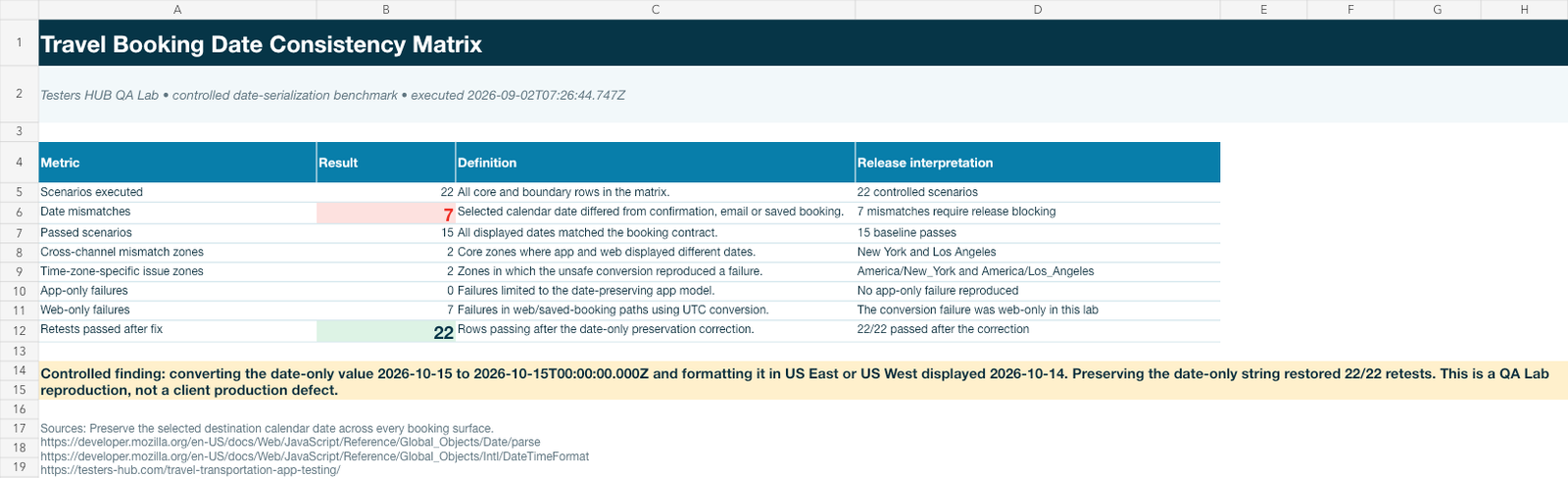
Six tabs cover the booking contract, all 22 scenarios, representative evidence, boundary coverage and the correction retest log.
Evidence examples
Four results show where the date contract broke
Selected and checkout: 2026-10-15. API: midnight UTC. Web confirmation/email/saved booking: 2026-10-14. App: 2026-10-15.
The same cross-channel mismatch reproduced in America/Los_Angeles: web showed the prior day; the app preserved the selected date.
Selected 2026-03-08 became 2026-03-07 in the modeled New York web view after UTC conversion.
Confirmation was correct in Asia/Kolkata; the saved booking shifted to the prior day after the device moved to America/New_York.
Boundary coverage
Midnight, daylight saving, year-end and state changes were included
The eight focused boundary rows covered a booking made at 00:05, destination one calendar day ahead, a US daylight-saving date, year-end, same-day destination booking, overnight itinerary viewed in UTC, a device-zone change after booking, and logout/login in the destination zone.
Five of those eight rows reproduced a mismatch. The test did not generalize from one failure; it preserved the passing UTC, Kolkata and Paris results as part of the evidence.
Correction and regression
Preserving the calendar-date value produced 22/22 passing retests
The lab correction kept the ISO date as a calendar-date string until a product rule explicitly added a time and zone. After that change, the original failing zones, neighboring surfaces, UTC baseline, app path, browser path, email model and saved-booking model all preserved the selected date.
A production fix would still need Regression Testing Services across cancellation, rescheduling, inventory, supplier messages, payment receipts, calendar export and notifications if they share the same date model. A 22/22 lab retest is evidence for this controlled contract—not automatic approval for a real release.
What this result does not prove
The lab isolates date handling; it does not simulate an entire travel stack
- No real traveler, client, supplier, payment or production booking data was used.
- The web and app paths model two implementation choices; they are not claims about named products.
- Email and saved-booking states were controlled outputs, not third-party delivery systems.
- The result does not prove all negative-offset zones or all daylight-saving transitions fail.
- Real releases require browser/device coverage, API inspection where permitted and end-to-end supplier validation.
That wider coverage belongs with Mobile App Testing Services and the primary Travel & Transportation App Testing service—not with generic booking-app intent.
Release decision
Payment success is not enough to approve a travel booking flow
A booking flow is not release-ready simply because payment succeeds; the traveler must see the same dates across search, checkout, confirmation, account history and notifications. Date consistency is a cross-system contract. It must survive the device time zone, browser or app, booking API, supplier state, payment review, saved itinerary, email and any calendar or notification output.
This is why travel app QA should establish the date meaning first, capture the value at every transition, and rerun the original failing zone alongside neighboring zones and channels after a fix.
Travel booking QA
Get a Travel App QA Scope
Share your booking flow, supported markets, platforms, time zones, payment methods and next release date. Testers HUB can prepare focused booking, date/time, payment and regression coverage.