

A structured AI draft can remove hours of blank-page work, but it is not the same as an approved test plan. Testers HUB reviewed a CSV containing 160 AI-generated test cases for a working project-management web application to see what was usable, what needed correction, and what the draft had missed.
To turn reviewed coverage into a managed testing engagement, explore the AI Test Management Platform requirements-to-regression workflow. Testers HUB can review the plan and execute an agreed QA scope; the evidence in this case study covers planning review only.
This anonymous AI test planning case study documents the review decisions using the supplied test-case evidence. It does not claim that the tests were executed or that defects were found.
Evidence boundary: every source test case remained Not Run. The source export did not record time to the first AI draft or human review time, so this case study does not publish unsupported speed, execution, defect, or business-outcome claims.
The Application and Source Draft
The review covered an authenticated project dashboard with seven modules: authentication and session management, dashboard overview, project and platform navigation, add-new-project workflows, client representation, reports, and settings.
The AI draft already included positive, negative, edge, validation, security, and UI/UX cases. It used consistent identifiers, steps, expected results, and priorities. That made it a useful planning starting point for our AI-driven software testing services.
How the Human QA Review Worked
The scenario was useful as written and its expected behavior was supportable from the available product context.
The risk was valid, but a route, control, persistence, session, or product assumption needed clarification.
A repeated-click case added little planning value, or several variants belonged in one clear matrix test.
The reviewer added accessibility, browser, responsive, role, integration, export, recovery, and performance cases.
What the AI Draft Did Well
The strongest result was structure. Of the 160 generated cases, 124 were accepted unchanged for planning. The draft captured routine positive flows, common validation failures, session checks, input boundaries, and basic security-sensitive behavior across each module.
That useful baseline meant the reviewer could spend more time challenging assumptions and cross-module risk instead of writing every ordinary scenario from zero.
Five Real Review Decisions
| Source case | QA decision | What changed | Why it mattered |
|---|---|---|---|
| AASM-007 | Edited | Converted one protected-route case into a route-access matrix. | The draft treated route variants separately without defining one consistent authorization expectation. |
| ANP-020 | Edited | Removed an unsupported assumption about whether duplicate project names must be rejected. | Expected behavior should follow an approved business rule, not a generic AI guess. |
| CRX-007 | Edited | Reframed pagination expectations around observed controls and available data. | The draft assumed a specific pagination implementation not established by the product context. |
| DOX-013 | Removed | Removed a repeated-click variation already covered by more useful interaction and state checks. | More rows do not automatically create better risk coverage. |
| PAPN-005 | Merged | Combined an overlapping platform-route variant into the route matrix. | A single traceable matrix is easier to maintain and execute than fragmented overlap. |
Coverage the Human Reviewer Added
The 12 new cases were not random extras. They addressed risks that require broader product and user context:
- Keyboard navigation and accessible error announcements
- Focus management after dialogs and validation failures
- Browser, responsive, zoom, and smaller-screen coverage
- Role and permission coverage, marked blocked until roles are confirmed
- Cross-module UI and API data consistency
- Out-of-order and delayed-response handling
- Session expiry while the project form contains unsaved work
- Downloaded report content and format validation
- Non-color status communication and contrast checks
- A product-specific performance baseline
These additions show why manual QA testing and experienced product review remain part of AI-assisted planning. AI created useful breadth; human review connected the plan to real user risk.
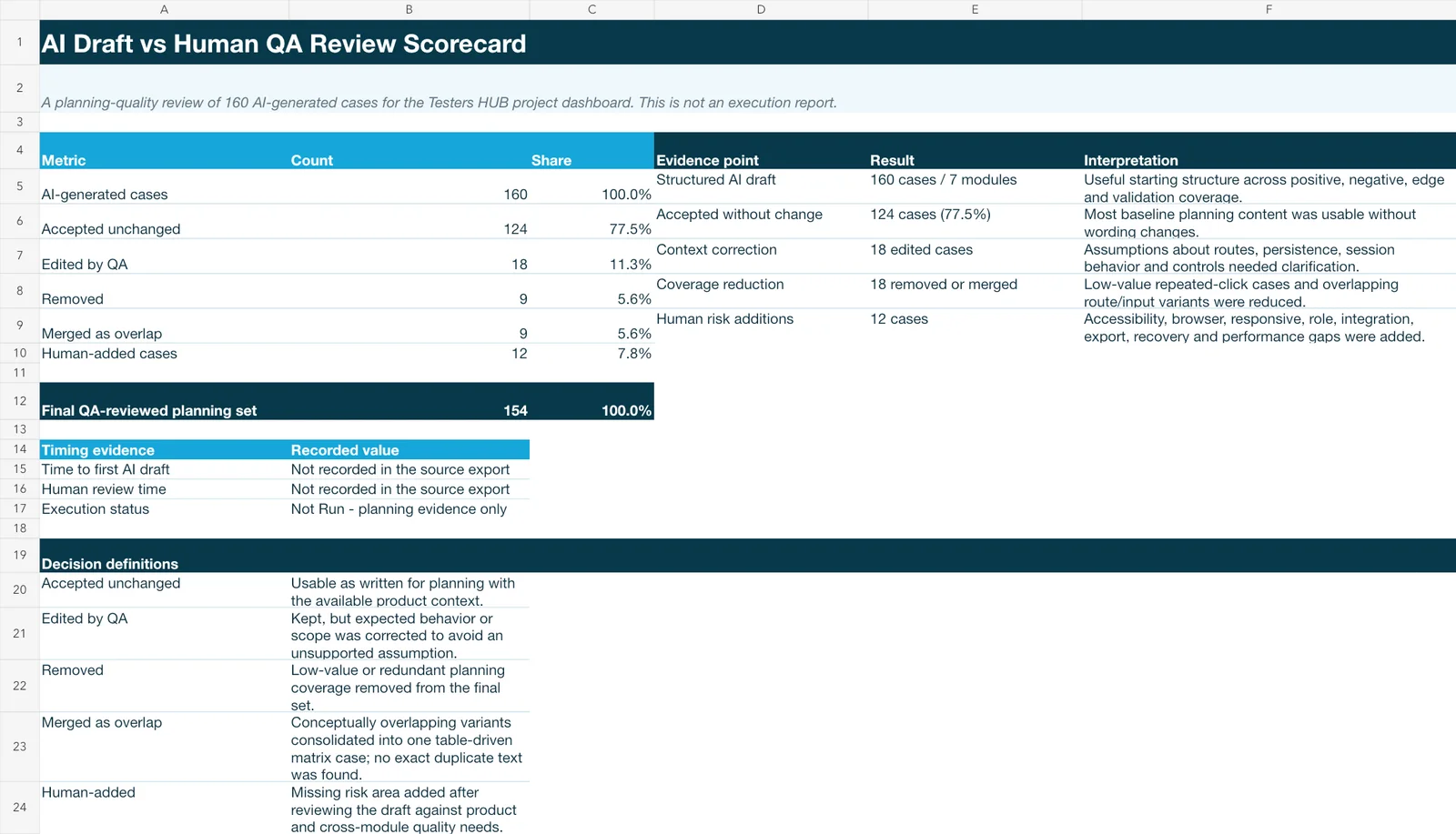
Download the AI Draft vs Human QA Review Scorecard
The workbook preserves all original rows, adds QA decision and review-reason columns, includes the human-added cases, and provides review examples and a formula-backed summary.
Planning Evidence Is Not Execution Evidence
The review improved the planning set from 160 generated rows to 154 reviewed cases. That number does not prove product quality. The cases still need prioritization, environment preparation, execution, exploratory investigation, defect reporting, and retesting.
For that work, teams may combine functional testing services with regression testing services. Product teams comparing platforms can also use our AI test management evaluation guide.
Get a Human-Reviewed AI Test Plan
Share your website, web app, PRD, BRD, Figma, workflows, or release context. Testers HUB will use AI to accelerate the first draft, then have experienced QA professionals review the coverage before delivery.
AI Test Planning FAQs
Are AI-generated test cases ready to execute without review?
Not automatically. AI can create a useful first draft, but an experienced QA reviewer should confirm product assumptions, remove low-value repetition, consolidate overlapping variants, and add risks that require application context.
How many AI-generated test cases were accepted in this review?
The draft contained 160 test cases. Testers HUB accepted 124 unchanged, edited 18, removed 9, merged 9 overlapping variants, and added 12 human-authored cases. The final QA-reviewed planning set contained 154 cases.
What did the human QA reviewer change?
The reviewer corrected unsupported assumptions about routes, persistence, sessions, permissions, and controls. The reviewer also added accessibility, browser, responsive, role, integration, export, recovery, and performance coverage.
Does AI test planning replace manual software testing?
No. This case study evaluates planning quality only. Every source case remained Not Run. Manual execution, exploratory testing, defect evidence, retesting, and release judgment still require qualified QA work.
What inputs can Testers HUB use for AI-assisted test planning?
Depending on the engagement, Testers HUB can review a working website or web app together with approved PRD, BRD, Figma, workflow, or release information. This case study used a working web application and its generated CSV draft.