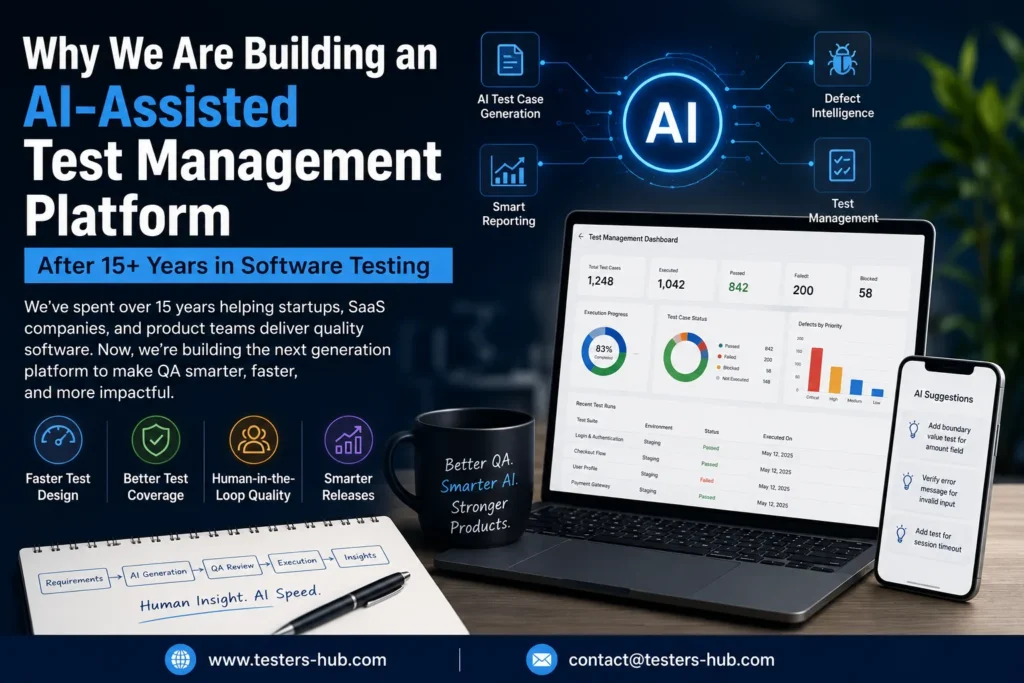
Evaluate an AI test management tool by checking whether its drafts map to your requirements, receive human approval and retain evidence through execution and retesting. Generated test-case counts alone cannot establish coverage.
AI features are appearing in more test-management products, but the useful question is not whether a tool can generate test cases. A QA manager needs to know whether it can support the full path from requirement review to manual execution, defects, retesting, regression planning, and a defensible release decision.
For practical delivery, explore our AI Test Management Platform workflow: requirements, AI-assisted coverage, human QA review, manual execution and regression updates. You can ask Testers HUB to manage the testing without adopting the platform yourself.
This guide explains how to evaluate an AI test management platform without replacing human QA judgment or buying features that do not fit the team’s real workflow.
Start With the QA Problem You Need to Solve
A small team may need faster test preparation. A mature SaaS team may need better traceability and a focused regression scope. Before reviewing products, document the current bottleneck: scattered requirements, repetitive case writing, weak defect evidence, unclear retest status, or a repository that has become too large to run for every release.
Seven Capabilities an AI Test Management Tool Should Support
1. Requirement context
The tool should use real requirements, workflows, acceptance criteria, product states, and business rules. Generic prompt output is not enough for execution-ready testing.
2. Human review and approval
Generated does not mean approved. Look for a visible lifecycle such as AI Draft → QA Review → Approved → Executed, with clear ownership at each stage.
3. Manual and functional execution
Manual testers need usable steps, expected results, test data, environment notes, and states such as Pass, Fail, Blocked, Hold, and Not Run. See how Testers HUB connects this workflow to manual testing services and functional testing services.
4. Developer-ready defect reporting
A useful defect contains reproducible steps, expected and actual behavior, environment details, severity, evidence, ownership, and retest history. AI may improve clarity, but a tester still owns reproduction and severity.
5. Regression planning
As repositories grow, teams need to organize critical paths, changed modules, prior failures, frequently broken areas, and smoke coverage. If a shortlisted tool offers AI regression suggestions, ask it to demonstrate how they are produced. The QA lead should approve the final scope; do not assume this feature is available in every platform. This is also the operating principle behind our regression testing services.
6. Traceability and reporting
The product should connect requirements, cases, runs, defects, retests, and releases. Reports should answer what was covered, what failed, what remains blocked, and which risks still affect the release.
7. Collaboration and access control
QA, development, product, and authorized client stakeholders need role-appropriate visibility without exposing sensitive credentials or unrelated projects.
AI Assistance Versus Human QA Ownership
| AI can assist | QA tester must own |
|---|---|
| Requirement summaries and initial scenarios | Business-context interpretation and relevance |
| Boundary and duplicate suggestions | Exploratory testing and risk prioritization |
| Defect-description draft | Reproduction, evidence, and severity |
| Execution summaries | Actual test result |
| Regression recommendations | Final regression scope |
| Release-data summaries | Release recommendation |
What a 23-Case Review Reveals About Evaluating AI-Generated Tests
Our AI requirements traceability case study examined 23 generated cases against 10 explicit acceptance criteria from one frozen, sanitized onboarding requirement screenshot. The review assessed planned coverage; the cases were not executed against the product.
| Review stage | Finding | What a buyer should check |
|---|---|---|
| Initial AI draft | 2 criteria fully covered, 5 partial and 3 missing | Map each requirement to a test; do not infer coverage from 23 case titles. |
| Unsupported assumptions | 5 additional test groups required clarification | Keep plausible risks separate from approved product behavior. |
| After human review | 9 of 10 criteria had approved coverage after review and 4 targeted additions | Inspect reviewer decisions and the remaining gap before approving the plan. |
The denominator is 10 explicit criteria, not 23 tests. Fully approved planned coverage changed from 2/10 (20%) to 9/10 (90%). The five assumption groups were excluded from that calculation.
For example, QA added checks for optional-step wording, field labels, preview content and sample-data labels. The promise that a user could invite an agent later remained partially covered because the entry route and expected state were not supplied. Leaving that gap visible was more useful than approving an invented workflow.
This single review does not establish universal AI accuracy, a test pass rate, productivity gains or defect-detection performance. Download the requirements-to-test traceability workbook to inspect the source criteria, draft mappings and final approval decisions.
Evidence to Request Before Choosing AI Test Management Software
Use the following questions in a demonstration or pilot. Only requirements mapping and QA review are supported by the benchmark above; execution, regression and reporting capabilities need their own evidence.
| Criterion | Evidence to request | Warning sign | Buyer decision |
|---|---|---|---|
| Source traceability | A requirement-to-test matrix with source versions | Case counts without criterion mapping | Can you see which requirement remains uncovered? |
| Unsupported assumptions | Open questions with product-owner decisions | Invented behavior shown as an approved expectation | Can uncertain tests remain on hold? |
| QA approval | Reviewer, edits and approval status | Generated automatically means ready to run | Can you distinguish draft from approved coverage? |
| Execution evidence | Build, environment, actual result and linked defects | A completed plan presented as passed testing | Can the team reproduce and review results? |
| Regression organization | Reusable suites, change context and human scope approval | Automatic recommendations claimed without a working demonstration | Does the available workflow fit your release process? |
| Reporting | Tested, blocked, untested and unresolved items | A green summary that hides exclusions | Can stakeholders assess the remaining release risk? |
Use the AI test management evaluation scorecard to record comparable evidence from each shortlisted product. A feature marked unavailable or roadmap should not receive credit as working functionality.
How to Run a Useful Pilot
- Select one business-critical workflow with known states and edge cases.
- Provide the same requirements and product context to each shortlisted tool.
- Record time to the first structured draft.
- Track cases removed, materially rewritten, and added by a human tester.
- Execute the approved set and measure defect acceptance and retest clarity.
- Review the final report with QA, development, and product stakeholders.
Do not publish productivity percentages from a pilot unless the baseline, scope, review method, and evidence are retained. The published traceability benchmark documents coverage review. Measure preparation time, human review effort and execution outcomes separately in your own pilot; do not treat its coverage figures as evidence of time savings.
Where Testers HUB AI Fits
Testers HUB AI combines AI-assisted test design and management with experienced testers who review coverage, execute real workflows, report defects, validate fixes, and prepare regression and release summaries. Current delivery is available through managed QA engagements for websites, web applications, Android and iOS workflows. Broader product access is being evaluated; expanded automation support remains on the roadmap. Automatic regression recommendations are not presented here as released Testers HUB AI functionality.
If your immediate need is an executable test plan and testing capacity, consider managed QA before adopting another tool. Agree who reviews requirements, executes cases, reports defects and verifies fixes. Teams with their own QA capacity can discuss early product evaluation and stakeholder access through the platform page.
Frequently Asked Questions
Can AI replace a test manager or manual tester?
No. AI can reduce repetitive preparation and improve organization, but testers still own product context, exploratory work, actual results, defect severity, regression scope, and release recommendations.
What should I test during an AI test-management pilot?
Choose one important workflow with known permissions, validations, alternate states, integrations, and failure behavior. A focused pilot makes review effort and evidence easier to compare.
Can an AI test management platform support manual regression testing?
Yes, when it can organize approved cases, changed modules, critical paths, historical failures, execution status, defects, and retests. Human approval should remain part of final regression selection.
Is Testers HUB AI available for mobile application testing?
Yes. Android and iOS workflows can include devices, OS versions, permissions, interruptions, network behavior, usability, and mobile defect reporting.