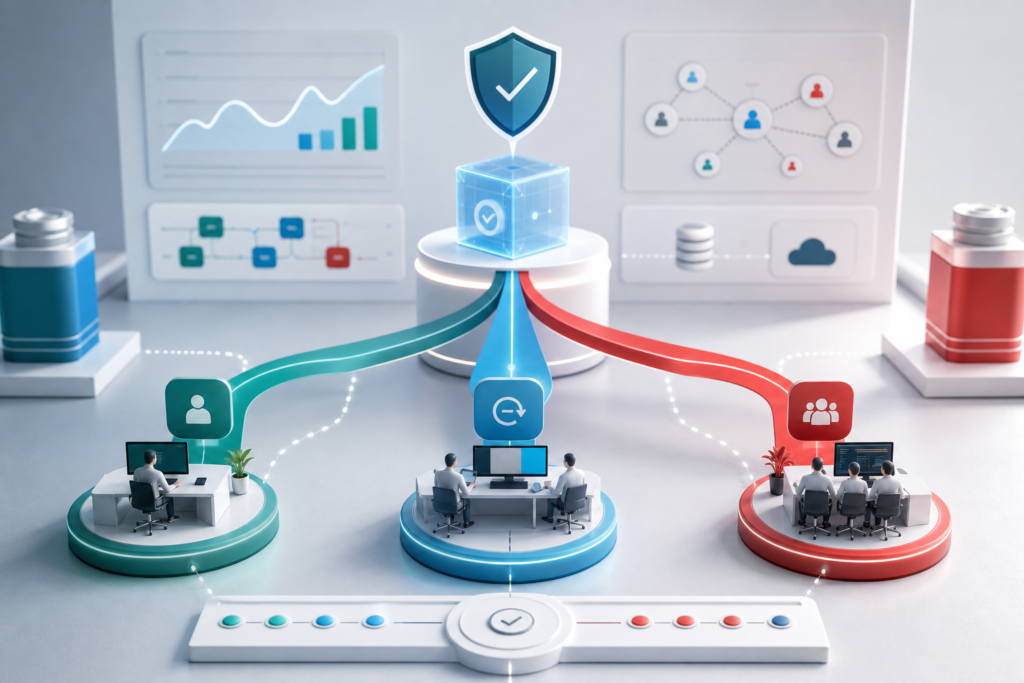
A SaaS team shipping every week has a very different QA requirement from a startup preparing one major launch. B2B SaaS QA outsourcing cost depends less on page count and more on release cadence, user roles, tenant complexity, integrations, billing paths, regression depth, and the QA capacity already available inside the team.
Quick answer
What does outsourced SaaS QA cost?
Testers HUB currently offers three ways to buy B2B SaaS testing services. The right option depends on whether you need a defined release checked once, repeatable regression around each sprint, or QA capacity embedded in continuous product development.
Flexible ongoing capacity for changing priorities, product learning, sprint collaboration, and regular releases.
Quoted after reviewing workflows, roles, environments, integrations, browser coverage, reporting, and retesting.
Scoped around release frequency, critical workflows, new features, risk-based regression, and fix verification.
Pricing note: These are Testers HUB engagement figures, not universal market averages. Actual cost depends on scope, product complexity, platforms, environments, reporting requirements, and test cycles.
Engagement models
The four common SaaS QA buying models
The goal is not to prove that outsourcing is always better. It is to match QA capacity to the way your SaaS product actually ships.
| Model | Best fit | Primary trade-off |
|---|---|---|
| One-time QA project | MVP, major launch, migration, release audit, billing change, or integration launch | Efficient for a defined scope, but product knowledge may need rebuilding for later projects. |
| Sprint / release QA | Teams shipping features every 1–4 weeks | Repeatable coverage without permanent capacity, but requires predictable handoffs and release windows. |
| Dedicated QA tester | Ongoing releases, changing priorities, and growing regression | Builds product knowledge and continuity, but needs enough regular work to use capacity well. |
| Internal QA employee or team | Stable long-term workload that requires permanent ownership and deep organizational context | Maximum internal continuity, with salary, hiring, benefits, equipment, management, and idle-capacity costs. |
Scope drivers
What actually drives B2B SaaS testing cost?
Owner, admin, manager, member, guest, and restricted users multiply the access paths that need positive and negative testing.
Workspace ownership, invitations, shared resources, exports, and tenant isolation require careful cross-account checks.
Trials, upgrades, downgrades, renewals, cancellations, invoices, limits, and feature access create state combinations.
Payments, CRM, email, notifications, APIs, webhooks, SSO, and third-party applications add dependencies and failure paths.
Weekly releases may make recurring QA more economical than repeatedly scoping isolated projects from the beginning.
A desktop-first SaaS product has a different matrix from a responsive platform used across desktop, tablet, and mobile.
Exploratory testing is faster to start; reusable test cases, traceability, and maintained regression suites require more setup.
Stable staging, realistic accounts, approved data, feature flags, and integration sandboxes reduce setup friction.
A quote should state whether fix verification and regression after fixes are included and how many cycles are planned.
Transparent arithmetic
Example SaaS QA budget scenarios
The calculations below apply the currently published Testers HUB dedicated-QA range of $15–$25 per hour. They are useful for early capacity planning before a workflow review.
| QA capacity | At $15/hour | At $25/hour | Illustrative planning use |
|---|---|---|---|
| 20 QA hours | $300 | $500 | Focused feature, targeted release check, or investigation with limited browser and role coverage. |
| 40 QA hours | $600 | $1,000 | One working week of focused QA across selected workflows, roles, defects, and retesting. |
| 80 QA hours | $1,200 | $2,000 | Broader release coverage, initial regression setup, or two weeks of flexible QA capacity. |
| 160 QA hours | $2,400 | $4,000 | Approximate full-time monthly capacity for continuous releases and changing priorities. |
Illustrative arithmetic using $15–$25/hour—not fixed package quotations. A final estimate still depends on workflows, roles, integrations, test depth, environments, reporting, and retesting.
Buyer decision
Dedicated SaaS QA tester vs sprint QA
Choose sprint QA when
- Releases are periodic rather than continuous.
- The scope is predictable before each test window.
- Developers and product owners can cover gaps between cycles.
- A repeatable critical-path regression pack is available or can be created.
- The team can provide stable release candidates and prompt fix builds.
Choose a dedicated tester when
- Features and priorities change continuously.
- Regression grows with every sprint.
- Long-term product, role, billing, and integration knowledge matters.
- QA needs to participate in Jira, Slack, standups, refinement, or release decisions.
- Testing demand is regular enough to use weekly or monthly capacity.
A dedicated tester is not automatically a full internal department. It is a way to retain SaaS product knowledge while adjusting weekly or monthly QA capacity around the roadmap.
Operating model
Outsourced SaaS QA vs hiring in-house
A fair comparison includes the full operating cost and the workflow impact—not a headline claim that one model always saves a fixed percentage.
In-house QA cost categories
- Salary and hiring costs
- Benefits, payroll obligations, and leave
- Equipment, devices, and software
- Management and career development
- Recruitment lead time and replacement risk
- Idle capacity during quieter release periods
Outsourced QA cost categories
- QA hours, sprint fee, or project quote
- Onboarding and product knowledge transfer
- Agreed tools, devices, and communication process
- Staging, test data, and access preparation
- Internal time for priorities, clarifications, and defect review
- Continuity planning when scope or vendor resources change
In-house QA may be the stronger choice when workload is permanent, internal context is difficult to transfer, and the company wants direct ownership of hiring and capability development. Outsourcing may fit better when demand changes, a launch needs temporary capacity, or the team needs independent QA without adding permanent headcount.
Trust check
When outsourcing SaaS QA is a poor choice
A tiny product with rare changes may not justify recurring external QA capacity.
If the current team has the skills, environments, devices, and time to cover risk, another provider may add coordination rather than value.
A highly specialized system may need internal subject-matter expertise that cannot realistically be documented or shared externally.
External QA cannot be effective without a usable staging environment, approved test data, role accounts, requirements, and timely clarifications.
Practical estimation
How much QA does a SaaS release actually need?
Page count alone is a weak estimate for SaaS. One screen can behave differently for multiple roles, tenant states, subscription levels, browsers, integrations, and failure conditions.
Consider a feature with three roles, five critical workflows, two browsers, negative paths, and one retest cycle. Even if it contains only a few screens, the tester must validate access, state changes, data visibility, errors, and regression across many combinations. The same screens with one role, one browser, and only happy-path coverage would require substantially less QA.
To estimate responsibly, define the smallest risk-based matrix that protects users and the release—then add explicit time for defect reporting, clarification, retesting, and the final release summary.
Original evidence asset
B2B SaaS QA Engagement Planning Matrix
The anonymized patterns below are grounded in published Testers HUB SaaS case studies. The recommended models and hour ranges are planning examples for comparable scopes; they are not disclosures of client billing or historical billed hours.
| SaaS type | Roles | Critical workflows | Release frequency | Integrations | Browser scope | Regression need | QA model recommended | Estimated hours | Why |
|---|---|---|---|---|---|---|---|---|---|
| Subscription and entitlement SaaS | Admin, paid user, trial user, restricted user | Upgrade, downgrade, renewal, cancellation, feature access | Per billing release | Payment gateway, webhooks, account state | Priority desktop browsers | High around plan changes | Sprint / release QA | 40–80 planning hours | Billing states and entitlement rules need structured coverage plus fix verification. View case study. |
| Multi-workspace AI SaaS | Owner, admin, member, restricted user | Workspace switching, invites, role changes, data visibility | Frequent product releases | AI services, APIs, notifications | Desktop plus responsive checks | High for role and tenant boundaries | Dedicated QA tester | 80–160 planning hours | Continuous changes benefit from retained product knowledge and recurring cross-workspace regression. View case study. |
| Session-based SaaS platform | Authenticated user and admin | Login, session renewal, timed activity, logout, recovery | Targeted reliability fix | Authentication and session services | Affected priority browsers | Focused around the repaired flow | One-time QA project | 20–40 planning hours | A bounded investigation and validation cycle can fit a fixed scope when the defect and affected flow are known. View case study. |
Planning hours are illustrative estimates calculated for comparable scopes; final estimates require a workflow and environment review.
Commercial checklist
What should be included in an outsourced SaaS QA quote?
A useful quote should answer the buyer’s practical question: “What exactly am I paying for?” Ask the provider to state each of these items clearly.
- In-scope workflows and explicit exclusions
- User roles, subscription states, and tenant coverage
- Platforms, browsers, devices, and environments
- Functional, exploratory, API, compatibility, or accessibility coverage
- Test cases, reusable regression assets, and ownership
- Regression depth for existing critical workflows
- Defect evidence: steps, expected/actual results, screenshots, and video
- Number of retest cycles and regression after fixes
- Daily, sprint, or release reporting cadence
- Communication channels, meetings, and response expectations
- Start date, test window, dependencies, and release deadline
- Hourly range, project fee, sprint fee, or dedicated allocation
Next decision
What Testers HUB engagement should a SaaS team choose?
Use a defined workflow, environment, browser, reporting, and retest scope for an MVP, migration, integration, or major release.
Maintain risk-based coverage and validate new features around each sprint or release window.
Build product knowledge and provide flexible capacity for changing features, Jira collaboration, and expanding regression.
After the workflows stabilize, selected regression checks may benefit from automation testing services while human QA covers changing and exploratory risk.
B2B SaaS QA planning
Get a B2B SaaS QA Cost Estimate
Share your SaaS roles, workflows, integrations, release frequency, browser coverage and next release date. We’ll recommend whether fixed-scope, sprint-based or dedicated QA is the better fit.