Healthcare QA budgeting guide
Quick Answer: Healthcare QA Cost Follows Risk, Not Screen Count
Healthcare software testing cost cannot be estimated reliably from the number of screens alone. A practical quote considers user roles, critical workflows, platforms, devices and browsers, integrations, test cycles, evidence requirements, and release risk. A patient portal with ten screens may need more QA than a larger informational app if it contains role restrictions, appointments, notifications, payments, data synchronization, and interrupted-session recovery.
Last reviewed: August 18, 2026
Seven cost factors
What Changes a Healthcare Software Testing Estimate?
The strongest estimate maps the real product journey before assigning effort. These seven inputs usually change coverage most.
User Roles
Patient, provider, administrator, coordinator, caregiver, support, and restricted roles create different access and state combinations.
Platforms
Web, Android, iOS, desktop, responsive portals, and connected services each add platform-specific behavior.
Devices and Browsers
Representative physical devices, operating systems, screen sizes, Chrome, Safari, Edge, Firefox, and embedded browsers affect the matrix.
Critical Workflows
Registration, consent, appointments, forms, telehealth, messaging, reports, payments, notifications, and recovery require end-to-end validation.
Integrations
Video, scheduling, SMS or email, payments, APIs, HealthKit, Health Connect, and other services add response and recovery states.
Test Cycles
An initial pass, fix verification, regression, and repeated release support are different scopes rather than one interchangeable activity.
Release Risk
Build stability, recent changes, known production complaints, deadline pressure, data rules, and evidence restrictions affect planning depth.
Estimation model
A Practical Healthcare QA Cost Formula
Instead of applying an unsupported market rate, build the estimate from observable scope inputs.
This formula is a planning framework, not an automatic dollar quote. The software testing cost calculator can help organize broad inputs, while the downloadable healthcare worksheet below focuses on roles, workflows, integrations, and release-specific risk.
Illustrative planning examples
How Scope Changes Across Healthcare Products
Healthcare Mobile App
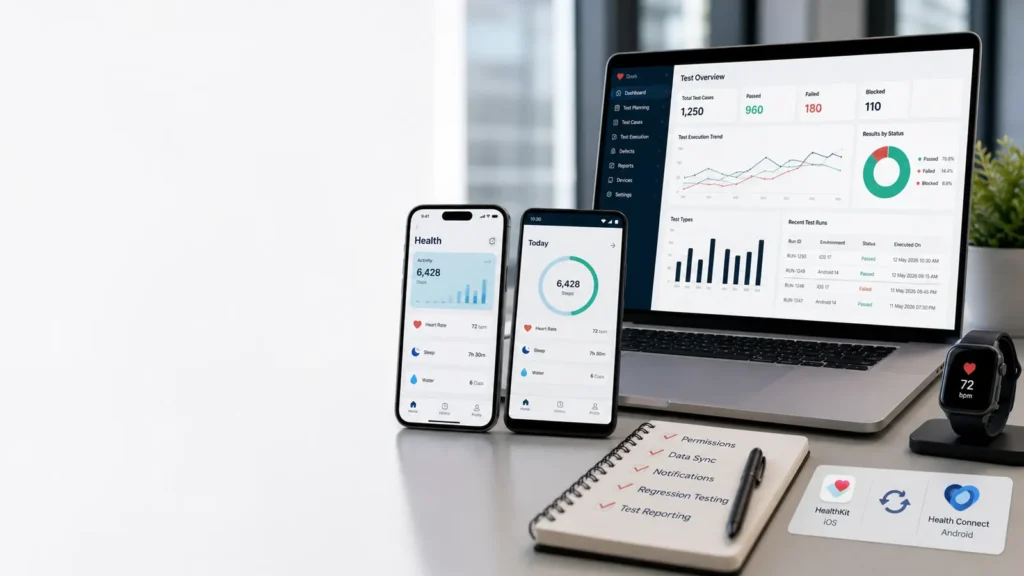
A release may include patient registration, consent, appointment reminders, camera or microphone permissions, notifications, background handling, interrupted sessions, HealthKit or Health Connect, and agreed real-device coverage. The estimate grows with platform combinations and state changes, not simply page count.
Patient Portal and Provider Dashboard
A portal may require patient, provider, coordinator, and administrator roles across forms, dashboards, browser sessions, documents, messaging, exports, responsive layouts, and third-party handoffs. Role × plan × workflow coverage often matters more than the visible number of screens.
Engagement choice
One-Time Release QA vs. Ongoing Regression
| Planning area | One-time release QA | Ongoing QA support |
|---|---|---|
| Best fit | Defined feature, redesign, migration, release candidate, or integration change | Frequent releases, recurring regressions, changing integrations, and continuing defect follow-up |
| Coverage | Agreed critical journeys and release risks | Maintained regression coverage plus changed and high-risk areas |
| Cycles | Initial execution with agreed retesting | Repeatable cycles aligned with the release cadence |
| Commercial model | Reviewed project scope | Dedicated or recurring QA scope |
Team model
In-House Tester vs. Outsourced Healthcare QA
In-House QA
Useful when a product needs continuous domain context, close daily collaboration, and enough recurring work to support a permanent role. Hiring, onboarding, devices, tooling, and coverage continuity remain internal responsibilities.
Outsourced QA
Useful for independent release review, flexible platform coverage, a defined deadline, regression support, or temporary capacity. A clear scope should state access, exclusions, evidence, devices, cycles, and ownership.
For broader budget options, review software testing pricing and engagement models.
Prepare a quote
What to Share for a Healthcare QA Cost Estimate
Product and Access
- Product type and platforms
- Accessible non-production build
- Approved test accounts and data
- Known access or evidence restrictions
Coverage
- User roles and permissions
- Critical workflows and integrations
- Devices, operating systems, and browsers
- Recent changes and known risks
Delivery
- Release date and urgency
- Expected execution cycles
- Retesting and regression needs
- Required reporting format
Clear Capability and Estimate Boundaries
Testers HUB provides functional QA, exploratory testing, integration-workflow validation, browser and mobile checks, accessibility observations, regression, and evidence-led defect reporting. We do not present this work as HIPAA certification, legal advice, regulatory approval, penetration testing, clinical validation, medical-device certification, HL7/FHIR conformance certification, or a formal compliance audit. Final pricing is provided only after a reviewed scope.
Frequently asked questions
Healthcare Software Testing Cost FAQs
How much does healthcare software testing cost?
Healthcare software testing cost depends on the number of user roles, critical workflows, platforms, devices, browsers, integrations, data states, execution cycles, and release risk. Testers HUB reviews these inputs before providing a commercial estimate.
Why is screen count not enough for a healthcare QA estimate?
A small interface can still contain complex permissions, account states, integrations, interrupted journeys, and sensitive workflows. Estimating by screens alone can miss the combinations that create most release risk.
Is healthcare mobile app testing priced differently from a patient portal?
It can be. Mobile scope may require physical devices, operating-system versions, permissions, notifications, background behavior, and store builds. A patient portal may require browser, responsive, role, form, session, and integration coverage.
What information is needed for a healthcare QA quote?
Share the product type, accessible test build, approved accounts, user roles, critical workflows, platforms, devices or browsers, integrations, release date, known risks, expected cycles, and evidence restrictions.
Can Testers HUB estimate ongoing healthcare regression testing?
Yes. Ongoing scope is planned around release frequency, stable regression coverage, changed workflows, supported platforms, fix verification, reporting expectations, and the level of tester involvement required.
Does a healthcare QA estimate include compliance certification or penetration testing?
No. Testers HUB provides functional, exploratory, integration-workflow, browser, mobile, accessibility-observation, regression, and evidence-led QA. A quote does not imply HIPAA certification, legal advice, regulatory approval, penetration testing, clinical validation, or formal compliance auditing.
Get a reviewed estimate
Plan Healthcare QA Around the Workflows That Matter
Share your healthcare product type, user roles, platforms, critical workflows, integrations, release date, and testing goals. We will recommend a practical scope and provide a clear quote without promising unsupported coverage.