If you had asked me 15 years ago what the hardest part of software testing was, I probably would have said finding bugs. Today, I would give you a completely different answer.
The hardest part is not finding bugs. It is everything that happens before and after testing.
Over the last 15+ years, our team has worked with startups, SaaS companies, eCommerce businesses, agencies, and game studios. We have tested products before their first release, supported weekly release cycles, and helped teams recover after poor reviews and frustrating customer feedback.
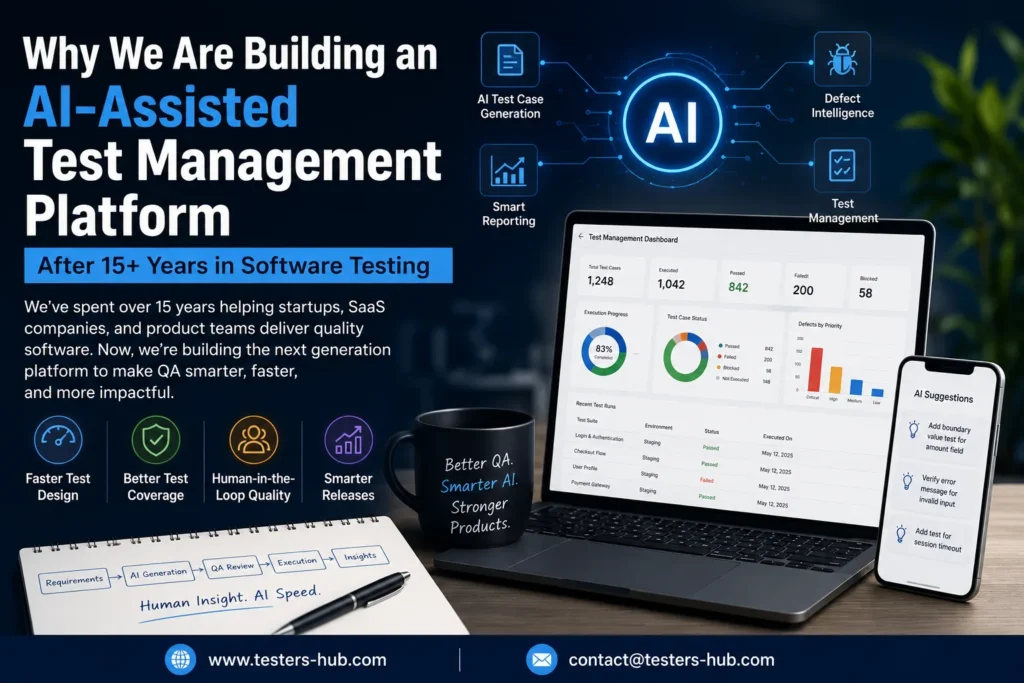
Despite all the changes in technology, one thing has remained surprisingly consistent: QA engineers still spend a great deal of time on repetitive work that could be faster. That realization is why we are building our own AI-assisted test management platform.
We are not building it to replace QA engineers. We are building it to help them spend more time on work that actually improves software quality.
The Problem We Kept Seeing Across QA Projects
Every project starts differently. Some clients provide detailed requirements. Others provide Figma designs or a Jira board. Sometimes the brief is simply, “Here is the product. Please test it.”
Regardless of where a project begins, the workflow usually follows the same path: requirements, test design, review, execution, defect reporting, retesting, and release.
However, large parts of that process remain heavily manual. Writing test cases, organizing scenarios, updating documentation after requirement changes, preparing release summaries, and maintaining regression suites are all essential. At the same time, they consume hours that experienced testers could spend examining real user behaviour and business risk.
We Asked a Better Question About AI in Software Testing
Instead of asking whether AI can replace software testers, we asked: Which parts of QA genuinely deserve a human’s time?
That question changed our direction. Our best QA engineers were not valuable because they could type test cases quickly. They were valuable because they could think. They noticed confusing workflows, business logic gaps, unusual customer behaviour, usability issues, and release risks that were not written into the requirements.
Those insights come from experience. Therefore, our platform is being designed around human judgement rather than around removing people from the testing process.
What AI Is Actually Good at in QA
During the last year, we have experimented with AI inside our own software testing services workflow. The most useful results came from repetitive, structured work.
For example, AI can prepare an initial draft of:
- Functional test cases
- Positive and negative scenarios
- Boundary-value checks
- Input and validation rules
- Requirement and defect summaries
- Initial test execution summaries
Instead of starting from a blank document, our QA engineers can start with a structured draft. Nevertheless, the draft is only the beginning.
Interested in an AI-Assisted Website QA Pilot?
Share your website, core workflows, release stage, and testing goals. Our QA team will explain how the current AI-assisted workflow can support test design, execution, defect reporting, and release summaries.
Where AI Still Needs Experienced Human QA
Imagine a requirement that says, “Users can create a new project.” AI can generate dozens of useful cases from that sentence. However, it does not automatically know how customers use the product, which workflow creates the most support tickets, which feature sales teams demonstrate most often, or which business rule changed yesterday.
Our QA engineers do. That is why every AI-generated test case still goes through human review before execution. Sometimes we remove scenarios. Sometimes we rewrite them completely. In other cases, we add exploratory tests that never existed in the original requirements.
The goal is not to generate more test cases. It is to create better, more relevant coverage.
We Are Not Building Another AI Writing Tool
There are already tools that can generate test cases. That is not the full problem we are trying to solve.
Our vision is an AI-assisted test management platform. Test case generation is the first capability, but the broader workflow includes requirement analysis, test coverage mapping, execution, defect reporting, retesting, regression planning, release readiness, and useful QA insights.
Software testing does not begin and end with writing test cases. It is an interconnected workflow, and we believe that workflow deserves better tools.
How Our AI-Assisted QA Workflow Works Today
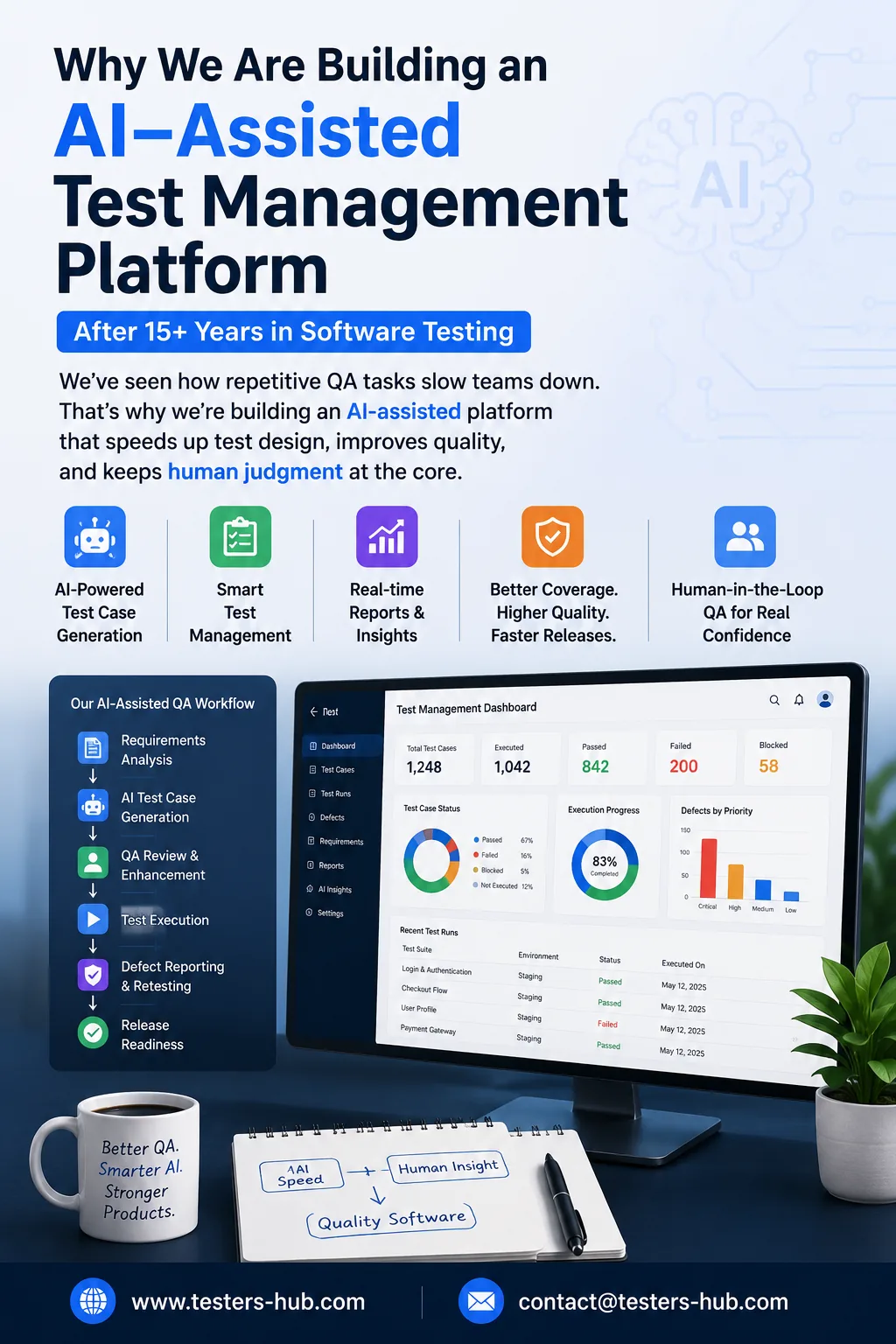
Our current website testing workflow begins with the requirement or product context. AI prepares initial test scenarios, and a QA engineer reviews and improves every case. Business logic and exploratory coverage are then added before execution begins.
During execution, testers retain control of results and evidence. AI can assist with defect descriptions and test summaries, but QA professionals remain responsible for accuracy, severity, retesting, and the final release recommendation.
AI and Human Responsibilities Are Deliberately Different
| AI assists with | QA professionals remain responsible for |
|---|---|
| Initial test case drafts | Business context and coverage relevance |
| Positive, negative, and boundary suggestions | Exploratory scenarios and unusual user behaviour |
| Defect description assistance | Reproduction, evidence, severity, and accuracy |
| Test execution summaries | Release risk and final launch recommendations |
This division is important. AI accelerates the process, while experienced testers remain accountable for quality.
Why Human QA Will Continue to Matter
AI can recognize patterns, but humans recognize context. AI can generate scenarios, while humans ask questions nobody wrote into the requirements.
What happens if a customer changes devices halfway through checkout? What happens if a seller updates inventory while another user is paying? What happens when onboarding technically works but still feels frustrating?
Those are not merely test cases. They are product questions. Answering them requires curiosity, experience, and critical thinking, which is why manual testing services and exploratory QA remain part of the platform-led workflow.
Where the Platform Is Today
The platform is in active development. It currently supports internal website testing workflows for AI-assisted test case generation, test execution, defect reporting, and test summaries.
We are testing these capabilities inside real QA processes before offering broader access. Website testing is the first supported area because it lets us validate complete user flows and reporting decisions in a controlled way. Mobile application support will be introduced gradually as the product matures.
For clients, this means the service remains accountable to a Testers HUB QA professional. The software supports the work; it does not make an unchecked release decision.
Why We Are Building the Platform
We are not building software simply because AI is trending. We are building it because we have lived these problems ourselves.
For more than 15 years, we have watched talented testers spend valuable time on repetitive documentation instead of exploring products, understanding customers, and improving release quality. If AI can remove part of that repetition, our engineers can focus on where they create the most value.
That is the future we are building toward: not automated QA, but smarter QA.
What Comes Next
The first capabilities are already helping us accelerate internal workflows. Future releases will gradually expand into broader test management, deeper reporting, automation planning, and mobile testing support.
We will continue sharing what works, what does not, and what we learn along the way. We believe the future of software testing is not AI versus humans. It is AI working alongside experienced QA professionals to deliver better software, faster.
Help Us Validate the Next Stage
If your team has a website release that needs structured test cases, human-led execution, defect evidence, and a clear QA summary, talk to us about a private pilot.
About Testers HUB
Testers HUB has spent more than 15 years helping startups, SaaS companies, eCommerce businesses, and game studios improve software quality through mobile app testing services, website testing services, game testing, manual QA, real-device testing, and structured software quality assurance.
Today, we are bringing that experience into the next chapter of quality assurance by building an AI-assisted test management platform designed by testers, for testers.
Frequently Asked Questions
What is an AI-assisted test management platform?
An AI-assisted test management platform uses AI to accelerate tasks such as initial test case generation, requirement summaries, defect descriptions, and test reporting while keeping experienced QA professionals responsible for review, execution, and release decisions.
Will AI replace manual software testers?
No. AI can reduce repetitive documentation work, but human testers are still needed to understand business context, real user behaviour, usability risks, unusual workflows, and release priorities.
How does Testers HUB use AI for test case generation?
AI prepares an initial set of functional, positive, negative, validation, and boundary scenarios. A Testers HUB QA professional then reviews, removes, rewrites, and expands those scenarios before execution.
Is the Testers HUB AI-assisted platform available now?
The platform is in active development and currently supports internal website testing workflows, including test case generation, execution, defect reporting, and test summaries. Broader access and mobile testing support will be introduced gradually.
Can a business request an AI-assisted website testing pilot?
Yes. Businesses can contact Testers HUB to discuss a private AI-assisted website QA pilot while the platform continues to develop.
What Is Available in Testers HUB AI Today?
The current workflow supports project and workspace management, AI-assisted test-case generation, experienced QA review, manual execution, defect reporting, retesting, test summaries, and client project visibility. Website and web-application workflows are available, and mobile test design and execution support covers Android and iOS projects. Automation support and broader AI-assisted regression recommendations remain roadmap items.
View the current Testers HUB AI workflow and request a pilot.
Where AI Drafts Still Need Human Correction
During internal review, AI drafts can include repetitive cases, assumptions not supported by the product, weak prioritization, or scenarios that miss business-specific permissions and recovery behavior. Our testers remove low-value cases, rewrite unclear steps, and add product risks before client delivery. We are measuring this review work in controlled pilots before publishing efficiency claims.