Yes, you can get professional game testing under $1,000, but only if the scope is planned carefully. The better question is not whether a small QA budget can help. The better question is what you should expect from it, what you should not expect, and how to spend that budget where it protects the game most.
This matters because many indie studios, startup game teams, and mobile game developers do not have unlimited QA budgets before launch. At the same time, releasing without outside testing can be expensive. Negative reviews, player churn, refund requests, crash reports, and poor retention often cost far more than a focused QA cycle.
At Testers HUB, we often speak with game teams that need practical game testing services without building a full-time QA department. Some teams need a quick gameplay pass. Others need mobile game testing services across real Android and iOS devices. Some are comparing game testing packages before deciding whether to outsource game testing or hire game testers for longer support.
So, let’s keep this realistic. A budget under $1,000 will not test everything. However, with the right priorities, it can find the issues most likely to affect players, ratings, and launch confidence.
Need a focused game QA scope?
Share your game type, platforms, build stage, and launch timeline. Our QA team will recommend a practical testing scope based on the risks that matter most.
Quick Answer: What Can You Get Under $1,000?
For many indie games and early releases, a professional QA budget under $1,000 can cover a focused testing cycle. In most cases, that means targeted coverage rather than full-project testing.
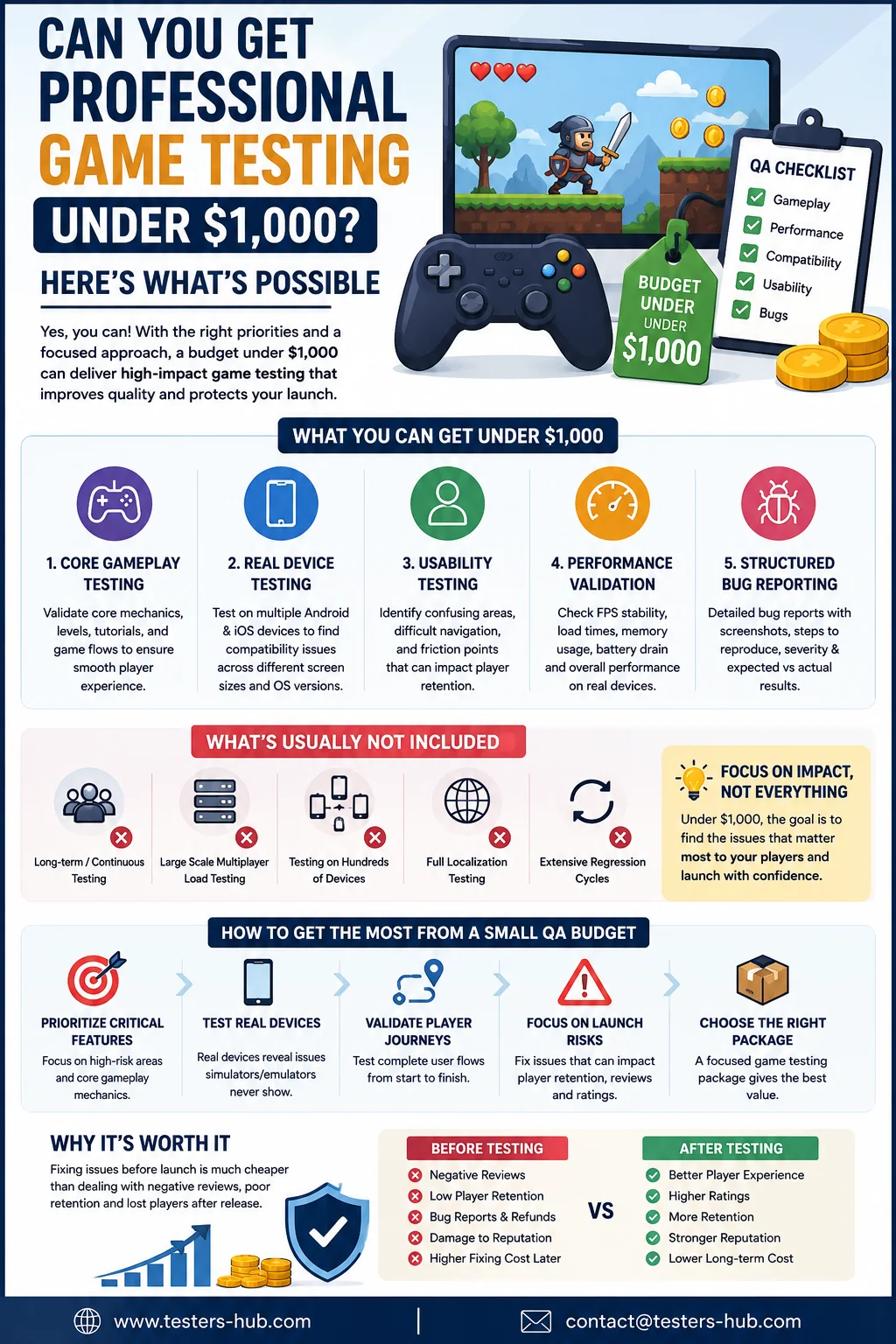
A practical sub-$1,000 game QA scope may include:
- Core gameplay testing for important levels, missions, tutorials, or player journeys
- Real-device testing on selected Android and iOS devices for mobile games
- Usability testing to identify confusing screens, unclear controls, or friction points
- Basic performance validation, including FPS symptoms, lag, load times, and battery impact
- Compatibility checks across selected devices, screen sizes, and OS versions
- Structured bug reports with screenshots, videos, steps to reproduce, severity, and expected results
- A short launch-readiness summary that helps the team decide what to fix first
However, the value depends on focus. If the scope tries to include every device, every mode, every level, every language, every multiplayer scenario, and full regression, the budget will spread too thin. Instead, the goal should be to identify the highest-risk issues before players do.
Why $1,000 Is a Better Threshold Than $500
A $500 QA budget can still help, especially for a very small build or one narrow gameplay flow. However, it usually limits coverage too much. The testing team may only have enough time for a quick smoke test, a few devices, and a short bug list.
By contrast, a $1,000 budget gives more room for structured testing. It allows testers to understand the game, play key flows, validate player journeys, document issues properly, and retest a limited number of fixes if the package includes it.
That extra coverage matters. Game bugs are not always visible in the first 15 minutes. Some appear after progression, repeated retries, device changes, ads, purchases, interrupted sessions, or longer playtime. Therefore, $1,000 is often a more realistic starting point for professional game QA services than $500.
What a Focused Game QA Cycle Should Prioritize
When budget is limited, priority matters more than volume. A smart QA cycle should focus on the player paths that can hurt reviews, retention, or revenue.
1. Core Gameplay Testing
Core gameplay testing checks whether the game feels stable, understandable, and playable. Testers review tutorials, controls, progression, rewards, game logic, save behavior, UI feedback, and key levels or missions.
For example, if your game is a puzzle title, testers should validate hints, level completion, scoring, retries, unlocks, and progression blockers. If it is an action game, testers may focus on controls, hit detection, camera behavior, difficulty spikes, checkpoints, and player feedback.
This is usually the most important part of a small-budget game testing services scope because gameplay issues directly affect player trust.
2. Real-Device Testing for Mobile Games
If the game is mobile, real-device testing is essential. Emulators and developer devices are useful, but they do not show every real-world issue.
Under a focused budget, the QA team should select a practical device list rather than testing hundreds of devices. For example, a mobile game QA cycle may include a mix of Samsung, Google Pixel, OnePlus, Xiaomi, iPhone, and tablet coverage based on your target audience.
This can reveal screen layout issues, touch control problems, permission behavior, loading delays, overheating symptoms, low-memory issues, and OS-specific bugs. For mobile-first titles, connect this scope with mobile game testing services instead of treating it as generic testing.
3. Usability and Player Experience Testing
Players do not only judge whether the game works. They judge whether the game feels clear, fair, responsive, and enjoyable.
A small QA budget should include usability feedback around onboarding, menu flow, tutorial clarity, button labels, store screens, inventory, rewards, difficulty, and player confusion. Sometimes the issue is not a technical bug. Instead, the player simply does not understand what to do next.
These findings are valuable because usability problems often reduce retention even when the game is technically stable.
4. Performance Validation
Performance testing under $1,000 will not usually include deep profiling or large-scale optimization. However, testers can still report practical symptoms that players notice.
This may include low FPS symptoms, lag during combat, long loading screens, battery drain patterns, overheating, memory-related crashes, and delays after ads or scene transitions.
For small teams, these observations can be enough to identify the worst performance risks before launch.
5. Structured Bug Reporting
Good bug reporting is one of the biggest differences between casual playtesting and professional game QA. A useful report should include steps to reproduce, actual result, expected result, device details, build version, screenshots, videos, severity, and notes for retesting.
Under a smaller budget, quality of reporting matters more than quantity. Ten well-documented defects are often more useful than fifty vague comments.
What Is Usually Not Included Under $1,000?
A clear scope protects both the game studio and the QA team. Therefore, it is important to understand what a sub-$1,000 budget usually cannot cover well.
- Long-term continuous QA across many builds
- Large-scale multiplayer load testing
- Testing on hundreds of real devices
- Full localization testing across many languages
- Complete regression testing after every fix
- Console certification testing
- Deep security testing or anti-cheat validation
- Full game completion for large RPG, open-world, or live-service games
These areas are important, but they usually need a larger package, multiple QA cycles, or dedicated testers. If your game includes multiplayer, liveops, heavy monetization, frequent updates, or long progression, it may be better to hire game testers for a sprint or ongoing support.
Sample Game Testing Scope Under $1,000
Every project is different, but a focused starter scope may look like this:
| Area | Possible Coverage |
|---|---|
| Game type | Indie game, casual game, mobile game, puzzle game, early launch build, or focused release update |
| Platforms | One primary platform, or limited Android and iOS coverage for mobile games |
| Testing style | Manual gameplay QA, exploratory testing, usability review, compatibility checks, and selected regression |
| Devices | A focused device set based on your target users |
| Deliverables | Bug report, screenshots, videos, severity, reproduction steps, and launch-risk summary |
| Best fit | Teams that need confidence before release, not complete enterprise-level QA coverage |
When a Larger Game Testing Package Makes More Sense
A $1,000 budget is useful, but it is not always enough. A larger game testing package may be better when:
- Your game has multiplayer, PvP, matchmaking, reconnects, or leaderboards
- You need multiple rounds of regression testing
- Your game has ads, in-app purchases, subscriptions, or complex monetization
- You are launching on both Android and iOS with broad device coverage
- You have many levels, modes, characters, weapons, or progression systems
- You need testing before a publisher review, investor demo, or major marketing campaign
In those cases, a larger package can provide deeper gameplay coverage, better regression control, more device coverage, and more complete launch confidence.
Compare Game Testing Packages
Review starter, standard, advanced, and dedicated game QA options based on your build stage, device coverage, and release goals.
How to Get the Most Value From a Small QA Budget
If your budget is limited, the best approach is to test the most important risks first. Here is how to make a focused cycle more useful.
Prioritize Player-Critical Flows
Start with the flows that players must complete: first launch, tutorial, core gameplay, saving progress, rewards, purchases, ads, and level completion.
Choose Devices Based on Real Users
Do not select devices randomly. Choose devices based on your target market, analytics, expected audience, and platform priority.
Share Build Notes Clearly
Tell testers what changed, what is risky, what should be ignored, and what must be validated. This saves time and improves reporting quality.
Ask for Severity and Impact
Not every bug has the same business impact. A useful QA report should separate launch blockers from polish issues.
Plan Retesting Before You Start
Even a small cycle should leave room for retesting critical fixes. Otherwise, the team may fix issues without knowing whether the fixes worked.
Outsource Game Testing or Hire Game Testers?
If you need one focused cycle, outsourced game QA services or a fixed package may be enough. This works well when you have a defined release, clear build access, and specific testing goals.
If you need ongoing help across multiple builds, live updates, multiplayer sessions, or regression cycles, it may be better to hire game QA testers. Dedicated testers can learn your game over time, track recurring issues, and support each release more consistently.
Both models can work. The right choice depends on your release timeline, budget, game complexity, and how often your team ships updates.
Is Professional Game Testing Under $1,000 Worth It?
For many small game teams, yes. A focused QA cycle under $1,000 can help prevent painful launch problems, especially when the scope is realistic.
It can uncover issues internal playtesting missed. It can give developers clearer bug reports. It can help founders decide what to fix before launch. In addition, it can reduce the chance of poor reviews caused by preventable gameplay, device, usability, or performance issues.
However, it should be seen as a focused launch-risk check, not complete quality coverage for the entire game. If your game is large, multiplayer-heavy, or close to a major release, a deeper package may be a better investment.
Final Recommendation
If you are working with a limited budget, start with the areas that matter most to players. Test the core gameplay. Validate the key devices. Check the first-time user journey. Look for performance symptoms. Ask for clear bug reports. Then use the findings to fix the issues that could hurt launch confidence.
Professional game testing under $1,000 is possible. The key is not to test everything. The key is to test the right things first.
Testers HUB provides affordable game testing services, mobile game testing services, game QA services, game testing packages, and dedicated game testers for indie studios, startups, and product teams. If you are planning a release, request a game testing quote and we will recommend a practical scope.
FAQs
Can you get professional game testing under $1,000?
Yes, if the scope is focused. Under $1,000 usually works best for a short QA cycle that covers high-risk gameplay, real-device checks, usability, basic performance review, and structured bug reporting.
What is usually included in a $1,000 game QA scope?
A focused scope can include core gameplay testing, selected Android or iOS device coverage, usability feedback, performance observations, crash checks, and clear bug reports with screenshots or videos.
What is not usually included under $1,000?
Large multiplayer load testing, hundreds of devices, full localization passes, long regression cycles, console certification testing, and ongoing liveops QA usually need a larger package or dedicated testers.
Is a $1,000 game testing budget enough for an indie game?
It can be enough for an indie game if the team prioritizes the most important platforms, player journeys, and launch risks. Larger or multiplayer games may need a deeper QA package.
Should I hire game testers or choose a game testing package?
Choose a package when you need a fixed, focused QA cycle. Hire game testers when you need flexible support across several builds, regression cycles, multiplayer sessions, or ongoing updates.
Can Testers HUB test mobile games under a focused budget?
Yes. Testers HUB can scope mobile game testing services around Android and iOS devices, core gameplay, monetization flows, ads, performance symptoms, and launch-readiness risks.