Indie teams rarely need the same level of external QA at every stage. During a prototype, the design may change several times in one day. By beta, however, one progression blocker, device-specific crash, broken purchase, or save-data problem can affect a large part of the player experience.
The useful question is not, “Should we test the game?” Testing should happen throughout development. The better question is, “Which checks should stay inside the studio, and when will independent game QA produce enough value to justify the cost?”
After working with game teams at different build stages, we have found that timing matters as much as scope. External testers are most useful when the build is stable enough to explore, the team can act on evidence, and a missed defect would threaten a milestone, submission, review score, retention, or revenue.
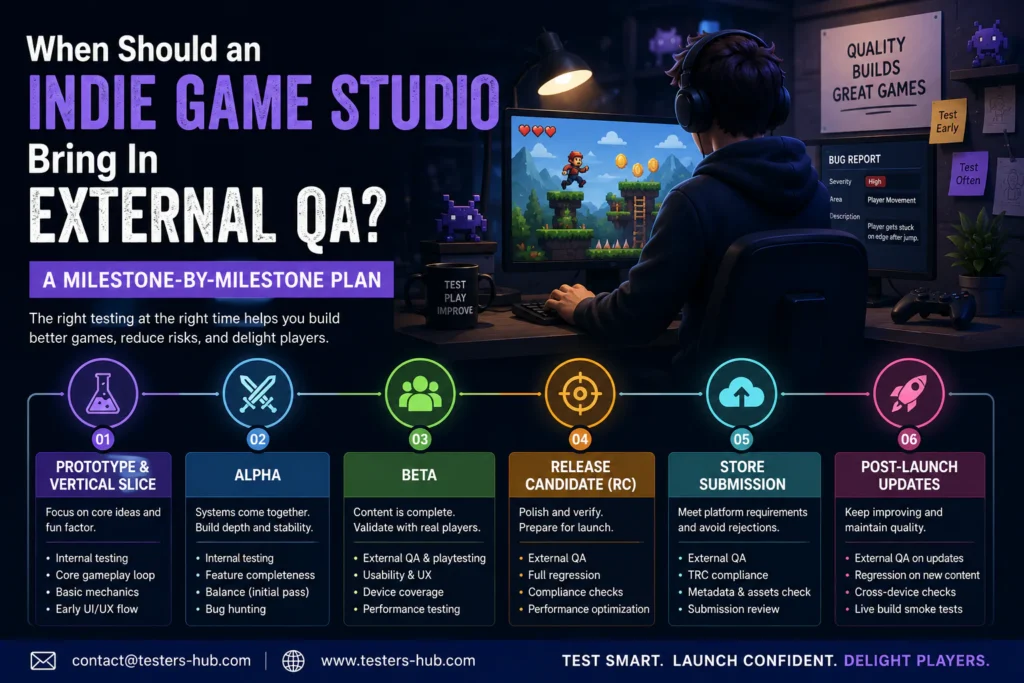
This guide provides a milestone-by-milestone plan for prototype, alpha, beta, release candidate, store submission, and post-launch updates. It also explains when to use focused game testing services, when to keep testing in-house, and when it makes more sense to hire game QA testers for ongoing support.
Planning your next game milestone?
Share your platform, current build stage, target devices, and release date. We will recommend a focused QA scope without adding testing your team does not need yet.
Quick Answer: Bring External QA In When the Build Has Real Player Risk
For most indie studios, alpha is the first point where structured external QA starts to pay off. The major systems are connected, the game can be played through meaningful flows, and independent testers can discover interactions the development team no longer sees clearly.
That does not mean every alpha needs a large test team. A focused pass may be enough. Coverage should then grow through beta and release candidate as content stabilizes, target platforms expand, and the cost of a missed defect increases.
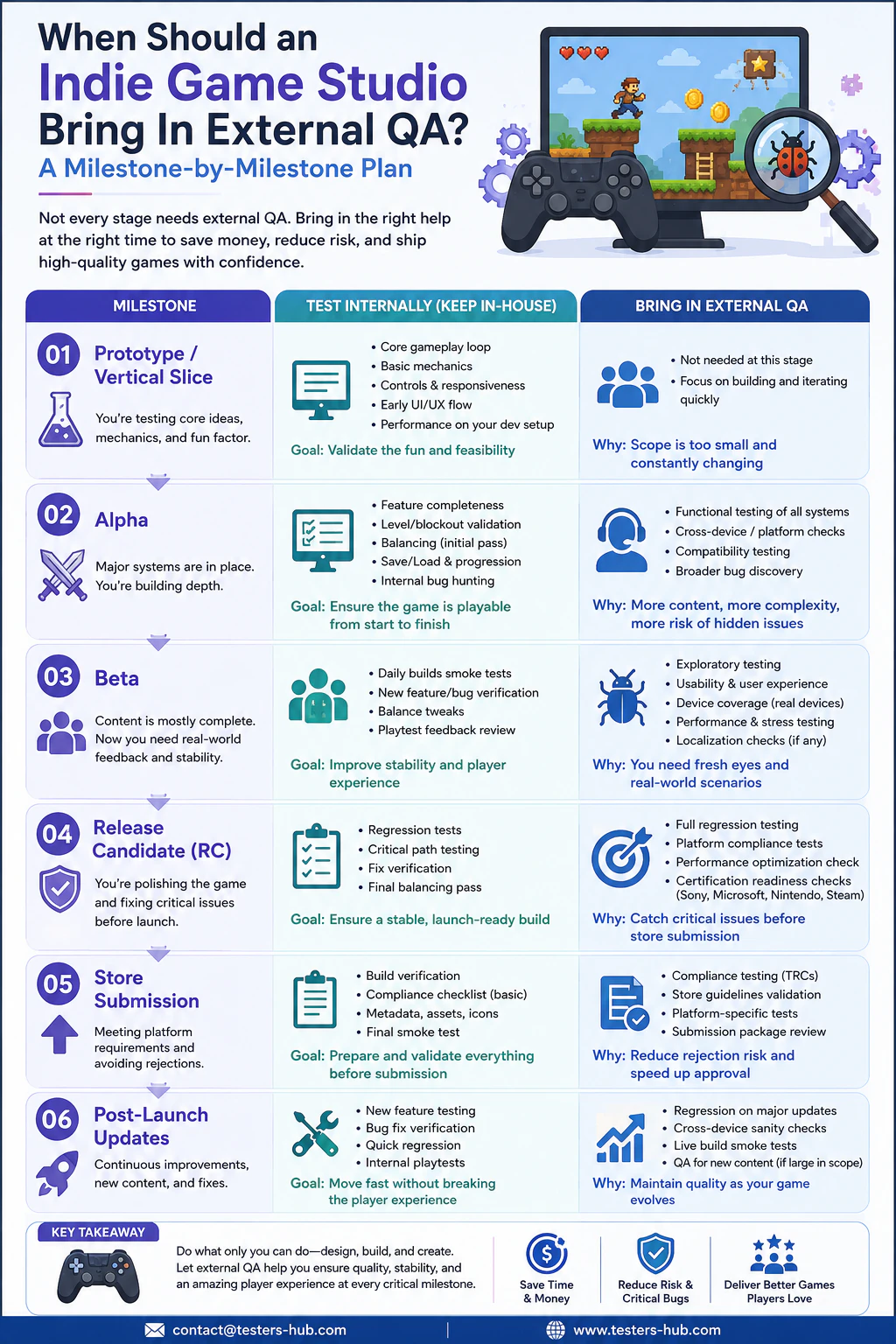
| Milestone | Keep In-House | External QA Role |
|---|---|---|
| Prototype / vertical slice | Core loop, controls, feasibility, fast iteration | Usually optional; use a specialist pass for demos or technical risks |
| Alpha | Daily build checks, feature validation, internal bug hunting | Focused functional, progression, compatibility, and broader exploratory testing |
| Beta | Smoke checks, balance changes, fix verification | Fresh-player journeys, real-device coverage, usability, performance, and regression |
| Release candidate | Critical-path checks and release decisions | Full risk-based regression, platform behavior, performance, and launch blockers |
| Store submission | Build, assets, metadata, and submission ownership | Compliance readiness, platform-specific checks, and final package review |
| Post-launch updates | Build verification and change-specific checks | Regression, device sanity checks, live build smoke tests, and major update support |
First, Separate Internal Testing, Playtesting, and Game QA
These activities overlap, but they do not solve the same problem.
Internal testing helps developers and designers confirm that new work behaves as expected. The team knows the architecture, intended flow, shortcuts, and known limitations, which makes internal checks fast and useful during frequent change.
Playtesting asks whether people understand and enjoy the game. It can reveal confusion, difficulty spikes, weak feedback, balance problems, and moments where players lose interest.
Professional game QA tests the build systematically. Testers examine expected and unexpected journeys, progression, saves, menus, controls, compatibility, performance symptoms, monetization, ads, network behavior, interrupted sessions, regression risk, and evidence needed to reproduce defects.
An external QA team should not replace the studio’s design judgment or everyday build checks. It should add independent coverage where familiarity, device limitations, deadline pressure, or release complexity creates blind spots.
Milestone 1: Prototype or Vertical Slice
At this stage, the team is proving the idea. Mechanics may be replaced, levels may be rebuilt, and the UI may only support the shortest usable journey. A large external QA cycle can become outdated before the report is complete.
What the studio should test internally
- Whether the core gameplay loop works and feels promising
- Basic controls, camera behavior, responsiveness, and feedback
- Early menu and UI flow
- Performance on the team’s main development setup
- Obvious blockers that prevent a demo or internal review
When external QA can still help
A short external review can be worthwhile before a publisher pitch, investor demo, public festival build, or important user test. It also helps when the team cannot reproduce a technical problem on a target device. In those cases, scope the work around the demo path or the specific risk instead of testing the entire prototype.
Milestone 2: Alpha
Alpha is often the best first milestone for independent QA. Major systems are in place, but content and polish are still changing. The build has enough depth for end-to-end workflows, yet the studio still has time to correct structural problems.
What internal testing should continue
- Daily smoke checks on new builds
- Feature-level validation by developers and designers
- Early balancing and tuning
- Save, load, checkpoints, and progression checks
- Verification of known high-risk changes
What external QA should add
Independent testers can follow the game from a fresh starting point, combine systems in unexpected ways, and test beyond the developer’s normal path. A focused alpha pass should cover core progression, game states, settings, input behavior, menus, compatibility, common interruptions, and defects that block continued play.
For mobile titles, this is also a useful time to begin selected mobile game testing services on real Android and iOS devices. Early device evidence can prevent the team from carrying layout, memory, touch, heat, or OS-specific problems into beta.
Milestone 3: Beta
During beta, content is mostly complete and the player experience should work from beginning to end. This is where broader external QA becomes highly valuable because the team needs evidence from real-world journeys, devices, play styles, and longer sessions.
External QA priorities during beta
- Exploratory gameplay across complete player journeys
- Usability and first-time user experience
- Real-device and platform coverage
- Progression, inventory, rewards, achievements, and save integrity
- Ads, in-app purchases, subscriptions, and restoration flows where applicable
- Performance symptoms during longer sessions and demanding scenes
- Multiplayer sessions, reconnects, invitations, matchmaking, and state synchronization
- Regression around defects fixed during alpha
Beta testing should not become an unstructured request to “play and find bugs.” Define target platforms, player journeys, high-risk systems, supported devices, known exclusions, expected evidence, and the build turnaround process. That structure makes outsourced game QA easier to measure and act on.
Moving from alpha to beta?
Compare focused gameplay, device, performance, multiplayer, and regression coverage for the milestone you are approaching.
Milestone 4: Release Candidate
A release candidate is not the time to discover that testing was never planned. Feature changes should be controlled, known blockers should be resolved, and the build should be close to what players will receive.
At this stage, external QA should concentrate on release risk:
- Installation, first launch, updates, and clean-start behavior
- Critical paths from onboarding through normal gameplay and completion
- Save data, cloud saves, account state, and progression continuity
- Platform, controller, resolution, and device-specific behavior
- Crash, freeze, frame-rate, loading, battery, memory, and overheating symptoms
- Purchases, ads, subscriptions, rewards, and restoration paths
- Focused regression of fixed defects and connected risk areas
The team should also agree on severity definitions and release criteria. A cosmetic issue may wait for an update; lost progress, blocked onboarding, broken payment, frequent crashes, or severe performance problems usually need a different decision.
Milestone 5: Store Submission
Store submission adds platform and packaging risk to product quality. A build can be enjoyable and still face delay because required behavior, metadata, assets, permissions, controller support, or submission details are incomplete.
Internal owners should remain responsible for accounts, credentials, final assets, legal details, age ratings, pricing, and submission decisions. External QA can support the process by validating the installable build, platform-specific behavior, submission checklist, critical journeys, and fixes made during the final review.
The exact compliance scope differs by platform. Therefore, studios should share the target store, build type, supported hardware, online features, regional requirements, and planned submission date before the QA cycle begins.
Milestone 6: Post-Launch Updates and Liveops
Launching the game changes the risk; it does not remove it. New content, SDK updates, engine upgrades, ad network changes, store requirements, OS versions, server changes, and hotfixes can break a previously stable player journey.
For occasional updates, a focused external regression pass may be enough. For frequent releases or liveops, dedicated testers usually provide better continuity. They learn recurring risks, maintain regression coverage, compare builds, support rapid fix verification, and help the studio avoid repeating the same defect pattern.
If releases are frequent, compare a fixed project with the option to hire game testers for a sprint or ongoing schedule. The most economical model depends on build frequency, supported platforms, game complexity, and how quickly fixes need to be retested.
Seven Signs Your Indie Studio Is Ready for External QA
- The team can complete a meaningful player journey. Testers need enough connected functionality to evaluate real behavior.
- Developers are repeatedly testing their own work. Familiarity makes expected paths easy to follow and unusual behavior easier to miss.
- Your target users own devices you do not have. External coverage can reveal compatibility and performance risks earlier.
- A release, demo, submission, or marketing date is approaching. Independent evidence helps prioritize the remaining work.
- Internal bug reports are difficult to reproduce. Structured steps, videos, logs, device details, and severity improve fix decisions.
- Regression work is taking time away from development. A repeatable external pass can protect critical flows while developers focus on fixes.
- The cost of a missed defect is increasing. Store rejection, poor reviews, lost purchases, churn, and emergency patches are more expensive than earlier discovery.
How to Scope External QA Without Wasting an Indie Budget
A smaller budget can still produce useful evidence when the scope is specific. Before requesting a quote, prepare:
- The current milestone and what should be stable in this build
- Target platforms, devices, stores, and regions
- The most important player journeys and revenue flows
- Known issues, exclusions, cheats, test accounts, and setup notes
- Build distribution method and update schedule
- Expected report format, severity levels, and evidence
- Time for developers to fix issues and testers to retest them
Studios with one stable milestone can choose a fixed package. Teams with changing builds, multiple updates, or broader regression may need a dedicated tester. Our guide to outsourcing game QA services explains how to evaluate process, communication, devices, reporting, and ownership before selecting a partner.
Budget also changes with platform count, build stability, game length, multiplayer complexity, device coverage, test depth, and the number of regression rounds. Review the practical factors on our game testing cost page before comparing quotes that may include very different coverage.
Should You Choose a Package or Hire a Game Tester?
Choose a game testing package when the build, milestone, platform, and expected deliverables are clearly defined. Packages are useful for alpha reviews, beta passes, release candidates, mobile device checks, and a planned regression cycle.
Hire a game tester when you need support across several builds, frequent fix verification, repeated multiplayer sessions, liveops, or long-term product knowledge. A dedicated tester can maintain coverage as the game changes instead of restarting context for every cycle.
Neither model is automatically better. The right choice is the one that matches release cadence and product risk. A practical QA partner should be willing to reduce the scope when a large cycle is premature and expand it when the next milestone creates real exposure.
Final Recommendation
Keep fast, change-heavy testing inside the studio during the earliest prototype work. Add focused external QA when alpha systems connect and independent journeys become meaningful. Expand coverage during beta, protect the release candidate with risk-based regression, review platform readiness before submission, and maintain regression support for important post-launch updates.
Most importantly, do not wait until the final week to introduce an external team. Testers need build access, product context, devices, time to investigate, and a path for retesting. Bringing them in one milestone before the highest-risk deadline usually gives the studio more useful evidence and more room to act on it.
Testers HUB provides game testing services, mobile game QA, real-device coverage, gameplay testing, compatibility checks, performance testing, regression, and dedicated testers for indie studios and product teams. Request a focused game QA scope based on the milestone you are preparing to ship.
FAQs
When should an indie game studio bring in external QA?
External QA usually becomes valuable during alpha, when the main systems work together and the build has enough depth for meaningful end-to-end testing. A smaller specialist review can help earlier, while beta, release candidate, store submission, and major post-launch updates normally need broader independent coverage.
Is external QA necessary during the prototype stage?
Usually not. During a prototype or vertical slice, the team should focus on the core gameplay loop, controls, responsiveness, and whether the idea is enjoyable. External QA may still help before a publisher demo or when a technical problem is blocking progress, but a full QA cycle is rarely the best use of budget at this stage.
What is the difference between game QA and playtesting?
Playtesting focuses mainly on whether the game is understandable, balanced, and enjoyable. Game QA also validates functionality, compatibility, saves, progression, performance, monetization, compliance, regression, and reproducible defect evidence. Strong release decisions often use both.
Should indie studios outsource game QA or hire dedicated testers?
A fixed outsourced QA cycle works well for a defined milestone or release candidate. Hiring dedicated game testers is usually better when the studio ships frequent builds, needs repeated regression, supports liveops, or wants testers who build deeper product knowledge over time.
How much game testing should happen before beta?
Before beta, the studio should be able to complete the main player journey without major blockers. Core systems, save and load behavior, progression, controls, and essential menus should receive internal checks, followed by focused external testing of the highest-risk workflows and target platforms.
What should external QA test before store submission?
The final scope should cover build installation, critical player journeys, save data, purchases where applicable, platform-specific behavior, metadata and assets, required compliance checks, performance symptoms, crash risks, and a focused regression of release-blocking fixes.
Can a small indie studio use external QA on a limited budget?
Yes. The studio can book a milestone-based pass around one platform, selected devices, critical gameplay, or a release candidate. Clear priorities, stable builds, useful test notes, and time reserved for retesting make a limited QA budget more effective.