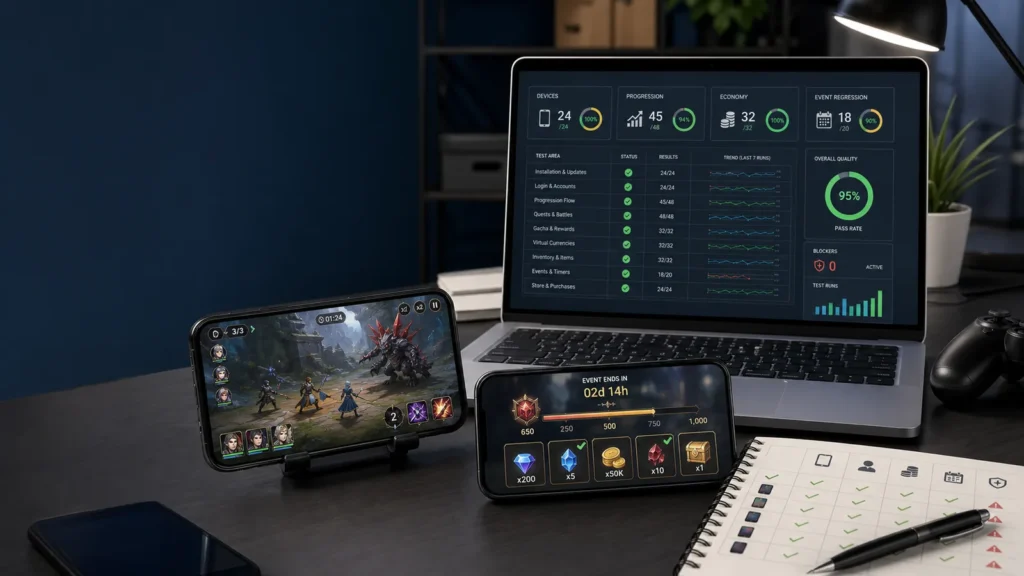
Outsourcing mobile RPG QA is not simply assigning someone to play through the latest build. A live RPG connects combat, progression, inventory, virtual currencies, banners, purchases, player accounts and timed events. One configuration change can alter several of those systems at once.
A useful external QA scope therefore starts with game rules and player states. It identifies what must remain consistent before, during and after a pull, reward claim, daily reset, app update, network interruption or login on another device.
This guide explains how US studios can structure outsourced QA for Android and iOS RPGs, gacha games and recurring LiveOps releases. It also shows what evidence to request, what affects cost and when a focused cycle should become ongoing mobile game testing services.
Need an RPG QA scope before your next release?
Share your game engine, platforms, progression systems, currencies, banners, event cadence and target devices. We will recommend focused coverage and a clear quote.
Quick Answer: What Should an Outsourced RPG QA Team Cover?
The scope should cover core gameplay, progression, characters, equipment, inventory, gacha and pity rules, currencies, purchases, events, accounts, saves, real devices and regression. The exact depth depends on the release trigger. A single banner review needs different preparation from a soft launch or a retained weekly LiveOps cycle.
Why Mobile RPG QA Requires Genre Experience
One change affects connected systems
Combat results can award XP, unlock quests, update missions, add inventory, change event progress and trigger purchase offers. Testers need to follow the whole dependency chain instead of checking one screen in isolation.
Progress must remain consistent for months
Long-term accounts contain states that a new-player test never reaches. High-level characters, completed tutorials, near-pity counters, paid inventory and event eligibility need controlled accounts and reproducible setup notes.
Paid and earned currencies must reconcile
For each transaction, QA should record the starting balance, action, configured cost or reward, resulting balance, inventory result, server response and history entry. This makes a missing entitlement or duplicate reward easier to prove.
Live events introduce time-dependent risks
Server time, device time, eligibility, remote configuration, daily reset and event closure can produce failures that do not appear during a normal daytime test. A LiveOps plan must include boundary states, not only the happy path.
Which Mobile RPG Systems Need Functional Testing?
- Tutorial, onboarding and first-time user experience
- Combat, party setup, controls and battle outcomes
- Quests, prerequisites, XP, level and character advancement
- Inventory, equipment, crafting, stamina and rewards
- Achievements, missions, friends, guilds and leaderboards where applicable
- Banners, summons, pity counters, duplicate conversion and pull history
- Free and paid currencies, purchases, restoration and entitlements
- Cloud saves, guest conversion, device transfer and app updates
How Should Gacha Banners and Pity Counters Be Tested?
| Test area | Evidence QA should capture |
|---|---|
| Availability | Start, end, region, segment and player eligibility |
| Summon pool | Approved characters, items and rarity groups |
| Displayed odds | UI values compared with supplied configuration |
| Pity counter | Increment, persistence, guarantee, reset and carry-over |
| Currency | Free or paid balance before and after each pull |
| Interruption | Network loss, app termination, retry and duplicate protection |
| Cross-device | Counter, history and inventory after login elsewhere |
Functional QA validates behavior against the studio’s documented rules. It does not certify mathematical randomness or regulatory fairness without a separately designed statistical engagement.
Preparing a new banner or pity-rule change?
Send the approved banner rules, player states and test environment so the pull sequence, balances, rewards and recovery paths can be scoped before activation.
How Should a Mobile RPG Economy Be Tested?
A transaction matrix should cover soft currency, premium currency, stamina, daily rewards, quest rewards, battle-pass rewards, event currencies, shards, crafting materials, shop bundles and promotional bonuses.
Reconciliation method: starting balance → action → configured cost or reward → resulting balance → inventory result → server response → transaction history.
QA should also test retries, interrupted requests, duplicate taps, expired offers, full inventory, account switching and the difference between free and paid balances.
What Should LiveOps Event QA Include?
Event regression should validate activation, segmentation, server time, missions, reward ladders, event stores, daily and weekly resets, conflicting events, unclaimed rewards, closure, post-event conversion and hotfix behavior. The currently live version should remain the regression baseline so a new event does not silently break login, inventory, purchases or progression.
How Should Saves and Account Progress Be Tested?
Include guest accounts, registration, account linking, social login, logout, relogin, cloud-save conflicts, device transfer, app update, reinstall and progress restoration. Where cross-platform accounts are supported, compare Android and iOS state using the same controlled player account.
Interrupted writes deserve special attention. Backgrounding, device shutdown, connectivity loss and two devices writing different states can expose failures that short internal sessions miss.
What Should Android and iOS Device Coverage Include?
- Current iPhones and representative older supported models
- Android flagship and mid-range devices across relevant chipsets
- Smaller screens, tablets or foldables when they are part of the audience
- Current and older supported OS versions
- Low-memory, background interruption and network-change scenarios
- Battery, heat and frame-rate observations during longer sessions
For 2026 Android releases, scope should include target API 36 behavior, third-party SDKs, billing, authentication, notifications, insets, background recovery and older supported OS versions.
Manual QA, Repeatable Checks or Player Research?
| Approach | Best use |
|---|---|
| Manual functional QA | Rules, edge cases, currencies, events and unexpected sequences |
| Repeatable automation | Stable logins, smoke checks, known paths and configuration validation |
| Player research | Appeal, tutorial clarity, difficulty perception and emotional response |
| Analytics | Population-level behavior after release |
These approaches complement one another. Player feedback is not a replacement for reproducible defect investigation, and functional QA is not a substitute for product analytics or economy design.
Fixed Scope, Per-Event QA or Dedicated Tester?
| Engagement | Best fit |
|---|---|
| Focused feature review | One banner, event or progression feature |
| Soft-launch QA sprint | New game preparing for regional or global release |
| Per-event regression | Regular seasonal or limited content |
| Monthly QA support | Frequent builds, SDK changes and hotfixes |
| Dedicated tester | Complex live title that benefits from retained product knowledge |
Compare per-event and retained QA
Use the planner to record platforms, player states, currencies, banners, events, devices and regression needs before comparing engagement options.
What Affects Mobile RPG Testing Cost?
Cost changes with platform count, device coverage, progression depth, the number of currencies and banners, event cadence, account complexity, multiplayer or guild features, build frequency, reporting needs and retest rounds. A quote should state platforms, devices, test accounts, progression states, banner configuration, event schedule, cycles, deliverables and exclusions.
Use the game testing cost guide to understand the main variables, then compare the visible scope on the game testing packages page. A lower quote is not necessarily better when it excludes devices, account-state setup or regression.
Internal Team, Freelancer, Player Panel or QA Company?
| Option | Strongest use | Main limitation |
|---|---|---|
| Development team | Fast feature checks | Limited independence |
| Freelance tester | Small defined feature | Capacity and continuity |
| Player panel | Qualitative feedback | Not complete functional QA |
| Managed QA company | Release and recurring regression | Needs structured onboarding |
| Dedicated tester | Long-term LiveOps knowledge | Ongoing budget commitment |
Questions to Ask a Mobile RPG Testing Company
- Have you tested RPG progression, currencies and event systems?
- Can you prepare and track multiple player states?
- How do you validate pity and guarantee rules?
- How do you test server resets and event closure?
- Can you test purchases, restoration and interrupted transactions?
- Which Android and iOS devices are available?
- Will the same tester remain on the title?
- How many retest cycles are included?
- Can you work in our tracker and reporting process?
- Which areas are explicitly outside scope?
A Practical Mobile RPG QA Cycle
- Review scope and approved game rules.
- Prepare controlled player states and devices.
- Run the initial functional cycle.
- Reconcile economy and event results.
- Investigate defects and triage evidence.
- Verify fixes on the agreed build.
- Run focused regression around connected systems.
- Share open risks and a release summary.
Information Needed for an Accurate Quote
- Android, iOS or both
- Unity, Unreal or another engine
- Soft launch, global launch or live title
- Account, save and device-transfer model
- Progression, currencies, banners and purchase flows
- Events and banners per month
- Target devices and OS versions
- Expected builds and retest cycles
- Target release date and reporting format
Teams that need ongoing ownership can also hire game QA testers for a sprint or retained schedule. For a broader platform and genre scope, review Testers HUB’s complete game testing services.
Outsource mobile RPG testing with a clear scope
Send your game systems, player states, release cadence and target devices. Testers HUB will recommend practical gacha, economy, LiveOps and regression coverage.
FAQs
How much does mobile RPG testing cost?
Cost depends on platforms, devices, progression depth, currencies, banners, event cadence, account states, builds and retest cycles. A focused feature review costs less than a soft-launch sprint or retained LiveOps regression. Testers HUB confirms the scope before quoting so the estimate reflects actual coverage.
Can QA verify a gacha pity system?
Yes. Testers can create controlled player states below, at and above the guarantee threshold, then verify increments, resets, carry-over, duplicate handling, displayed state and server results against the approved rules.
Can Testers HUB test displayed banner odds?
Testers HUB can confirm that displayed odds and reward groups match the configuration supplied by the studio. Functional QA does not certify mathematical randomness or regulatory fairness unless a separate statistical engagement is explicitly designed.
Can LiveOps events be tested before activation?
Yes, when the studio supplies a staging build, remote configuration, test accounts and a way to control event timing or eligibility. QA can validate visibility, segmentation, missions, rewards, stores, resets, closure and adjacent regression before the public start time.
How many devices should a mobile RPG cover?
The matrix should represent the audience and risk rather than an arbitrary device count. It normally includes current iPhones, representative Android flagships and mid-range models, smaller screens, supported OS versions, different chipsets and interruption conditions.
Can one tester cover both Android and iOS?
A retained tester can own product context across Android and iOS, while the agreed device matrix may require additional testers or scheduled devices. The scope should identify who owns cross-platform comparison and fix verification.
How are long-term progression states created?
Studios can provide prepared accounts, debug tools, server-side state changes or controlled test data. QA records each account state so progression, inventory, currencies, pity counters and event eligibility remain reproducible.
Is in-app purchase testing included?
It can be included when sandbox accounts, store builds and approved purchase scenarios are available. Coverage may include purchase, cancellation, interruption, entitlement delivery, restoration and free-versus-paid currency behavior.
Is player research included in mobile RPG QA?
Functional QA and player research answer different questions. QA investigates rule correctness, defects and regression. Player research evaluates appeal, comprehension and sentiment. They complement rather than replace one another.
Can QA continue after launch?
Yes. Per-event regression, monthly support or a dedicated tester can cover new banners, seasonal events, economy changes, SDK updates, hotfixes and recurring releases.
Is regression included after fixes?
Fix verification and focused regression can be included in the agreed cycle. The quote should state the number of builds or retest rounds, affected systems and evidence supplied after verification.
What should we share for an accurate mobile RPG QA quote?
Share platforms, engine, build stage, game rules, progression systems, currencies, banners, event cadence, account states, target devices, build frequency, release date, reporting needs and any systems outside scope.