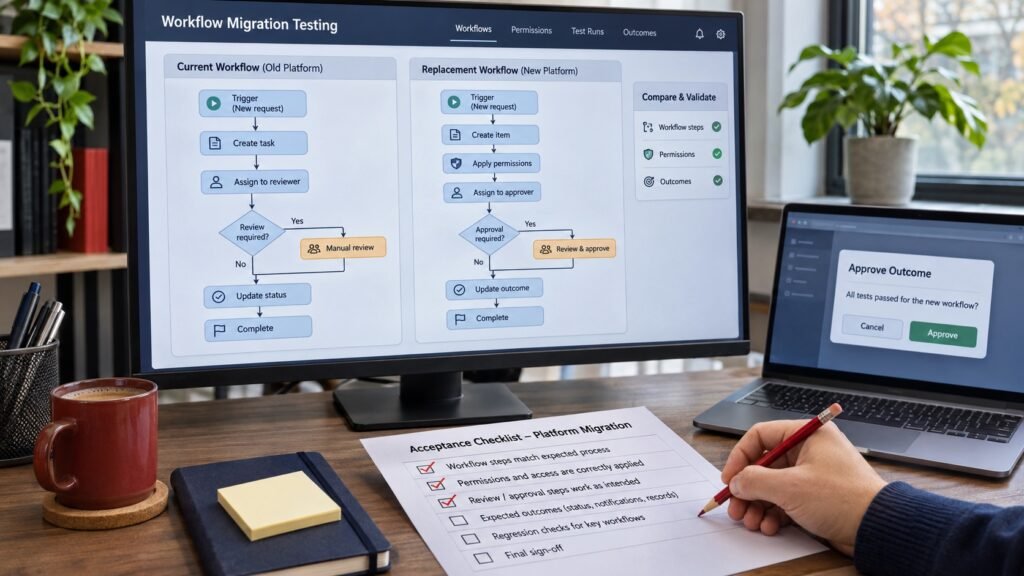
AI agent migration testing checks whether a replacement implementation meets approved business requirements. Compare user workflows, tool actions, permissions, saved state and failure recovery. Preserve acceptance criteria, record candidate results and disclose any comparison you cannot make because the original environment is unavailable.
For a SaaS founder, a successful deployment is the start of that review. A familiar chat screen can conceal a missing approval, an incorrect account update or an evaluation that no longer measures the intended rule. Independent AI testing services can help define and execute a practical scope. The matrix and worked example below are illustrative test designs, not completed Testers HUB migration results.
1. What is changing with OpenAI Agent Builder?
Status checked November 27, 2026: OpenAI lists November 30, 2026 as the shutdown date for Agent Builder, reusable prompt objects and the /v1/prompts endpoint, and the Evals dashboard, API and graders for evaluation workflows. Evals is already read-only. ChatKit remains available. Check the official deprecation notice for current status.
The documented paths include Agents SDK or eligible ChatGPT Workspace Agents, moving reusable prompt content into application code, and recreating evaluations in Promptfoo. These are separate dependencies: identify which your application actually uses. ChatKit availability alone does not establish that its connected backend will keep working.
This guide also applies to later framework, model and evaluation-platform changes. Test the complete application affected by the migration.
2. What does acceptable behavior mean after migration?
Use approved requirements, including intentional changes, as the reference. The old application may contain defects. Matching its exact wording, every tool call or a known failure is not automatically a passing result.
OpenAI’s Agent Builder migration guide cautions that export does not guarantee unchanged behavior. Review control flow, triggers, authentication, tools and permissions in the replacement runtime.
Separate deterministic rules, such as which account may be updated, from variable output quality, such as response completeness. Agree a human-review rubric and repeat count for variable cases. One good answer cannot establish consistency. Reuse your broader AI agent action-safety checks where relevant.
3. What evidence should you preserve before access ends?
Retain permitted copies of requirements, reviewed test cases, known defects, available historical results, prompt content and configuration. Record application build, model identifier, SDK version, tool schemas, data snapshot and evaluation rules. Keep secrets and private customer data out of shared evidence.
Map each critical requirement to a test and evidence source. Testers HUB’s requirements traceability case study reviewed 23 generated cases against 10 explicit criteria. That was a planning review, not executed migration testing. Its useful lesson is to separate approved requirements from plausible assumptions.
Ask product owners to approve intended differences and unresolved questions before testing. Preserve records through supported, authorized methods; do not assume an evaluation export or automatic conversion exists.
4. How should you compare the existing and migrated application?
Use controlled test accounts, repeatable fixtures and comparable starting states. Run in a sandbox, with approved integrations. Reset state between runs so an earlier action cannot distort the next result. Record configuration differences and distinguish a valid intentional change from a regression.
Proposed AI migration QA acceptance matrix: every row starts as Not Run. Product owners must approve the requirements and thresholds before execution.
| Migration area | Approved requirement | Verification | Evidence to retain |
|---|---|---|---|
| Customer workflow | The intended task reaches its permitted outcome. | Follow the journey through the resulting application record. | Inputs, initial state and final record. |
| Tools and integrations | The correct action targets the correct account. | Check arguments, authorization and actual effect. | Sanitized tool result and record identifier. |
| User approval | Restricted writes require valid approval. | Try missing, expired and changed-request approval. | Approval state and observed action. |
| Saved conversations | History follows agreed access and retention rules. | Reopen sessions and switch permitted roles. | Account, session and visible history. |
| Prompts and retrieval | Required rules and authorized sources support the answer. | Check moved prompt variables, citations and stale sources. | Prompt version, source version and answer. |
| Evaluation criteria | Approved checks remain represented. | Compare recreated graders with human-reviewed examples. | Criterion mapping and disagreements. |
| Failed actions | Recovery reflects actual state without unintended duplication. | Exercise failure before and after a sandbox write. | Error, retry and resulting state. |
| Fix verification | The reported issue is corrected within agreed scope. | Rerun on the corrected build; record related regression separately. | Build, defect reference and retest result. |
Also verify login, streaming, confirmation controls and recovery on agreed desktop and mobile browsers. Measure response timing and usage against product-defined budgets. Functional results and output evaluations complement one another.
5. Worked example: approval before a support-ticket update
Illustrative example — not executed: assume a support assistant may update a ticket only after an authorized user approves the exact proposed change. Approval expires after the product-defined interval. An uncertain retry must not create an unintended duplicate action.
- Before approval: request a ticket update. Check that a proposal appears and the underlying record remains unchanged.
- After valid approval: verify the intended ticket and fields, account boundary and resulting history. Compare the final message with the recorded outcome.
- After expiry or a changed request: require the fresh approval specified by these illustrative rules; the earlier approval must not authorize a different action.
- After an uncertain timeout: arrange an approved simulation where the update commits but its response is lost. Check state reconciliation and retry behavior against the duplicate-prevention rule.
A proposed defect report would identify the build, role, approval state, request, expected rule, observed record, impact and trace reference. Actual results remain blank until execution. Missing diagnostic access is a coverage limitation, not a pass.
6. How do you validate recreated evaluations?
Map prompts, test inputs, providers and scoring criteria into the replacement evaluation workflow. Confirm that missing fields, renamed variables and changed response formats have not silently removed a check.
OpenAI’s Promptfoo migration guidance describes manual recreation and warns that scores may differ between systems. Validate graders with human-reviewed acceptable, unacceptable and borderline examples before using them for release decisions.
Keep known failures and a held-out evaluation set. Review disagreements and critical failures separately from averages. Agree repeat counts and candidate acceptance criteria; a higher aggregate score cannot excuse an unauthorized action. Do not replay production writes while comparing outputs.
7. What if the original environment is unavailable?
Test the candidate against approved requirements and trustworthy historical evidence. Identify where a screenshot, recorded result or sanitized trace substitutes for a runnable baseline. State when neither is available.
Classify results as Pass, Fail, Blocked or Not Run. Keep a separate field for baseline availability: passing an approved requirement does not prove equivalence to an inaccessible application. Ask the product owner to resolve undocumented behavior.
The report should connect scope, configurations, actual results, defects, fix verification and remaining uncertainty. Record exclusions and accepted risks for the release owner. NIST’s AI Risk Management Framework provides voluntary risk-management guidance; this checklist does not establish certification or guarantee safe behavior.
8. When should you hire independent AI testers?
Consider external QA when the replacement changes multiple integrations, internal testers lack time, or the team needs a separate review of business-critical workflows. Developers implement the migration; QA supplies evidence about the agreed candidate behavior.
A useful proposal specifies workflows, roles, test access, browsers, run counts, evidence, exclusions, reporting and retesting terms. Cost depends on that scope and setup effort. Combine AI-specific checks with web application testing when login, billing or workspace behavior is affected.
Agree specialist security, load testing or evaluation infrastructure separately where capabilities support them. Functional QA should not be presented as migration engineering or an AI safety certification.
Questions buyers ask about AI migration testing
Can an application look correct while its actions are broken?
Yes. A plausible response does not prove that the intended record changed. Check the permitted tool action, resulting state and user-facing status together.
Must migrated answers match the old wording?
Only if exact wording is an approved requirement. Otherwise assess required facts, permitted actions, completeness and intentional changes using an agreed rubric.
Can manual testers perform AI migration QA?
They can validate accessible workflows, roles and outcomes. Backend assertions, controlled failures and evaluation configuration may require developer support and authorized diagnostic access.
Can testing continue after legacy access ends?
Yes, against approved requirements and available records. Disclose missing baseline evidence and avoid claiming direct before-and-after equivalence where it cannot be demonstrated.
What should an independent QA report contain?
Agreed scope, versions, execution results, reproducible defects, blocked or untested cases, corrected-build verification and unresolved risks for the release owner.