In the app market today, a single crash or glitch can cost you thousands of users. That’s why it’s not just helpful to choose the right mobile app testing company; it’s essential. But how do you know that the team you hire will get real results?
You should ask strategic questions that help you judge technical skills, processes, communication, and long-term reliability before signing any QA contract.
Let’s go over the most important questions you need to ask before hiring a mobile app QA partner and what to look for in their answers.
How to Find Reliable Mobile App Testing Providers
A reliable mobile app testing provider should explain exactly how they will test your app, which devices they will use, how bugs will be reported, and how quickly retesting can happen. Do not choose a vendor only because the price looks low. Choose the team that can reduce release risk and help your developers fix issues faster.
Before hiring, check whether the provider offers mobile app testing services across real devices, Android app testing services, iOS app testing services, usability checks, compatibility testing, and post-fix retesting. If you need flexible capacity, it may be better to hire mobile app testers for the release instead of building an internal QA team immediately.
For lead-quality decisions, ask for sample bug reports, device coverage, turnaround time, NDA readiness, pricing structure, and whether the team can support urgent release testing before App Store or Google Play submission.
Key Factors to Consider When Selecting a Mobile App Testing Vendor
Before you choose a mobile app testing vendor, look beyond the basic promise of finding bugs. A good QA partner should understand your product goals, target users, release timeline, and the devices your customers actually use. Otherwise, the testing may look complete on paper but still miss the issues that affect real users after launch.
Here are the most important factors to review before selecting a mobile app testing company for your next Android or iOS release.
Relevant Mobile App Testing Experience
Ask whether the vendor has tested apps similar to yours. For example, a fintech app, healthcare app, ecommerce app, gaming app, or SaaS mobile product may require different test scenarios, user flows, risk areas, and compliance awareness. Relevant experience helps the QA team find practical issues faster.
Real Android and iOS Device Coverage
Device coverage is one of the biggest reasons to hire an external QA vendor. The team should be able to test across real Android phones, iPhones, tablets, screen sizes, operating system versions, and network conditions. Emulator-only testing is useful during development, but it should not be the final quality check before release.
Manual and Automation Testing Capability
Manual testing is important for usability, onboarding, permissions, gestures, payment flows, and real-user behavior. However, automation can help with repeatable regression checks over time. Therefore, the right vendor should explain when manual testing is better, when automation makes sense, and how both can support your release plan.
Clear Bug Reporting and Evidence
A reliable mobile app testing vendor should provide bug reports that your developers can act on quickly. Each issue should include steps to reproduce, expected result, actual result, device details, screenshots or videos, severity, and retesting status. Clear reporting saves development time and reduces back-and-forth communication.
Communication and Turnaround Time
Mobile app releases often move quickly. Because of that, communication matters as much as technical skill. Check how often the QA team shares progress, how quickly they respond to questions, and whether they can support urgent testing before App Store or Google Play submission.
Pricing Transparency
The lowest quote is not always the safest choice. Instead, review what is included in the pricing: number of devices, test cycles, retesting, bug reports, test summary, and post-release support. A transparent testing scope helps you compare vendors fairly and avoid surprise costs later.
Data Security and NDA Readiness
If your app handles customer data, payments, health information, business workflows, or private beta access, the vendor should be comfortable signing an NDA and following secure access practices. This is especially important when you share builds, credentials, API endpoints, or staging environments.
Post-Launch Support
Testing should not always stop after the first release. Many issues appear after users start installing the app on different devices and networks. A strong QA partner can help with regression testing, hotfix validation, crash reproduction, and future release cycles.
In short, the best mobile app testing vendor is not just the team that runs test cases. It is the team that understands your release risk, documents issues clearly, and helps you make better launch decisions.
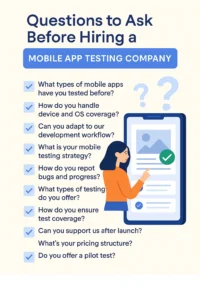
1. What kinds of mobile apps have you tried out before?
Not all QA teams have worked with every type of mobile app. Some of them make gaming apps, while others make eCommerce, fintech, or health apps.
Why this is important:
Testing different apps can be hard in different ways. For example, a health-tracking app needs to be tested for compliance, while a game needs to be tested for performance under load.
Things to look for:
Request examples, case studies, or client references that are relevant to your field. A good mobile app testing company will already know about the technical and user aspects of your app.
Want experts who’ve tested across domains?
2. How do you take care of coverage for devices and operating systems?
There are a lot of different parts to the Android and iOS ecosystems. A bug might only happen on a certain version of an operating system or a certain model of device. So, it’s important to find out how thoroughly they test for compatibility with devices.
Questions to ask next:
- Do you test on emulators or real devices?
- How big is your device lab?
- How do you deal with updates to the operating system?
What to look for:
A company that tests real devices with different screen sizes and operating systems will find a lot more problems than one that only uses emulators or simulators.
3. Can you get used to how we grow?
QA shouldn’t be a separate step; it should be a part of your CI/CD pipeline, sprint cycles, and releases. So, you need to know how their group fits into your work.
Ask them:
- Do you use Agile or Kanban?
- Can your testers come to our daily stand-ups?
- Do you know how to use ClickUp, Trello, or Jira?
What to look for:
A good QA company should be able to work with the tools and deadlines you set, not make you follow their own strict rules.
Need flexible QA support tailored to your process?
4. How do you plan to test your mobile devices?
A good mobile QA company should have a clear plan in mind even before the contract is signed. Ask them how they test apps from the start.
A good answer has:
- Testing for functionality and usability
- Testing on real devices with Android and iOS
- Testing different networks (4G, 5G, offline)
- Checks for compatibility, localisation, and regression
- When necessary, both manual and automated testing should be used.
Red flag:
If they say, “We’ll just explore the app and send you bugs,” that’s not a testing strategy; it’s just guessing.
5. How do you let people know about bugs and progress?
Talking to each other is the key to everything. The QA team needs to not only find bugs but also report them in a way that is clear and consistent.
Ask:
- How often do you send out test reports? Every day or every week?
- What do you use to keep track of problems?
- Do your reports have screenshots, videos, and step-by-step instructions for how to recreate the problem?
What to look for:
Bug reports should be clear, detailed, and put in order of how important they are. There should be proof, details about the device, and instructions on how to fix each problem. Without this, developers could spend hours trying to fix a bug.
6. What kinds of tests do you do?
Different apps need different kinds of testing. Check what else they can do besides functional testing:
- Testing for updates that go back
- Testing performance under load
- Testing the security of sensitive apps
- Testing for usability to improve UX
- Testing for compliance with the App Store
What to look for:
Even if you don’t need all of these types right now, working with a team that does means you can grow QA without having to switch providers.
7. How do you make sure that all tests are done?
You don’t want to miss anything when you test. Ask them how they make sure that nothing gets missed, especially when there are multiple user flows and devices
Questions to ask next:
- Do you make checklists or test cases?
- How do you put high-risk flows at the top of your list?
- Do you use tools to keep track of coverage?
What to look for:
A good QA company will use test case management tools like Zephyr, TestRail, or Xray and make it clear what is and isn’t covered.
Want to see a real-world test case set?
8. Can You Help Us After We Launch?
Great QA partnerships really shine when it comes to post-launch support. There needs to be more testing after new bugs, OS updates, and user feedback.
Ask:
- Do you let people retest after fixing bugs?
- How long does it take you to fix urgent bugs?
- Can you help with monthly regression rounds?
What to look for:
The team should stay with you and not leave after the first round of testing.
9. How do you set your prices?
Of course, money matters. But being open is just as important. Ask them how much they charge for their services.
Common ways to set prices:
- Fixed price for a defined scope
- Pricing by the hour with time logs
- A QA team that works full-time every month
What to look for:
Stay away from teams that are unclear or don’t answer questions. A good company should be able to tell you what’s included, what’s not, and how extra work will be charged.
10. Do you offer a test run?
It’s a good idea to do a short pilot test before making a long-term commitment. This lets you see how well the team communicates, reports bugs, and tests things.
Ask:
- Can we try it for a week?
- What is part of the pilot test?
- Will the same team stay on if we extend?
What to look for:
If a mobile app testing company is sure of itself, it will be happy to do a short test phase because they know you’ll want to stay after.
Final Thoughts: Pick QA That Works for Your App and Your Goals
A good mobile app testing company doesn’t just find bugs; they also make your product better, make it easier to use, and raise your app store ratings. If you ask the right questions early on, you can avoid making expensive mistakes and find a QA partner who can help your product grow.
The right QA team will give you an edge over your competitors, whether you’re making a new MVP or growing an existing app to millions of users.
Let’s Help You Test Smarter, Not Just Harder
At Testers HUB, we provide:
✅ QA for Android & iOS
✅ Testing on 30+ real devices
✅ Weekly test cycles and regression rounds
✅ Usability, performance, and security testing
✅ Detailed reports with screenshots, videos & priorities
Questions that are often asked
What is the difference between automated and manual mobile testing?
In manual testing, real people use the app, while in automated testing, scripts are used to mimic actions. For usability and exploratory checks, manual is best; for regression, automation is best.
Is it possible to hire mobile testers for just one round of testing?
Yes, a lot of companies, including ours, do one-time QA rounds. But if an app gets regular updates, a long-term QA partner makes sure the quality stays high.
How can I tell if a QA company is honest?
Look at their reviews, case studies, and example bug reports. Also, see how they talk to each other and deal with a pilot test.
How many devices should I try out?
It depends on who your users are. Most apps work well with 8 to 12 real devices that cover a range of major OS versions and screen sizes.
Do you test apps made with Flutter or React Native?
Yes! We know how to test hybrid and cross-platform apps, like those made with Flutter, React Native, and Ionic.