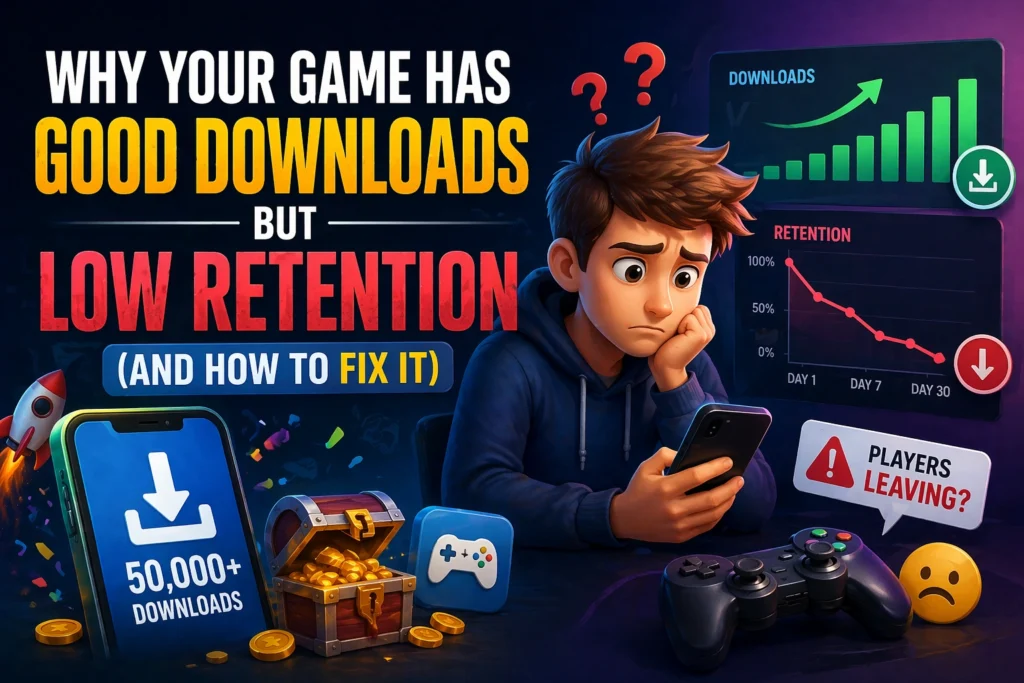
You launched your game. Downloads are coming in, the early numbers look promising, and your marketing seems to be working.
However, when you review the analytics after a few days, a serious problem appears:
Players are not returning.
This is one of the most common challenges in the gaming industry today. Many games attract installs, yet very few keep players engaged after the first session.
As a result, studios waste ad spend, lose momentum, and struggle to grow.
Because the truth is simple:
👉 Downloads come from marketing
👉 Retention comes from player experience
If players leave early, the real issue is usually inside the game.
Therefore, this guide explains the top reasons for low retention and how professional game testing services can help fix them before growth stalls.
What Does Low Game Retention Mean?
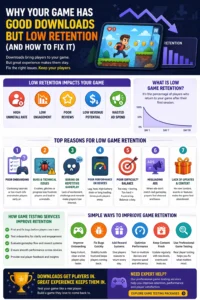
Retention measures how many players return after their first play session.
For example:
- 1,000 users install your game
- Only 200 return the next day
- Only 80 return after one week
That indicates weak retention.
Even if installs look good, poor retention often means:
- Low engagement
- Weak monetization potential
- Negative reviews
- High uninstall rates
- Expensive user acquisition waste
Therefore, retention is one of the most important health metrics for any mobile game.
Top Reasons Players Download but Don’t Return
Let’s look at the real causes behind player drop-off.
1. Weak First-Time User Experience
First impressions decide everything.
If players feel confused, bored, or overwhelmed during the first few minutes, they leave quickly.
Common onboarding mistakes include:
- Long tutorials
- Too many popups
- Unclear objectives
- Slow start to gameplay
Today’s players want to play immediately.
Therefore, many studios use mobile game testing services to evaluate the onboarding flow before launch.
2. Bugs and Stability Issues
Nothing damages retention faster than technical issues.
Examples include:
- Game crashes
- Progress not saving
- Frozen screens
- UI buttons not responding
- Reward systems failing
Even small bugs can create frustration.
As a result, many users uninstall the game without giving it a second chance.
That is why studios often hire game testers to simulate real-world behaviour before players experience these problems.
3. Repetitive or Unrewarding Gameplay
Sometimes the game works technically, yet players still leave.
Why?
Because the gameplay does not feel rewarding fast enough.
Common issues:
- Repetitive mechanics
- Slow progression
- No excitement loop
- Weak reward timing
Players usually stay when they feel:
- Progress
- Challenge
- Achievement
- Curiosity for what’s next
Therefore, good QA is not only bug testing—it also helps identify gameplay friction.
4. Poor Performance on Real Devices
Many games run smoothly on development devices. However, players use a wide range of phones.
That includes:
- Older Android devices
- Mid-range phones
- Devices with low battery
- Weak internet conditions
Problems often include:
- Lag
- Overheating
- Battery drain
- Slow loading times
A trusted mobile game testing company checks performance across multiple real devices before launch.
5. Difficulty Balance Problems
If your game is too easy, players lose interest.
If it is too hard, players quit.
Therefore, balance matters.
Testers can help identify:
- Sudden difficulty spikes
- Poor progression pacing
- Frustrating levels
- Reward imbalance
As a result, difficulty tuning becomes based on real feedback instead of guesswork.
6. Misleading Ads or Wrong Expectations
Sometimes marketing creates installs but hurts retention.
For example:
- Ads show gameplay that doesn’t exist
- Rewards seem exaggerated
- Core mechanics feel different than promised
When expectations and reality do not match, players leave quickly.
Therefore, acquisition quality matters just as much as quantity.
7. Lack of Fresh Content
Even strong games lose players if nothing changes.
Players often expect:
- New levels
- Events
- Challenges
- Seasonal rewards
- Regular improvements
Without updates, the game feels abandoned.
How Game Testing Services Improve Retention
Successful studios do not rely on guesswork. Instead, they use structured game testing services to identify friction early.
When you work with an experienced QA team, they can:
- Detect crashes and blockers
- Review onboarding experience
- Test gameplay flow
- Check reward systems
- Validate performance across devices
- Highlight player frustration points
As a result, you improve retention before losing thousands of users.
🎮 Need Better Retention?
When Should You Hire Game Testers?
Many developers wait too long.
However, the best time to hire game testers is:
- Before launch
- Before major updates
- When retention starts dropping
- Before scaling paid user acquisition
- When ratings begin falling
Early testing usually costs far less than fixing churn later.
Small Fixes That Can Improve Retention Fast
You do not always need a full rebuild. Sometimes small changes create major results.
Improve Onboarding
- Shorter tutorials
- Faster gameplay access
- Clear first objective
Fix Stability Issues
- Prioritize crashes
- Test updates carefully
- Monitor device-specific bugs
Increase Rewards
- Daily bonuses
- Unlockables
- Achievement systems
Improve Performance
- Faster load times
- Reduced lag
- Better battery optimization
Keep Content Fresh
- New events
- New levels
- Seasonal incentives
Why Hiring a Mobile Game Testing Company Is Worth It
Some studios see testing as an expense.
However, quality assurance often saves money by improving:
- Retention
- Ratings
- Revenue
- Ad ROI
- Player trust
A professional mobile game testing company helps ensure players enjoy the game on real devices under real conditions.
Quick Example
A casual game may generate 10,000 installs from ads.
If poor onboarding reduces day-1 retention from 35% to 15%, thousands of users disappear immediately.
However, fixing onboarding and crash issues can dramatically improve repeat sessions.
That is why retention optimization often creates higher ROI than buying more installs.
Let’s Be Honest
Downloads alone do not define success.
Retention does.
You can spend heavily on ads. However, if players leave after one session, growth becomes expensive and unsustainable.
Fixing retention is not about guessing.
It is about identifying real problems and solving them early.
Final Thoughts
If your game gets downloads but low retention, do not ignore the warning signs.
Focus on:
- Better first-session experience
- Stable gameplay
- Performance optimization
- Reward systems
- Continuous updates
- Real-world QA feedback
Because the difference between winning games and forgotten games is often simple:
👉 One keeps players
👉 One loses them
Frequently Asked Questions
What causes low game retention?
Common causes include poor onboarding, bugs, repetitive gameplay, performance issues, and lack of updates.
How can I improve retention in my mobile game?
Improve onboarding, fix bugs, optimize device performance, add rewards, and update content regularly.
Should I hire game testers?
Yes. Professional testers identify issues players face before retention drops further.
What does a mobile game testing company do?
They test gameplay, usability, performance, and compatibility across multiple real devices.
Are game testing services useful for indie studios?
Absolutely. They help smaller teams launch stronger games without building an internal QA department.
Improve Your Game Retention Today
If players are downloading your game but leaving early, the issue is usually fixable.
At Testers HUB, we help studios:
- Identify retention blockers
- Improve gameplay experience
- Optimize performance
- Test across real devices
👉 Need expert feedback before your next update? Contact us for a free consultation.