A sale can look ready while a discount disappears at payment, a selected size changes in the cart, or a mobile banner covers the checkout button. Before you book QA, the useful question is: which shopper journeys must work for this release, on which devices, and how much time is available to find and fix problems?
This guide helps store owners, agencies, and product teams define that scope before a campaign, product launch, or migration. For coverage and a scoped quote, explore Testers HUB’s eCommerce testing services.
When should you start planning QA?
Start planning when the release date, campaign rules, and proposed changes are known. Testing can begin once a usable build, representative products, test accounts, and approved payment test methods are available. Waiting until the day before a sale leaves little room for developers to correct defects and for testers to check the replacement build.
Work backwards from the launch date. Reserve separate windows for initial testing, developer fixes, agreed retesting and regression, and a final launch decision. Testing effort is the time spent executing and reporting checks; elapsed time also includes waiting for access, answers, fixes, and third-party systems.
- A focused promotion: prioritize the changed offer, eligible products, cart totals, payment methods, and order creation.
- A product or collection launch: include variants, stock states, campaign links, discovery, checkout, and fulfillment handoff.
- A migration or checkout redesign: allow broader coverage for accounts, catalog data, integrations, redirects, order states, and existing shopping journeys.
A vendor should confirm the testing window after reviewing these details. A promise based only on the number of store pages can miss the work hidden in payment methods, regions, and business rules.
A practical scope matrix for the launch
Assign priority by the effect on a shopper’s ability to buy and receive the correct order. Browser, device, and integration checks belong in the highest priority whenever a failure could block that journey.
| Priority | Coverage | What to verify |
|---|---|---|
| 1 — Purchase and order integrity | Guest/account checkout, payment, campaign pricing, coupons, shipping, tax, selected variants, inventory, and order handoff on priority devices and browsers. | The correct item and total reach checkout; successful, failed, cancelled, and pending payment states behave correctly; orders and fulfillment records match without duplication. |
| 2 — Discovery and supporting journeys | Search, filters, category navigation, product detail content, account features, and additional shopping combinations. | Shoppers can find and select the right products. Promote any launch-critical route or newly changed feature to Priority 1. |
| 3 — Additional coverage and polish | Lower-traffic device/browser combinations, cosmetic consistency, secondary content, and nonessential marketing features. | Record what can wait and the risk of deferring it. Order emails, accessibility barriers, and integrations move up when required to complete or fulfill a purchase. |
For example, mobile Safari checkout is Priority 1 if it is a major buying route. A campaign coupon is also Priority 1 when it is the offer customers were promised. A decorative alignment issue on a rarely visited information page may be lower priority.
Follow payment all the way through to the order
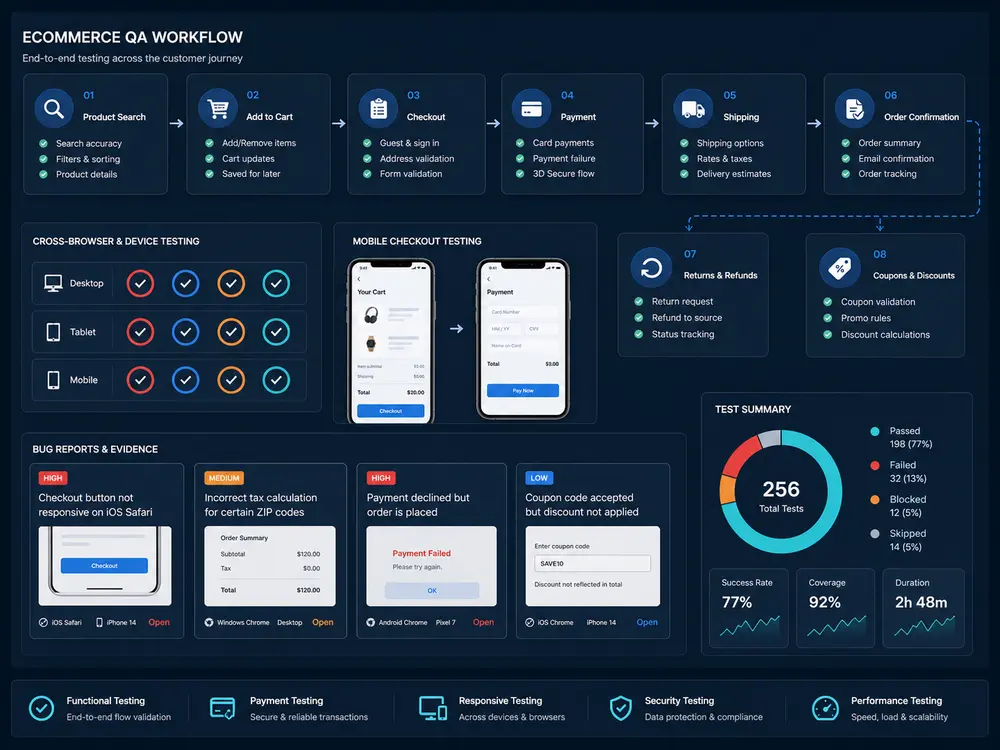
A successful payment screen is only one checkpoint. Verify the store’s order record, amount, currency, shipping method, inventory change, confirmation, and downstream handoff to the systems included in scope.
- Check eligible and ineligible products, coupon expiry, stacking rules, and shipping thresholds.
- Follow payment redirects, authentication, cancellation, failure, pending states, and retries.
- Check repeated clicks or page refreshes for duplicate charges or duplicate orders using approved test methods.
- Confirm the behavior for out-of-stock items and inventory changes during checkout.
- Review the confirmation email and fulfillment integration when they are part of the order journey.
Use staging and payment sandboxes where available. Any production checks, real transactions, cancellation steps, and test-data cleanup should be agreed with the store owner beforehand.
How many testing and retesting cycles should you plan?
Keep the initial coverage separate from checking fixes. One full end-to-end testing cycle means executing the agreed journeys for the approved build and device/browser matrix, then reporting findings. It does not mean unlimited checks across every product, device, or replacement build.
For fixed package planning: one full end-to-end testing cycle within the agreed scope. Retesting and regression testing are planned and charged separately. Retesting checks whether a reported defect has been fixed; regression checks whether related or previously working journeys still behave correctly after the change.
Reserve a window for that follow-up when launch-critical defects would need correction. The number of additional passes depends on the changes, build stability, and fixes delivered. If a theme, payment plugin, or shipping integration changes after the first pass, revisit the affected coverage before launch.
What can you reduce when time is limited?
Reduce breadth deliberately: choose representative products, prioritize payment methods and regions by actual use, and start with the devices and browsers that matter most to customers. Defer low-impact polish or unchanged secondary journeys only after recording the gap.
Keep the complete purchase path in view. Testing a payment button without checking discounts, shipping, order creation, or mobile access can leave the most consequential defects undiscovered. Wider compatibility work can be scoped through our website testing services.
Does campaign QA prove the store can handle peak traffic?
Functional QA checks whether shopping journeys work under the agreed conditions. It does not establish capacity during a traffic surge. If peak load is a concern, scope performance testing separately with expected concurrent users, browsing and checkout patterns, transaction volumes, environment access, and acceptable response times.
Confirm hosting and platform permissions before generating load, and account for third-party payment or shipping services that should not receive uncontrolled test traffic. A functional checkout pass should never be reported as proof of peak-sales capacity.
What affects eCommerce testing cost?
The estimate follows the combinations that need testing and the effort to investigate and report results. A large catalog with repeated templates may need less work than a smaller store with complex subscriptions, custom bundles, or international checkout rules.
- Store and workflow complexity: templates, variants, bundles, accounts, subscriptions, and changed features.
- Payments and markets: gateways, wallets, currencies, countries, tax rules, and shipping combinations.
- Environment coverage: real devices, browsers, operating systems, and responsive layouts.
- Integrations: inventory, fulfillment, CRM, email, analytics, and other agreed connections.
- Builds and cycles: initial testing, replacement builds, separately planned retesting, and regression.
- Readiness and deadline: available access, stable test data, documentation, and the tester capacity needed within the release window.
Review our maintained software testing pricing and engagement options for budget planning. Confirm what the estimate includes, what is excluded, and how additional builds or coverage are charged before work starts.
A relevant example: checking a fashion store before launch
Our published US fashion-store case study describes a selected size changing in the cart, promotional banners obstructing mobile Safari checkout, and coupons failing at the payment stage. These examples show why product data, campaign rules, and device usability should be tested together as one buying journey.
Read the eCommerce product-launch QA case study for the project’s testing scope and findings. Use those risks to inform your own checklist; the coverage still needs to follow your store’s architecture and release changes.
What to send a QA vendor for an estimate
- Store URL, platform, staging access, and the purpose of the release.
- Launch date, campaign start/end times, and planned code or configuration freeze.
- Changed features, priority products, variants, offers, and key customer journeys.
- Checkout types, payment methods, countries, currencies, shipping, and tax rules.
- Target devices/browsers and available traffic data to help prioritize them.
- Integrations, approved test accounts, sandbox access, and known issues.
- Expected builds, developer availability for fixes, and retesting/regression requirements.
The response should identify the agreed coverage, device/browser matrix, testing window, reporting format, exclusions, and treatment of extra work. At completion, ask for a summary of passed, failed, blocked, and untested checks alongside the defect reports so the release owner can make an informed decision.
Prepare the QA scope for your next sale
Preparing for a store launch, campaign, migration or major sale? Share your store URL, platform, checkout/payment methods, target devices and launch date. We’ll recommend the QA coverage and testing window.