
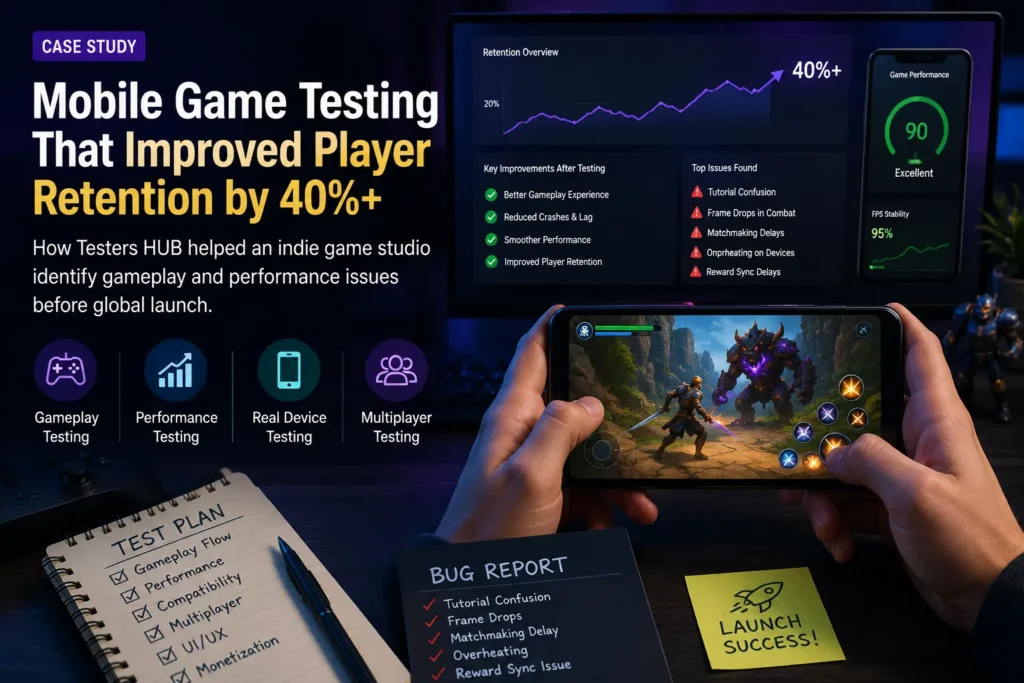
How Mobile Game Testing Helped an Indie Studio Improve Player Retention Before Launch
For many indie studios, getting downloads is hard. However, keeping players engaged is often an even bigger challenge.
Recently, an indie mobile game studio contacted Testers HUB after facing an unexpected issue during soft launch testing.
Initially, the game received a decent number of installs from beta users. However, player retention numbers started dropping quickly after the first gameplay session.
At first, the studio assumed it was a marketing issue. However, after reviewing gameplay recordings and player feedback, they realized users were leaving because of gameplay frustration and hidden performance problems.
Although the internal team had already tested the game multiple times, most testing was performed on high-end devices with stable WiFi connections. As a result, many real-world gameplay issues remained unnoticed.
That’s when the studio decided to use external mobile game testing services before scaling user acquisition campaigns.
Launching a Mobile Game Soon?
Find gameplay issues before your players uninstall the game.
Project Overview
The client was a small indie game studio preparing to launch a multiplayer action-based mobile game for Android and iOS platforms.
The game included:
- Real-time multiplayer gameplay
- Reward-based progression
- In-game purchases
- Push notifications
- Matchmaking system
- Daily rewards and achievements
The studio wanted to improve gameplay stability and identify user experience issues affecting retention before the global release.
Main Challenges Faced by the Studio
The client shared several major concerns during the soft launch phase.
These included:
- Low Day-1 and Day-3 retention
- Players quitting during tutorial stages
- Frame drops during combat
- Device overheating complaints
- Matchmaking delays
- UI overlap on smaller devices
- Lag under unstable network conditions
Most importantly, these issues were not consistently visible during internal testing. Therefore, the development team struggled to reproduce many of the reported problems.
Game Testing Scope Covered
To identify the root cause of these issues, our QA team performed comprehensive mobile game testing across real devices and gameplay environments.
The testing scope included:
- Gameplay testing
- Functional testing
- Multiplayer testing
- Real device testing
- Compatibility testing
- Performance testing
- UI/UX validation
- Regression testing
- Network condition testing
Additionally, we tested gameplay behavior under:
- low battery conditions
- unstable internet
- background app interruptions
- extended gameplay sessions
As a result, we were able to reproduce several issues that internal testing had missed.
Devices & Platforms Tested
The game was tested across multiple Android and iOS devices to simulate real player environments more accurately.
Android Devices Tested
- Samsung Galaxy S Series
- Samsung Galaxy A Series
- Google Pixel
- Redmi Note Series
- Realme Devices
- Motorola G Series
- OnePlus Devices
iOS Devices Tested
- iPhone 17 Pro
- iPhone 17
- iPhone 16
- iPhone 16 Plus
- iPhone 15 Pro Max
- iPhone 14 Pro Max
- iPhone 14
- iPhone 12 Mini
- iPhone 11
- iPhone XR
- iPad Devices
Additional Testing Conditions
Furthermore, we tested the game under:
- 4G and weak network conditions
- Low-memory devices
- Different graphics settings
- Extended gameplay sessions
- Mid-range performance environments
Because of this approach, the studio gained much better visibility into real-user gameplay experiences.
Need Real Device Game Testing?
We test games under real-world gameplay conditions.
Key Issues Identified During Testing
During testing, our game QA testers identified several hidden issues directly impacting player experience and retention.
1. Tutorial Confusion Causing Early Player Drop-Off
Many new users struggled during onboarding because tutorial instructions disappeared too quickly during active gameplay.
As a result, some players failed to understand the first reward mechanism and exited the game early.
This issue was significantly affecting Day-1 retention.
2. Frame Drops During Multiplayer Combat
During heavy combat sequences, FPS dropped noticeably on mid-range Android devices.
Moreover, the issue became more severe during longer sessions and directly impacted gameplay responsiveness.
Consequently, users experienced frustration during competitive matches.
3. Device Heating During Extended Sessions
Certain Android devices experienced overheating after 20–25 minutes of gameplay.
In addition, battery drain was unusually high under high graphics settings.
Because of this, some beta users stopped playing earlier than expected.
4. Matchmaking Delays Under Weak Networks
Under unstable network conditions, matchmaking requests occasionally froze without displaying proper status updates.
As a result, users believed the game had stopped responding.
This created frustration for multiplayer players and negatively affected gameplay flow.
5. Reward Sync Delay
Some players experienced delayed reward updates after completing matches.
Although rewards were eventually credited, users believed progression was broken.
Consequently, this created a poor gameplay perception and reduced trust in the reward system.
How Testers HUB Helped
Our QA team documented:
- reproduction steps
- gameplay recordings
- FPS observations
- network conditions
- affected devices
- severity levels
- usability feedback
Additionally, we provided gameplay-focused recommendations related to:
- onboarding flow
- UI visibility
- session stability
- reward communication
- graphics optimization
As a result, the development team was able to fix critical gameplay issues much faster before launch.
Looking to Improve Player Retention?
Identify gameplay frustrations and hidden performance problems early.
Final Outcome
After fixes and optimization, the studio observed several improvements.
These included:
- smoother gameplay performance
- improved tutorial completion
- better matchmaking stability
- reduced overheating complaints
- improved player engagement
- stronger retention metrics during later beta phases
Most importantly, the studio launched with far greater confidence and improved gameplay stability across devices.
Furthermore, early player feedback became significantly more positive after the improvements were implemented.
Why Real Mobile Game Testing Matters
Many game studios test games internally using:
- flagship phones
- stable networks
- experienced players
However, real users play games under very different conditions.
For example, issues like:
- frame drops
- overheating
- lag
- onboarding confusion
- reward delays
can significantly affect retention and app ratings.
Therefore, professional mobile game testing services play a critical role before launch.
Need Mobile Game Testing Support?
If your game is preparing for launch or facing retention issues, external QA testing can help identify hidden gameplay and performance problems before players do.
Testers HUB provides:
- Mobile Game Testing Services
- Indie Game Testing
- Multiplayer Game QA
- Gameplay Testing
- Real Device Testing
- Performance Testing
- Compatibility Testing
Frequently Asked Questions
Why is mobile game testing important before launch?
Mobile game testing helps identify gameplay issues, crashes, lag, device compatibility problems, and retention-impacting frustrations before users experience them.
Can game testing improve player retention?
Yes. Identifying onboarding confusion, performance issues, reward problems, and gameplay frustrations can significantly improve player engagement and retention.
Does Testers HUB test games on real devices?
Yes.
Testers HUB performs real-device game testing across multiple Android and iOS devices.
What types of games can benefit from QA testing?
Indie games, multiplayer games, casual games, RPGs, action games, and live-service games can all benefit from professional game testing services.
Do you test games under different network conditions?
Yes. Our QA team performs gameplay testing under multiple network and device conditions to simulate real player environments.