
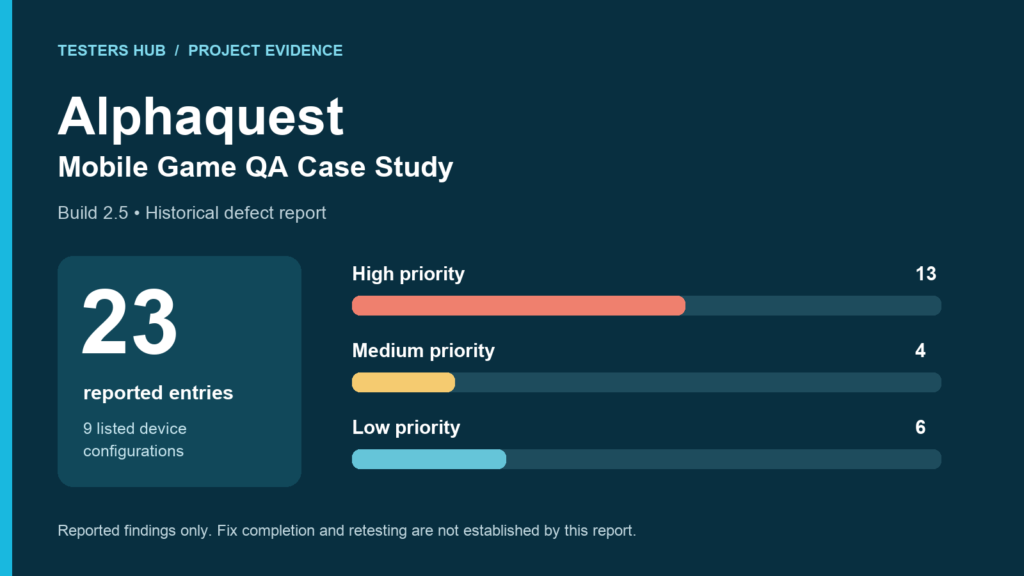
Testers HUB’s Alphaquest mobile game QA report records 23 defect entries for build 2.5, with 13 marked high priority. The findings cover player-facing problems in navigation, purchases, social connections, gameplay state and recovery from a lost connection.
This case study draws on the supplied “Defect report_Alpha Quest Game” workbook and its “Defect Report_ Build Ver 2.5” tab. It describes historical findings, not the current state of the game. The report does not include completed fix verification or retest results.
For studios evaluating mobile game testing services, the useful evidence is the connection between a player journey, a reproducible observation and a development follow-up—not a promise of a defect-free release.
1. What the Alphaquest report covers
The recorded scenarios include Single Player and Challenge modes, Help and tutorial screens, a coin shop, ad-related controls, Facebook connections, invitations and gameplay rewards. This gives buyers a concrete example of mobile game QA reaching beyond whether the main game screen loads.
Each entry has a defect ID, device details, category, severity field, description, reproduction steps, expected result, actual result, priority, visibility and attachment-reference field. The workbook contains 21 entries categorized as Functional and two as GUI. These are counts of reported entries, not a count of verified fixes or separate device-level failures.
2. Which platforms and build are documented?
The Alphaquest build 2.5 report lists Android phones, iPhones and tablets. This is historical project coverage; the original report retains the detailed device and OS records.
The repeated environment list is not a per-device execution log proving that every defect occurred on every configuration. Platform-specific findings should only be attributed to the applicable platform.
3. What issues were recorded?
The examples below retain the original defect IDs so they can be traced to the source report. “Buyer relevance” explains why a studio would investigate the issue; it is not a measured commercial outcome from Alphaquest.
| ID / area | Recorded observation | Buyer relevance |
|---|---|---|
| 008 · Navigation | No way to close the Single Player / Challenge popup and return to Home. | A player needs a clear route back before continuing. |
| 011 · Coin shop | The purchase flow displayed “The item you requested is not available for purchase”. | Check store configuration and the full purchase journey before relying on monetization. |
| 012 · Invitations | The description records invited Facebook friends missing from the friends list. | An invitation flow must reach a usable multiplayer state. |
| 017 · Network recovery | A white screen followed dismissal of a “No network connection” message during a Challenge sequence. | An error message needs a workable recovery path. |
| 019 · Scoring | The multiplier continued increasing after a level restart instead of resetting to 1. | Reset actions should restore the intended gameplay state. |
| 021 · Onboarding | The tutorial did not appear after the splash screen as expected in the report. | Validate the expected first-time-player path. |
Other entries record nonfunctional controls, Help-screen display issues, missing interstitial ads and reward-rule behavior requiring investigation. No revenue loss, player-retention change or store-rating improvement is established by these observations.
4. A closer look at the network-recovery finding
Defect 017 provides a useful example of a connected failure sequence. With a Challenge available, the tester turned off the connection and followed pause, flag, reload and play actions. After acknowledging the “No network connection” popup, the report records a white screen.
The important distinction is between displaying an error and recovering from it. A useful follow-up would check whether the player can return to a stable screen, retry safely and continue after connectivity returns. Those are proposed verification checks; the workbook does not show that they were completed on a corrected build.
For related planning scenarios, see our multiplayer mobile game QA guide. Functional recovery checks do not establish server-load capacity or multiplayer scale.
5. How the defect report supports development follow-up
The report’s priority breakdown is 13 high, four medium and six low. Severity is a separate field: 12 entries are marked Major, six Minor, four Normal and one has no severity value. Keeping those fields distinct avoids turning “high priority” into an unsupported claim that an issue was a release blocker.
Reproduction steps and expected-versus-actual results give developers a starting point for investigation. The sheet also references screenshots and recordings for several entries. Those references are part of the original reporting structure; this case study does not reproduce or independently authenticate the linked media.
A release triage should review the original priorities against agreed requirements and player impact. For example, a text issue and a purchase issue may share a priority label in a report without carrying the same risk for a particular release.
6. What the evidence does—and does not—confirm
The supported deliverable is a 23-entry defect register for the stated build, with documented environments and reproduction detail. It demonstrates the kinds of findings Testers HUB reported during the project.
Two entries need clarification before stronger claims are made: defect 006 describes a first-purchase crash but its actual-result cell repeats the expected behavior; defect 023 similarly repeats expected wording for a power-up issue. Defect 012’s actual-result sentence is incomplete, although its description states the invitation problem. We have not silently corrected the source or treated these entries as independently verified outcomes.
There is no fix-status, retest-build or pass/fail retest column in the supplied sheet. We therefore do not claim that all 23 entries were resolved, that a regression pass succeeded, or that the project produced a quantified launch improvement. This is a findings-based case study.
7. What a studio can apply to its next QA cycle
Alphaquest’s findings show why a mobile game testing scope should include the transitions around the core loop: opening and closing menus, restarting a level, reaching a purchase, connecting a social account and responding to network loss.
- Agree the expected behavior: document tutorial rules, reset behavior, rewards and supported account paths.
- Keep environment evidence precise: record the actual build, device and OS used for each failure.
- Make reports actionable: keep steps, observed behavior and attachments consistent with each other.
- Separate reporting from closure: verify a developer fix on the corrected build, then agree related regression checks.
If your release schedule needs recurring execution, explore how to hire game QA testers. A new quotation should specify coverage and capacity for your game; Alphaquest’s historical device list is not a package entitlement.
Recommended latest-device matrix for new projects
Planning recommendations, reviewed 22 October 2026. These current device options are separate from the Alphaquest test environments. Confirm availability, exact OS builds and the agreed scope before booking; this is not a statement that these devices were used on Alphaquest or are included in every package.
Use stable production software for release checks. Apple’s current platform release is iOS 27 / iPadOS 27; Android updates vary by manufacturer, region and carrier, so record the installed version rather than assuming every Android device runs the same release.
On smaller screens, swipe the matrix horizontally to see all columns.
| Coverage | Suggested device | OS selection | QA focus |
|---|---|---|---|
| Android flagship | Samsung Galaxy S26 Ultra | Latest stable Android / One UI release available for the selected regional model | Gameplay, purchases, interruptions and sustained sessions |
| Android midrange | Samsung Galaxy A57 5G | Latest stable manufacturer-supported release | Loading, memory pressure, network recovery and asset downloads |
| iPhones | iPhone 18 Pro and iPhone 18 Pro Max | iOS 27; confirm the latest stable patch at kickoff | Screen-size differences, safe areas, purchases and return to play |
| Android tablet | Samsung Galaxy Tab S11 | Latest stable Android / One UI release available for the selected model | Large-screen layouts, touch targets, rotation and resume behavior |
| iPad | 11-inch iPad Air (M4) | iPadOS 27; confirm the latest stable patch at kickoff | Tablet layouts, orientation changes and background recovery |
Add at least one device near your game’s minimum supported hardware and OS requirements, selected from player analytics or launch-market expectations. Include another Android manufacturer where your audience warrants it. Recent flagship results alone cannot establish compatibility across the supported range. Test beta OS releases separately from release sign-off.
8. Questions about the Alphaquest mobile game QA case study
How many defects does the Alphaquest report contain?
The supplied build 2.5 report contains 23 defect entries: 13 high, four medium and six low priority. These are reported findings, not 23 confirmed fixes.
Does the report cover Android and iOS?
Yes. The recorded environments include Android phones, iPhones and tablets. The repeated device list does not establish that every reported issue occurred on every device.
Were the fixes retested successfully?
The supplied report does not include completed retest evidence. Fix verification, regression completion and release outcomes are not claimed in this case study.
Can this device matrix be used for a new game release?
The recommended matrix above is a starting point for new projects, separate from Alphaquest’s historical environments. Final coverage should reflect supported devices, player analytics, minimum OS requirements and release risks.
Source note: summarized with Testers HUB’s authorization from “Defect report_Alpha Quest Game”, worksheet “Defect Report_ Build Ver 2.5”. The source file shows a last-modified date of 24 October 2022; this does not establish the exact test-execution dates. The summary was prepared on 22 October 2026. No client location, project duration or unrecorded outcome is inferred.
Need QA testing support for a similar release?
Tell us about your app, website, game, platform coverage, and launch timeline. Testers HUB will recommend a practical QA scope and quote.