
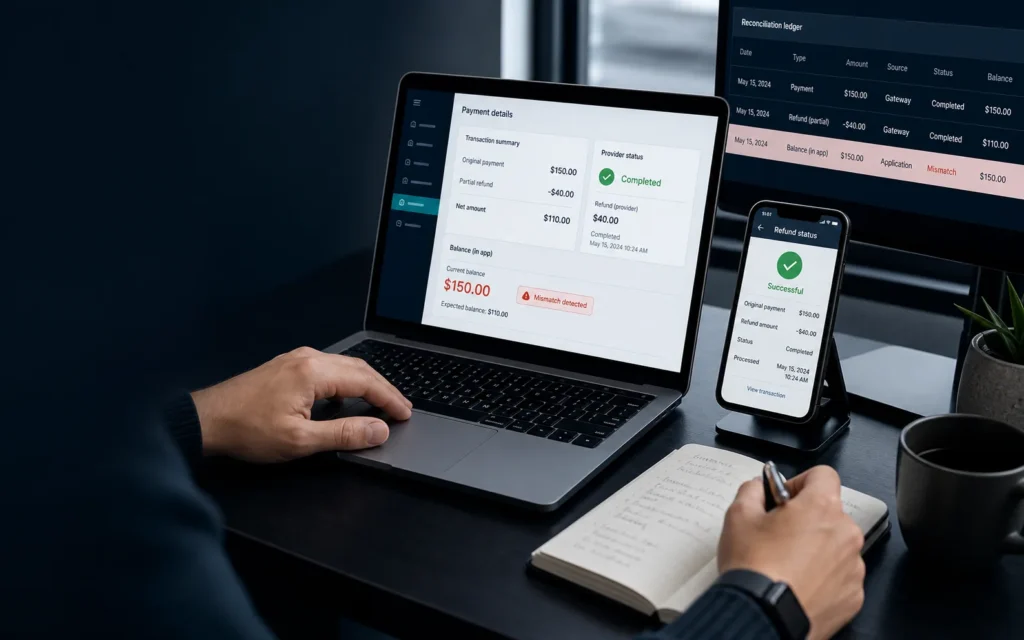
Testers HUB QA Lab / Controlled Reproduction: This is not a client engagement and does not claim a production defect or commercial result. We used illustrative sandbox-style amounts and redacted identifiers to demonstrate a realistic refund reconciliation QA method.
A payment interface can say that a refund succeeded while the product still shows the wrong financial state. The provider status may be correct, yet the internal ledger, customer balance, transaction history, admin portal, or notification can remain out of sync.
Quick answer: A successful refund status is not enough. Refund reconciliation testing must verify that every system representing the transaction reaches the same final amount and state.
This controlled QA Lab case study shows how Testers HUB traced a partial refund through a provider event, webhook, internal transaction, ledger adjustment, customer balance, history, and admin view. It supports our broader fintech testing services without creating a separate refund-testing offer.
Need to Validate Payment, Refund or Wallet Workflows?
Share your payment provider, transaction states, refund rules, platforms, and approved sandbox access. Testers HUB can recommend a focused FinTech QA scope covering payment, refund, balance, and reconciliation risks.
The Product Scenario
We modelled a customer-facing finance app connected to a payment provider and an internal transaction ledger. The starting balance was $275. A controlled payment of $150 reduced the balance to $125. Later, the test account requested a $40 partial refund.
The provider and customer transaction history both reported the refund as completed. However, the wallet still displayed $125 because the internal ledger had no matching +$40 adjustment. The expected balance was $165.
Why the Happy Path Looked Correct
The first payment path passed: the payment completed and appeared in transaction history. The refund request also appeared to pass because the provider returned a completed state and the visible history changed to “refunded.” A screen-level check could have stopped there.
Instead, our manual testing services method continued into the financial state behind the label. We compared the provider event with the internal ledger, customer balance, admin status, and persistence after refresh and sign-in.
What QA Checked Next
Refund identifier, amount, currency, and final provider state.
Event payload, timestamp, delivery, retry, and duplicate handling.
Refund transaction, balance adjustment, and reconciliation status.
History, wallet, admin view, notification, refresh, and new session.
The Reconciliation Failure
| System | Expected | Observed in the lab | QA result |
|---|---|---|---|
| Payment provider | $40 refunded | $40 refunded | Pass |
| Refund webhook/API | Completed event received | Completed event received | Pass |
| Internal ledger | +$40 adjustment | Adjustment missing | Fail |
| User balance | $165 | $125 | Fail |
| Transaction history | Partial refund completed | Partial refund completed | Pass |
| Admin portal | Refunded | Refunded | Pass |
The visible refund state was accurate in four places, but the missing ledger adjustment left the customer balance wrong. That mismatch made the overall scenario a release-blocking failure in the controlled reproduction.
How We Reproduced the Problem
- Create a controlled test account and record the starting balance.
- Complete a sandbox payment and capture the payment identifier.
- Verify the provider, internal transaction, customer history, and resulting balance.
- Initiate a partial refund and capture the refund identifier.
- Record the provider status, webhook delivery, and application API state.
- Compare the internal ledger, wallet balance, customer history, admin view, and notification.
- Refresh, sign out, and sign in again to check state persistence.
- Repeat with delayed delivery, a duplicate event, a full refund, and a second partial refund.
- After the correction, retest the original failure and adjacent payment and refund scenarios.
Refund Scenarios Added to the Coverage Matrix
| Scenario | Expected financial result | Additional evidence |
|---|---|---|
| Full refund | The original amount is fully reversed once. | Provider, event, ledger, balance, history, admin |
| Partial refund | Only the requested amount is returned. | Original and refunded amounts remain traceable |
| Second partial refund | The cumulative refunded amount is correct. | Both refund identifiers and cumulative total |
| Refund pending | The product remains pending until a final state arrives. | Timestamp and customer message |
| Refund failed | The balance remains unchanged and retry guidance is clear. | Failure reason and recovery path |
| Delayed webhook | The product eventually reconciles once delivery succeeds. | Provider completion and application update times |
| Duplicate webhook | The refund and ledger adjustment are applied once. | Event IDs and idempotency result |
| Refresh and new session | The same correct state persists. | Before and after screenshots or API responses |
Duplicate and Delayed Event Tests
Duplicate delivery
We delivered the same logical completed-refund event twice. The expected result was one $40 refund, one ledger adjustment, and one balance change. Duplicate-safe processing must not convert a $40 refund into $80.
Delayed delivery
We held the callback after the provider reached its completed state. The product was expected to remain pending, communicate that status clearly, and reconcile after the event arrived. We also varied delivery order because provider events must not be assumed to arrive in sequence.
Method reference: Stripe documents duplicate webhook delivery and non-guaranteed event ordering. Wise documents sandbox refund events and partial-refund testing. These references support the test design; they do not imply that either provider was used in a client project.
Refund Reconciliation Evidence Matrix
| Checkpoint | Illustrative value | Evidence status |
|---|---|---|
| Starting balance | $275 | Recorded before payment |
| Payment | -$150 | Provider and product matched |
| Balance after payment | $125 | Matched expected state |
| Partial refund | +$40 | Provider and history completed |
| Expected balance | $165 | Calculated from approved inputs |
| Actual balance | $125 | Mismatch |
| Difference | $40 | Unreconciled |
| Internal ledger | Adjustment missing | QA fail |
Evidence Collected Without Exposing Sensitive Data
A useful refund report records the controlled test account, redacted payment and refund identifiers, original and refunded amounts, starting and expected balances, provider and application states, timestamps, environment, browser or device, screenshots or video, permitted API responses, and retest status.
Identifiers and credentials should be redacted before evidence is shared beyond the approved project team. The report must also distinguish confirmed defects from blocked checks, observations, and provider sandbox limitations.
Retest and Release Decision
After the lab correction, the original partial-refund scenario was repeated first. Focused regression then covered full and partial refunds, payment history, wallet totals, admin state, duplicate delivery, delayed delivery, refresh, and new-session persistence.
The controlled release decision was based on system agreement, not a single green status. Provider, event, ledger, balance, history, admin, and notification states all had to represent the same approved refund outcome.
Related FinTech QA Resources
Review our FinTech payment workflow QA case study for broader payment-state and interrupted-session coverage. For reward ledgers and transaction-state rules, see cashback and rewards testing. Product teams can also review software testing pricing and engagement options.
Need to Validate Payment, Refund or Wallet Workflows?
Share your payment provider, transaction states, refund rules, platforms, and approved sandbox access. Testers HUB can recommend a focused FinTech QA scope covering payment, refund, balance, and reconciliation risks.
Refund Reconciliation QA FAQs
What is refund reconciliation testing?
Refund reconciliation testing compares the provider status, webhook or API event, internal transaction, ledger adjustment, customer balance, transaction history, admin status, and notification to confirm they represent the same financial outcome.
Why can a refund show completed while the customer balance is wrong?
The provider may complete the refund while a delayed, rejected, duplicated, or incorrectly mapped event prevents the product ledger or balance from updating. QA must trace every state instead of accepting one successful screen.
How do you test duplicate refund webhooks?
Deliver the same logical refund event more than once and verify idempotent processing. The refund total, ledger adjustment, wallet balance, and customer history must change once, not once per delivery.
Do you test full and partial refunds?
Yes. A focused scope can include full refunds, one or more partial refunds, pending and failed refunds, delayed events, duplicate events, refresh and sign-in persistence, notifications, and retesting after a fix.
Is this a client case study?
No. This page documents a Testers HUB QA Lab controlled reproduction using illustrative sandbox-style data. It demonstrates the testing method without claiming a client engagement, production defect, or business outcome.
Technical References
Need QA testing support for a similar release?
Tell us about your app, website, game, platform coverage, and launch timeline. Testers HUB will recommend a practical QA scope and quote.