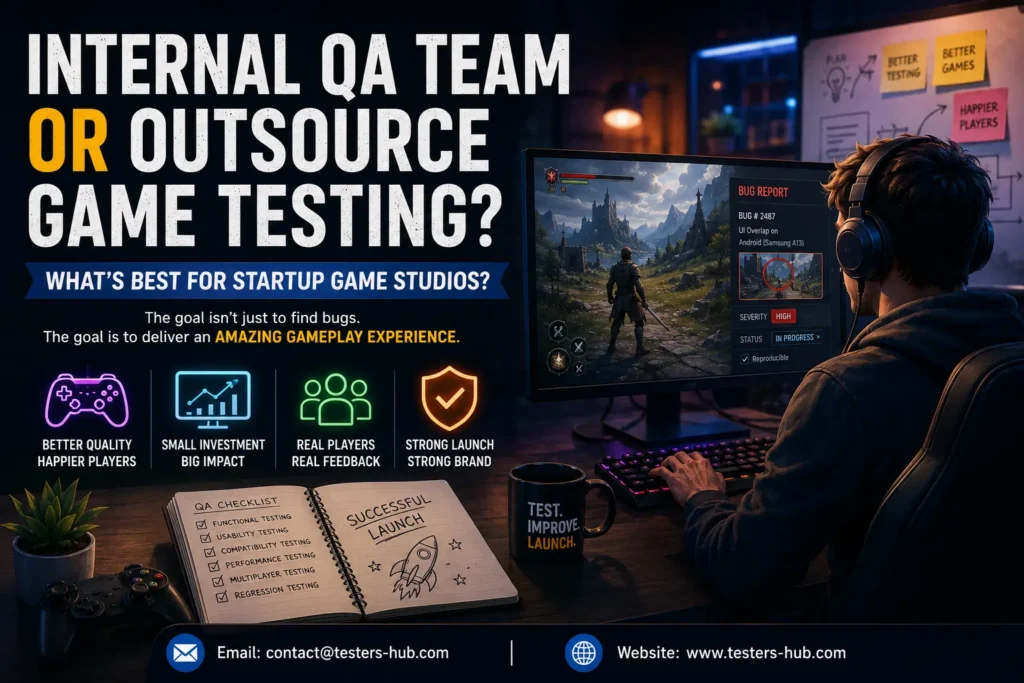
Every startup game studio eventually reaches the same decision point:
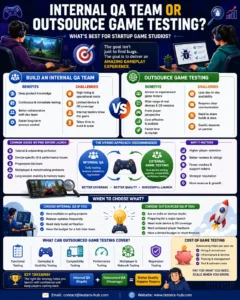
Should we build an internal QA team or outsource game QA testing?
At first, hiring in-house testers feels like the obvious answer.
After all, having dedicated QA resources sounds like the best way to improve game quality before launch.
However, after working with indie developers and startup studios preparing games for release, we’ve noticed something interesting:
Many teams don’t struggle because they lack testers.
They struggle because they invest in the wrong testing strategy too early.
A few months ago, a mobile game startup preparing for launch in the UK approached us for advice.
Their plan was straightforward.
They wanted to hire two full-time QA testers before launch.
The budget was approved.
The hiring process had already started.
Everything looked reasonable.
Then we reviewed their actual testing requirements.
That’s when the conversation changed.
Launching a Game Soon?
Identify gameplay issues, crashes, and compatibility problems before players do.
The Device Problem Nobody Calculates
The studio owned:
- 2 Android devices
- 1 iPhone
- 1 tablet
Internally, the game worked perfectly.
However, their target audience across the US and UK would be playing on:
- Samsung Galaxy A Series
- Google Pixel devices
- Xiaomi phones
- older iPhones
- tablets
- budget Android devices
This wasn’t a staffing problem.
It was a coverage problem.
When we began testing through our game testing services, several issues appeared immediately:
- UI overlap on smaller screens
- touch responsiveness delays
- performance drops on mid-range Android devices
- notification inconsistencies
The game wasn’t broken.
It simply wasn’t being tested where real players would actually play it.
This is one reason many startups choose to outsource game QA rather than relying solely on a small internal testing setup.
Internal Testers Stop Thinking Like Players
Here’s something most founders don’t realize.
The longer someone works on a game, the harder it becomes to behave like a new player.
Developers understand:
- objectives
- controls
- progression systems
- gameplay mechanics
Even internal QA teams eventually become familiar with the experience.
During one project, we observed something interesting.
The development team completed the tutorial in under four minutes.
External testers averaged nearly nine minutes.
Several players became stuck on the exact same objective.
Nobody internally had noticed.
Why?
Because everyone already knew what to do.
Real players didn’t.
This is why studios that hire game testers externally often discover onboarding issues, progression blockers, and usability problems much earlier.
Fresh testers bring fresh perspectives.
And that perspective often uncovers issues internal teams completely miss.
Multiplayer Testing Changed Everything
The studio’s internal testing process supported:
- 3 developers
- 2 testers
At most, they could simulate five concurrent players.
The game featured multiplayer matchmaking.
Internally, everything looked stable.
However, when broader game QA testing began, things changed quickly.
We started seeing:
- matchmaking delays
- lobby failures
- synchronization issues
- connection drops
None of these problems appeared during internal testing.
Simply because the testing environment was too small.
This happens frequently with:
- multiplayer games
- co-op games
- live-service titles
Testing scale matters.
And scale is often difficult for startups to achieve internally.
Looking to Outsource Game QA?
Get experienced testers, real-device coverage, and launch-focused support without building an internal QA department.
What Does Game Testing Actually Cost?
This is usually the next question founders ask.
“What is the cost of game testing compared to hiring internal QA staff?”
Many startups initially compare:
QA Salary vs Outsourced Testing Cost
However, the actual comparison is much larger.
Building an internal QA function often requires:
- salaries
- recruitment costs
- onboarding time
- management resources
- testing devices
- software subscriptions
The true cost extends far beyond payroll.
For many early-stage studios, flexible game testing packages provide a more practical solution.
Instead of hiring permanent staff before launch, startups can access experienced testers, broader device coverage, and structured QA workflows without long-term commitments.
This is one reason many founders researching the cost of game testing ultimately choose a hybrid or outsourced approach.
Need Flexible Testing Packages?
Compare our game testing packages and find the right QA support for your next release.
What We Commonly Find During Indie Game Testing
Across many indie game testing projects, similar patterns appear repeatedly.
Tutorial Confusion
Developers understand tutorials.
Players often don’t.
Device-Specific Bugs
Games working on flagship phones may struggle on older Android devices.
Performance Problems
Mid-range devices frequently reveal FPS drops and memory issues.
Progression Blockers
Players become stuck in places developers never expected.
Long Session Stability Issues
Problems often appear after 30–60 minutes of gameplay rather than during short internal sessions.
These are exactly the types of issues professional game QA testing helps uncover before launch.
When Internal QA Actually Makes Sense
Internal QA isn’t a bad investment.
In fact, it becomes essential when studios:
- maintain multiple games
- release updates weekly
- support live-service products
- operate large player communities
At that stage, continuous testing becomes part of daily operations.
An internal team can provide tremendous value.
Improve Reviews and Retention Before Launch
Professional game testing services help identify issues that affect player experience and ratings.
Why Many Startup Studios Choose External Game Testing First
Most startup studios need flexibility.
They need:
- device coverage
- multiplayer validation
- real player feedback
- launch readiness testing
- usability insights
without building an entire department.
This is where professional game testing services become extremely valuable.
Instead of committing to permanent hiring immediately, studios can:
- outsource game QA
- hire game testers on demand
- expand device coverage
- validate multiplayer performance
- improve launch readiness
before release.
For many startups, this provides better ROI than building a full QA team too early.
The Best Launches Usually Use Both
Interestingly, the strongest launches we see rarely rely on only one approach.
Instead:
Internal QA Handles
- feature verification
- daily testing
- developer collaboration
- regression testing
External Game Testers Handle
- real-device testing
- compatibility testing
- usability validation
- multiplayer testing
- fresh player feedback
This combination often delivers the best balance between quality, speed, and cost.
Final Thoughts
Most startup game studios don’t need a full-time QA department immediately.
What they need is confidence before launch.
That confidence comes from:
- broader device coverage
- real-player feedback
- multiplayer validation
- structured game QA testing
not simply increasing headcount.
The goal isn’t just to find bugs.
The goal is to launch a game players enjoy from day one.
And for many studios, partnering with experienced game testing services or choosing to outsource game QA provides the fastest path to achieving that goal.
Frequently Asked Questions
Is it cheaper to outsource game QA than hire internal testers?
For many startups, yes. Outsourcing eliminates hiring, training, management, and device infrastructure costs.
Should indie studios hire game testers before launch?
Yes. Many indie developers hire game testers before launch to identify usability, compatibility, and gameplay issues.
What is the cost of game testing?
The cost of game testing depends on device coverage, game complexity, multiplayer requirements, and testing scope.
Do game testing services help with mobile games?
Absolutely. Professional mobile game testing services help uncover performance, compatibility, and usability issues across Android and iOS devices.