Most MVP failures don’t happen because the idea was bad.
They happen because the product wasn’t stable enough for real users.
Inside the team, everything seems fine. The app works on the developer’s device. Core features respond correctly. Internal demos run smoothly. Therefore, launch day feels safe.
However, the moment real users start interacting with the product, unexpected behavior appears.
Buttons don’t respond.
Sessions expire.
Checkout fails.
Layouts break.
Confusion increases.
And suddenly, traction slows down.
The uncomfortable truth is this: many MVPs fail not because they were incomplete, but because they were under-tested.
The Illusion of “It Works on My Device”
In early-stage startups, testing is usually informal.
Developers test features as they build them. Founders explore the app before demos. Maybe a few friends try it as well.
Although that feels sufficient, it creates a false sense of security.
Internal testing tends to follow expected paths. Real users, however, do not behave predictably.
They:
- Use older devices
- Switch networks mid-session
- Enter invalid data
- Tap buttons repeatedly
- Navigate in non-linear ways
Because of this gap between expectation and reality, small defects surface immediately after launch.
Preparing your first public release?
Where MVPs Break Most Often
While every product differs, patterns appear repeatedly in early launches.
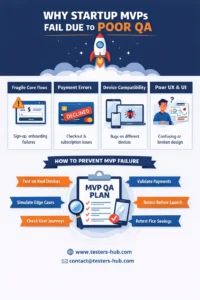
1. Fragile Core Flows
If sign-up, onboarding, or primary feature access fails even occasionally, users abandon quickly. Early-stage products cannot afford friction in first-use moments.
2. Monetization Gaps
Subscription logic, pricing display inconsistencies, or incomplete transaction handling can damage trust instantly. Even one failed payment attempt can discourage new users.
3. Environment-Specific Issues
An MVP may perform well in controlled conditions. However, once exposed to varied browsers, devices, and operating systems, hidden layout or behavior inconsistencies appear.
4. Usability Confusion
Technically working features can still create friction. For example, unclear error messages or hidden actions reduce user confidence.
5. No Final Stability Pass
Often, teams fix known issues but skip a final structured validation cycle. Consequently, new side effects go unnoticed.
Why Early QA Matters More for Startups
Established companies can survive early bugs because they already have brand trust.
Startups cannot.
In the US and UK markets, user expectations are especially high. Therefore, first impressions heavily influence retention, reviews, and referrals.
Additionally, early traction metrics influence funding conversations. Poor stability during launch weeks can distort growth signals.
In short, MVP stability is not just technical — it is strategic.
The Difference Between Over-Testing and Smart Testing
Many founders worry that testing will delay launch.
However, structured MVP validation does not require enterprise-level effort.
Instead, smart MVP testing focuses only on:
- Primary user journeys
- Cross-device behavior
- Monetization paths
- Error handling logic
- Critical edge cases
- A final regression check
This approach remains lean. Yet it dramatically reduces early risk.
In many cases, 100–120 focused hours before launch prevents weeks of post-release firefighting.
A Founder’s Pre-Launch Reality Check
Before releasing your MVP publicly, ask:
- Have we tested on more than one device type?
- Have we validated negative scenarios (failed login, declined payment, weak network)?
- Have we retested after final bug fixes?
- Have we reviewed the product from a first-time user perspective?
If any answer feels uncertain, the launch may be riskier than expected.
Final Perspective
An MVP does not need perfection.
However, it does need reliability where it matters most.
Speed without stability creates friction.
Stability without structure creates blind spots.
Balanced validation creates confidence.
If your MVP is approaching release, reducing preventable launch risk should be a priority — not an afterthought.
FAQ
1. Why do many startup MVPs struggle after launch?
Most early failures are linked to untested edge cases, device inconsistencies, or fragile core user flows.
2. How much QA is realistic for an MVP?
Focused validation of 100–120 hours is often enough to reduce high-impact launch risks.
3. Is internal testing enough for early-stage products?
Internal testing helps, but it often misses real-world behavior patterns and compatibility issues.
4. Does MVP testing delay product release?
When structured properly, MVP testing supports launch timelines instead of delaying them.
5. What is the biggest QA mistake startups make?
Skipping a final structured validation pass before public release.