
If you are preparing to launch your mobile app, SaaS platform, or web product, then your first impression truly matters. However, many early-stage startups skip structured testing due to budget or timeline pressure. As a result, small but critical bugs often slip into production. At Testers HUB, we provide affordable, focused QA for startup MVP launches across the United States and United Kingdom. Instead of offering enterprise-scale testing, we design lean, high-impact QA cycles that help founders validate core user flows before going live. Our startup MVP testing packages start from $1,500, making them ideal for seed-stage teams and indie founders who need clarity, speed, and reliability.
While enterprise companies require long regression cycles, startups need something different. Therefore, this service is specifically built for:
Early-stage founders preparing for first launch
SaaS platforms going from beta to public release
Mobile apps launching on iOS or Android
Marketplace and subscription-based MVPs
Product teams planning investor demos
Shopify or eCommerce MVP launches
At Testers HUB, our mobile app testing strategy focuses on real-world usage scenarios so that iOS and Android apps perform reliably in production.


Startup MVP testing is a focused quality assurance approach that prioritizes core functionality, real-device compatibility, and user journey stability before public release.
Unlike full enterprise QA, MVP testing emphasizes:
Core feature validation
Login and authentication flows
Payment or subscription testing (if applicable)
Cross-browser and cross-device compatibility
UX blockers and usability gaps
Critical edge cases
Quick regression before launch
Because MVP products are still evolving, testing must remain agile. Therefore, we focus on identifying high-impact issues that could affect user retention, ratings, or early traction.
Before launch, many startups assume that if the product works on one device, it will work everywhere. However, real-world users access apps across multiple devices, browsers, and environments. Therefore, our structured MVP QA process focuses on validating stability where it matters most.
First, we validate complete user flows including sign-up, login, onboarding, dashboard usage, key features, and session handling. This ensures your main functionality works smoothly from start to finish.
Next, we test your MVP on real Android and iOS devices as well as major browsers like Chrome, Safari, Firefox, and Edge. In addition, we check layout behavior across different screen sizes.
If monetization is involved, we test checkout, failed transactions, coupon logic, pricing accuracy, and subscription activation to prevent revenue-impacting issues.
We identify broken layouts, hidden buttons, scrolling problems, readability issues, and unclear error messages so users don’t face frustration after launch.
We simulate invalid inputs, interrupted sessions, and unusual user behavior to uncover hidden risks before real users do.
Finally, after fixes are deployed, we retest critical flows to confirm stability and ensure no new issues are introduced before going live.
Because early reviews matter significantly in the US and UK markets, catching small issues beforehand prevents long-term brand damage.

A US-based SaaS startup was preparing for a public beta launch. Although internal testing had been performed, users previously reported login timeouts and checkout inconsistencies.
We performed focused MVP testing covering authentication flows, session expiration behavior, and subscription activation across real Android and iOS devices. Additionally, we validated edge cases related to failed payment attempts.
We identified 18 critical and 32 medium-severity issues before launch. As a result, the startup reduced early support tickets by approximately 40% in the first month after release.
Because early retention directly impacts funding conversations, preventing those issues helped improve user confidence significantly.
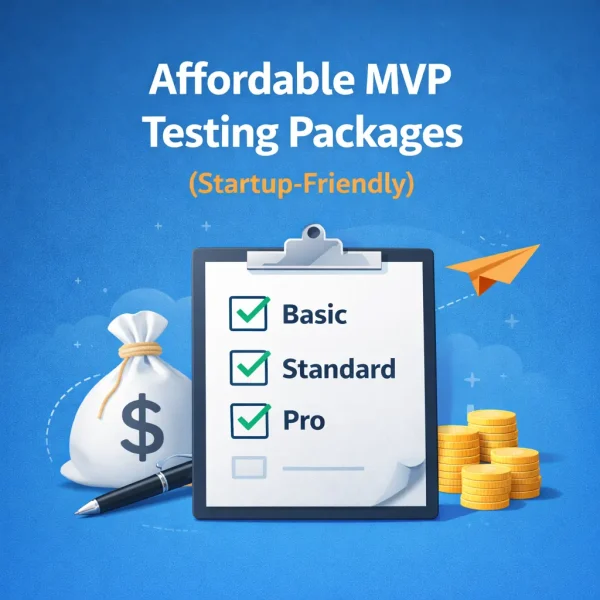
We understand that early-stage startups operate with limited capital. Therefore, instead of offering generic hourly billing, we provide structured packages.
Includes:
2 Dedicated QA Testers
100–120 hours of focused testing
Real-device testing coverage
Structured defect report (Google Sheet / Jira / Trello)
Severity classification
1 Retesting cycle
Summary report for founders
For more complex MVPs, custom plans are available based on feature count and device matrix.
Most US & UK startups invest between $1,500 – $2,000 for structured MVP validation before launch.
While there are many QA providers globally, startups often need clarity and flexibility. Therefore, founders choose Testers HUB because:
We are an independent software testing company
We provide real-device testing, not emulator-only checks
We offer fast turnaround aligned with launch timelines
We support remote collaboration with US & UK time overlap
We do not require long-term contracts
We focus on structured reporting, not vague summaries
Additionally, our communication style is founder-friendly. Instead of overwhelming you with unnecessary documentation, we prioritize actionable insights.
MVP testing is designed for early-stage startups preparing for launch. Instead of testing everything, we focus on validating what matters most before going live.
100–120 Hours of Testing
Lean and focused cycles designed to validate stability quickly.
Core User Flows Coverage
Sign-up, onboarding, dashboard, main features, and checkout (if applicable).
Pre-Launch Validation
Ideal for beta releases, investor demos, and initial public launch.
Budget-Conscious Strategy
Controlled scope that prevents over-testing while ensuring stability.
1–2 Week Execution Cycle
Fast turnaround to match startup speed and release timelines.
Targeted Regression Testing
Retesting only critical areas after fixes to maintain launch readiness.
👉 Best for: Startups, SaaS MVPs, mobile apps in beta, early-stage eCommerce platforms.
Enterprise testing is structured for mature products with large user bases and frequent updates. Therefore, it involves deeper coverage and long-term engagement.
240+ Hours of Testing
Continuous testing cycles covering multiple modules and integrations.
Full Regression Suite
Complete test cases across all features, integrations, and edge cases.
Ideal for Mature Products
Suitable for SaaS platforms, marketplaces, and high-traffic applications.
Long-Term Engagement Model
Dedicated QA teams aligned with development sprints.
Multi-Month Cycles
Ongoing releases, automation integration, and performance validation.
Advanced Testing Layers
API testing, integration testing, automation frameworks, and performance testing.
👉 Best for: Funded startups, scale-ups, enterprises, and products with active user bases.
Most startups invest between $1,500 and $2,000 depending on scope, feature complexity, and device coverage.
Typically, MVP QA cycles are completed within 1–2 weeks. However, timeline depends on product size and retesting needs.
Yes. We test on real Android and iOS devices to simulate real-world user environments.
Yes. Even minor UI bugs or payment failures can significantly impact user retention, early reviews, and investor perception.
Absolutely. We frequently support startups preparing for product launches, beta releases, and investor demos.
*We’ll review your details and respond within 24–48 hours.
Your information will only be used to provide a QA testing quote.
*We’ll review your details and respond within 24–48 hours.
Your information will only be used to provide a QA testing quote.
*We’ll review your details and respond within 24–48 hours .
Your information will only be used to provide a QA testing quote.
*We’ll review your details and respond within 24–48 hours.
Your information will only be used to provide a QA testing quote.
*We’ll review your details and respond within 24–48 hours .
Your information will only be used to provide a QA testing quote.
*We’ll review your details and respond within 24–48 hours.
Your information will only be used to provide a QA testing quote.



*T&C Applied
*Valid for limited period