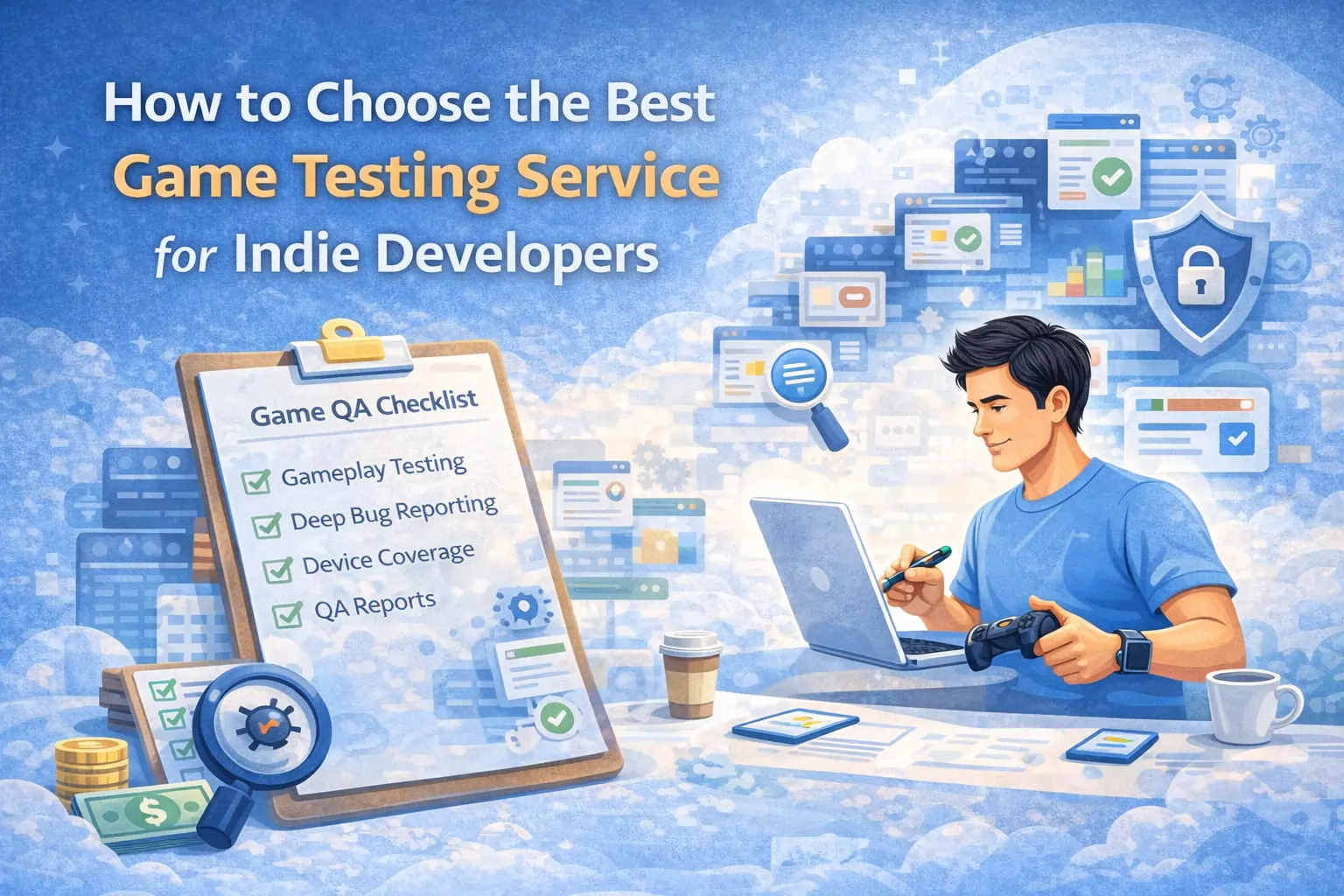
Selecting a trustworthy game QA outsourcing is one of the most decisive steps in delivering a stable and enjoyable gaming experience. Modern players expect smooth gameplay, fast loading, balanced mechanics, and error-free progression. Because development teams often juggle tight deadlines and limited device coverage, many studios rely on external QA partners to maintain consistent quality throughout production.
However, outsourcing QA is not a decision to take lightly. The partner you choose will directly influence your game’s performance, polish, and reputation. A reliable team strengthens your workflow, finds issues early, and complements your development process. A weak team, on the other hand, can miss critical bugs and slow you down.
To avoid costly mistakes, here’s how to identify a dependable game QA outsourcing service.
Work with Testers HUB to ensure your game is stable, polished, and launch-ready
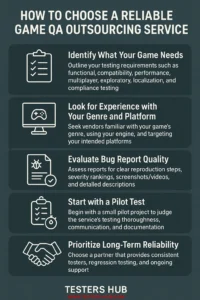
Identify What Your Game Actually Needs
Every game requires a different combination of testing techniques. Before speaking with vendors, outline what your title truly needs. A story-driven RPG, for example, relies heavily on progression and dialogue validation, while a multiplayer shooter demands latency, server, and sync testing.
Consider whether your game needs:
- Functional testing for mechanics, interactions, and logic
- Compatibility testing on varied devices and displays
- Performance testing for FPS stability and resource consumption
- Multiplayer validation for matchmaking, lag, and reconnection
- Creative exploratory testing to uncover unpredictable issues
- Localization checks for UI, dialogue, and cultural accuracy
- Store compliance testing for Steam, App Store, or Google Play
When you know your goals, evaluating a QA partner becomes far simpler.
Look for Experience With Your Platform and Genre
Game testing is not the same as testing regular mobile apps or SaaS platforms. Good QA partners understand genre-specific behavior, player expectations, and common problem areas. A team experienced in puzzle games may not be ideal for a physics-heavy action title.
When evaluating vendors, check whether they have experience with:
- Your engine (Unity, Unreal, Godot, custom engines)
- Your target platform (Android, iOS, PC, console, WebGL)
- Your gameplay style or genre
Studios that have previously tested similar games usually deliver deeper coverage and more accurate reports.
Verify Their Device & Hardware Coverage
Real-device testing is essential for accurate game QA. Emulators and simulators cannot replicate real-world performance, heating issues, refresh rates, GPU variations, controller behavior, or memory fluctuations.
A reliable QA partner should maintain:
- A broad selection of Android and iOS phones
- Older and newer OS versions
- Low-end, mid-tier, and flagship devices
- Tablets, foldables, and varying aspect ratios
- A range of PC hardware setups
The wider the coverage, the more confident you can be about your game’s final performance
Examine the Quality of Their Bug Reports
Finding bugs is only half the job—how they are documented matters just as much. Clear, structured reports speed up fix cycles and reduce frustration for your developers.
A strong QA team provides:
- Detailed steps to reproduce the issue
- Screenshots or screen recordings
- Expected vs. actual results
- Severity and priority levels
- Device/OS information
- Consistent formatting
If the sample reports are vague, incomplete, or unclear, treat it as a red flag.
Request a Small Pilot Before Committing
A short pilot round is the most reliable way to judge a QA vendor. It allows you to evaluate their depth, communication, logic understanding, and reporting quality before signing a longer contract.
During the pilot, observe:
- How quickly they understand your game
- Whether they catch meaningful bugs
- Their ability to explore creatively beyond basic flows
- Their communication speed
- The structure and clarity of their documentation
If the pilot proves valuable, you can move forward with greater confidence.
Evaluate Communication, Responsiveness, and Workflow
Great QA teams don’t just test well—they communicate clearly. Because bugs can block critical development tasks, you need a partner who responds promptly, raises questions early, and adapts to your workflow.
A reliable QA partner should:
- Provide timely updates
- Use communication channels you prefer (Slack, Discord, Skype, etc.)
- Clarify assumptions instead of guessing
- Share daily or weekly summaries
- Collaborate smoothly with developers
Good communication often matters more than the size of the team.
Consider Pricing, Flexibility, and Transparency
While cost is always important, the cheapest option often leads to inconsistent results. Focus instead on value—what you receive for the price you pay.
Look for a vendor that offers:
- Clear pricing with no hidden charges
- Flexible engagement models (hourly, weekly, monthly, per-build)
- Easy scalability depending on development stages
- Transparent deliverables and timelines
A trustworthy partner will explain their pricing structure openly and help you choose the best model for your needs
Prioritize Long-Term Reliability
Game QA doesn’t end after launch. New levels, patches, events, optimizations, and bug fixes require continuous retesting. Because of this, long-term reliability is one of the most important things to consider.
A dependable QA partner should:
- Maintain consistency in assigned testers
- Understand your game deeply over time
- Retest fixes quickly
- Provide backup testers when required
- Support you throughout updates and expansions
A long-term QA partner becomes an extension of your team, not just a vendor. Ready to Outsource Your Game QA? Let Testers HUB Help.
Final Thoughts
A reliable game QA outsourcing service brings structure, clarity, and stability to your development workflow. By examining their experience, device coverage, communication style, reporting quality, and long-term commitment, you can select a partner who strengthens your game rather than holding it back. Since player expectations continue to rise, investing in the right QA provider is essential for delivering a polished, enjoyable, and high-performing game.
FAQ – Choosing a Game QA Outsourcing Partner
1. How do I know if a QA vendor is trustworthy?
Look at their reporting samples, communication responsiveness, device list, and pilot test performance.
2. Should small indie studios outsource?
Yes. Outsourcing provides access to experienced testers and multiple devices without hiring a full internal team.
3. What is the difference between app QA and game QA?
Game QA requires deeper creativity, device coverage, and gameplay understanding. Apps follow predictable flows; games do not.
4. How long should a pilot test last?
A 10–20 hour pilot usually gives enough insight into the vendor’s skills and workflow.
5. Can external testers handle multiplayer or server-based games?
A good QA team can test latency, packet loss, synchronization, matchmaking, and reconnection behavior.