Game development is expensive, and every missed bug increases that risk. That is why more studios now invest in professional game testing services before launch. Whether you are building a mobile title, PC game, or live-service product, strong QA helps you catch gameplay issues, performance problems, and platform-specific bugs before players do.
Still, one big question remains: how much does game testing cost?
The answer depends on several factors. For example, video game QA pricing changes based on game complexity, supported platforms, testing scope, release frequency, and team size. Therefore, if you understand what drives cost, you can choose the right game QA services without overspending.
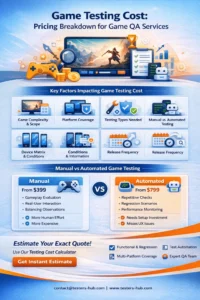
👉 Instead of relying on rough estimates, you can use our software testing cost calculator to estimate your QA budget faster.
Why Game Testing Services Matter Before Launch
A game may look polished in development; however, real issues often appear only when testers explore edge cases, longer play sessions, and multiple devices or builds.
That is why professional game testing services are essential. A skilled game testing company helps studios validate:
- core gameplay flows
- menus and UI interactions
- progression and rewards
- monetization flows
- performance and stability
- device and platform compatibility
- regression after fixes
As a result, developers reduce launch risk, protect player retention, and improve overall product quality.
What Affects Game Testing Cost?
The cost of game QA services is never fixed because each project has different requirements. Still, the factors below have the biggest impact on pricing.
1. Game Complexity and Feature Depth
First of all, game complexity directly affects testing effort.
A simple endless runner or puzzle game needs less validation than a multiplayer action game, RPG, or strategy title with complex systems. Likewise, games with in-app purchases, progression systems, live events, AI behavior, or social features require deeper testing.
Because of this, more mechanics usually mean:
- more test cases
- more edge cases
- more retesting cycles
- more QA hours
So, if your game includes advanced logic or layered gameplay systems, your game testing cost will naturally increase.
2. Platform Coverage
Next, supported platforms play a major role in video game QA pricing.
Your QA scope may include:
- Android
- iPhone and iPad
- PC
- console
- tablets
- foldables
For example, mobile game testing cost often rises when broader Android device coverage is required. On the other hand, testing a PC-only title may focus more on hardware configurations, resolution variations, and performance.
Therefore, the more platforms you support, the higher the overall game QA cost.
3. Type of Game QA Services Required
Different projects need different testing depth. Some studios only need core functionality validation, while others require broader game QA services across several areas.
Common testing types include:
- Functional testing to verify gameplay features
- Compatibility testing across devices and platforms
- Performance testing for FPS, memory, and load times
- Regression testing after fixes and updates
- Localization testing for translated builds
- Security testing for hacks, exploits, and abuse cases
As the testing scope expands, pricing increases too. Therefore, choosing the right mix of services is important for budget control.
4. Manual vs Automated Testing
Another major factor is the testing approach.
Manual game testing is best for:
- gameplay feel
- real-user interaction
- balancing observations
- UI/UX issues
- progression validation
Automated testing is better for:
- repetitive checks
- regression scenarios
- stable repeated workflows
- performance monitoring
However, automation requires setup, scripting, and maintenance. Because of that, most studios use a hybrid model. This gives better quality without relying only on one method.
5. Device Matrix and Real-World Conditions
If you are budgeting for mobile game testing services, device coverage matters a lot.
Many studios want testing across:
- flagship Android devices
- mid-range Android phones
- older iPhones
- multiple OS versions
- different network conditions
Real-device testing costs more than simulator-only checks; however, it also finds real-world issues that impact players directly. So, broader device coverage generally means higher but more reliable QA investment.
6. Release Frequency
Release cadence also affects pricing.
For example:
- one-time pre-launch QA = lower short-term cost
- weekly updates = repeated regression effort
- live-service games = continuous QA support
Because of this, ongoing games often benefit more from a monthly QA model than repeated one-off testing cycles.
7. QA Team Size and Experience
The number of testers assigned to the project changes both speed and cost.
- 1 tester may fit an early indie build
- 2–3 testers give broader gameplay coverage
- 3–5 testers suit larger or deadline-driven releases
In addition, experienced testers often cost more; however, they usually identify high-impact issues faster. As a result, they can reduce delays and expensive post-launch fixes.
8. Reporting and Documentation
Finally, reporting depth influences pricing.
Basic QA may include short bug logs. In contrast, advanced QA may include:
- detailed defect reports
- screenshots and video evidence
- test cases
- build-wise summaries
- retest status reports
Although deeper documentation costs more, it also improves communication between QA and development teams.
Common Pricing Models Used by a Game Testing Company
A professional game testing company may offer different pricing models depending on your project type.
Hourly Model
Best for flexible or short-term needs.
- useful for exploratory QA
- suitable for evolving scope
- common for small test rounds
Fixed-Price Model
Best for clearly defined testing scope.
- predictable budget
- useful for milestone or pre-launch validation
- common for indie studios
Monthly QA Retainer
Best for frequent releases and live updates.
- continuous support
- repeated regression coverage
- better value for ongoing projects
Per Build / Per Cycle Pricing
Best for milestone-based game production.
- easier release planning
- useful for repeated test rounds
Manual vs Automated Game Testing: Which Saves More Money?
Studios often ask whether automation can fully reduce game testing cost. The answer is not always.
Manual Testing
Manual testing is essential for gameplay quality. It helps uncover issues tied to:
- controls
- timing
- balance
- UI clarity
- player flow
This makes it especially important for game QA services focused on actual player experience.
Automated Testing
Automation helps reduce repetitive effort in:
- regression validation
- repeated flows
- stable checks
- performance monitoring
Therefore, the most cost-effective approach for many studios is a balance of manual and automation testing rather than choosing one alone.
Our Game Testing Packages
To simplify planning, we offer structured game testing services for different studio needs.
Starter — Starting from $399
Best for: indie games, early builds, basic gameplay validation
Includes:
- 1 game build
- 1 test cycle
- core gameplay and functionality testing
- selected device or platform coverage
- basic usability feedback
- detailed defect report
Standard — Starting from $799
Best for: mobile game testing, pre-release validation, growing indie studios
Includes:
- 1 game build
- 2 test cycles
- gameplay and UI validation
- compatibility testing
- regression testing after fixes
- detailed defect report
- final QA summary
Advance — Starting from $1199
Best for: feature-rich games, multi-flow validation, complex mechanics
Includes:
- 1 game build
- 3 test cycles
- end-to-end gameplay testing
- business logic and edge-case validation
- compatibility and regression testing
- detailed test cases
- comprehensive defect report
- final summary report
Monthly — Starting from $1499
Best for: live-service games, funded studios, frequent release teams
Includes:
- ongoing game QA support
- dedicated monthly testing hours
- repeated regression testing
- compatibility coverage
- defect reporting and retest cycles
- daily or weekly QA updates
How to Reduce Game Testing Cost Without Hurting Quality
If you want to control budget more effectively, these steps help:
- start testing earlier in development
- prioritize core gameplay loops first
- focus on top-priority devices and platforms
- use manual testing for new areas and automation for repetitive checks
- choose a game testing company with relevant genre experience
As a result, you reduce waste while still protecting launch quality.
Is Investing in Game QA Services Worth It?
Yes — and usually far more than teams expect.
Poor QA often leads to:
- launch-day bugs
- negative player reviews
- urgent patches
- lower retention
- damaged reputation
On the other hand, professional game QA services help you release with more confidence, better stability, and fewer expensive surprises.
That is why investing in game testing services is usually cheaper than fixing reputation and retention problems after launch.
Final Thoughts on Game Testing Cost
In 2026, game testing cost depends on complexity, platforms, release cadence, testing scope, and reporting depth. Therefore, there is no one-size-fits-all price for every title.
The better approach is to budget based on real production needs and actual player risk.
At Testers HUB, we provide flexible game testing services for indie studios, mobile game teams, and scaling game companies that need dependable QA support.
👉 Want to estimate your video game QA pricing more clearly?
Use our software testing cost calculator or contact us for a custom quote.
📩 contact@testers-hub.com
🌐 www.testers-hub.com
FAQ: Game Testing Services Cost
1. How much do game testing services cost in 2026?
It depends on your game type, platform coverage, number of cycles, and QA depth. Small indie games cost less, while feature-rich or multi-platform games require larger budgets.
2. Does mobile game testing cost less than PC or console QA?
Not always. While some mobile projects are smaller, wide Android device coverage can increase mobile game testing cost significantly.
3. Is a game testing company better than building an internal QA team?
For many studios, yes. Outsourcing reduces hiring, tooling, and infrastructure overhead while still providing professional QA expertise.
4. What is included in game QA services?
Most game QA services include gameplay testing, bug reporting, compatibility checks, regression testing, and performance validation.
5. Can small studios afford professional game testing services?
Yes. Many smaller teams begin with a focused package for core gameplay and then scale QA coverage as development grows.
6. How can I estimate my game testing budget quickly?
You can use our testing cost calculator to get a faster estimate based on your project scope and requirements.