Game testing costs often vary far more than studios initially expect. While two games may appear similar on the surface, the actual testing effort required can differ significantly. As a result, QA pricing is rarely fixed and instead depends on multiple practical factors.
Rather than asking “How much does game testing cost?”, it is far more useful to ask:
What factors actually influence the cost of game testing services?
In this guide, we break down those factors step by step so studios can plan QA budgets realistically, avoid unnecessary spending, and still release stable, player-ready games.
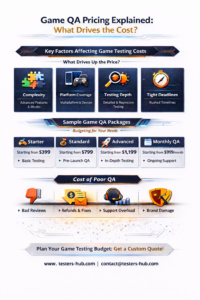
Game QA pricing depends on game complexity, platform coverage, testing depth, timelines, and engagement model.
What Game Testing and QA Really Involve
Game testing is not limited to finding visible bugs. Instead, it focuses on how a game behaves when real players interact with it across different scenarios. In other words, QA validates both technical stability and player experience before launch.
Typically, QA activities include:
- Verifying gameplay mechanics and controls
- Validating UI behaviour and navigation
- Checking scoring, progression, and reward logic
- Identifying crashes, freezes, and performance drops
- Ensuring compatibility across devices and OS versions
Because of this, broader coverage directly increases testing effort and, consequently, cost.
Key Factors That Impact the Cost of Game Testing Services
1. Game Scope and Complexity
First and foremost, the size and complexity of a game play a major role in QA pricing. For example, a simple arcade-style game requires far less testing than a feature-rich title.
Costs usually increase when a game includes:
- Multiple gameplay modes or levels
- Non-linear progression systems
- In-game economies or monetization logic
- Multiplayer or backend-driven features
Therefore, as complexity grows, testing must become deeper and more structured.
2. Platforms and Device Coverage
In addition to complexity, platform coverage significantly affects cost. For instance, testing on a single platform is far less demanding than supporting multiple environments.
QA effort increases when testing includes:
- Android and iOS builds
- Multiple OS versions
- Low-end and high-end devices
- Different screen sizes and hardware profiles
Although real-device testing adds cost, it also dramatically reduces post-launch risk.
3. Depth of Testing Required
Not all testing efforts are equal. Depending on the release stage, the depth of QA can vary widely.
Common examples include:
- Smoke or exploratory testing → lower effort
- Full gameplay flow validation → moderate effort
- Edge-case, negative scenario, and regression testing → higher effort
As a result, games closer to launch generally require broader and more expensive QA coverage.
4. Number of Test Cycles
Another major cost driver is the number of test cycles involved. Typically, QA includes:
- Initial testing
- Retesting of fixed issues
- Regression testing after updates
Although skipping retesting may seem cost-effective at first, it often leads to unstable releases later.
5. Timeline and Release Pressure
When timelines are tight, QA costs usually rise. This happens because teams must:
- Test in parallel across devices
- Deliver faster turnaround times
- Allocate more resources within shorter windows
Therefore, involving QA early helps avoid last-minute cost spikes.
6. Engagement Model (Short-Term vs Ongoing)
Finally, the chosen engagement model influences pricing. On one hand, short-term testing works well for early builds or soft launches. On the other hand, live games benefit far more from continuous QA support.
In many cases, ongoing QA provides better long-term value by reducing repeated release risks.
Sample Game Testing Packages (Cost Reference)
To make these factors more concrete, the following examples show how testing scope typically translates into pricing.
Starter Package
Starting from $399
Best for: Early playable builds and soft launches
Includes:
- One game build (up to 10 screens)
- One test cycle
- Testing on four real mobile devices
- Gameplay and feature validation
- Compatibility checks
- Detailed defect report
Standard Package
Starting from $799
Best for: Pre-launch validation
Includes:
- Expanded coverage (up to 15 screens)
- Two test cycles (testing + retesting)
- Testing on six real devices
- Gameplay flow and progression validation
- OS and device compatibility testing
Advanced Package
Starting from $1199
Best for: Feature-rich or monetized games
Includes:
- End-to-end gameplay coverage (up to 20 screens)
- Three structured test cycles
- Testing on eight real devices
- Edge-case and negative scenario testing
- Regression testing before release
- Test cases and comprehensive reporting
Monthly QA Support
Starting from $999
Best for: Live games and frequent updates
Includes:
- 40 hours/week QA availability
- Continuous testing across updates
- Regression testing for every release
- Multi-device and multi-platform coverage
- Daily and weekly QA status reports
Why QA Cost Is Really About Risk Control
Ultimately, the real cost of QA is not the upfront investment. Rather, it is the cost of releasing an unstable game.
Poor testing often results in:
- Negative reviews and ratings
- Refund requests
- Emergency patches
- Increased customer support load
- Long-term brand damage
Therefore, well-planned QA acts as insurance against these risks.
Frequently Asked Questions (FAQ)
Why do game testing costs vary so much between projects?
Because scope, platforms, timelines, and testing depth differ significantly from one game to another.
Is lower-cost QA always risky?
Not necessarily. However, very low pricing often means reduced coverage or skipped regression.
When should studios choose ongoing QA instead of one-time testing?
Typically, live games or titles with frequent updates benefit most from continuous QA.
What is the most common QA budgeting mistake?
Underestimating regression testing and device coverage near launch.
Final Takeaway
Game testing costs are driven by scope, platforms, testing depth, timelines, and engagement model. When studios understand these factors, they can plan QA more effectively and avoid last-minute surprises.
Instead of cutting QA budgets blindly, aligning testing effort with release risk leads to smoother launches and better player trust.