A mobile game can look completely stable during development and still frustrate real players after launch.
Recently, a small game studio released a multiplayer mobile game after weeks of internal QA and emulator-based testing. Internally, everything appeared stable:
- smooth controls
- acceptable loading times
- stable FPS
- no major crashes
However, after launch, player complaints started appearing almost immediately.
Some users reported overheating after long gameplay sessions, while others experienced lag on Android devices. In addition, several players mentioned delayed controls during combat.
The surprising part was that none of these issues appeared during internal testing.
This happened because most testing was performed on emulators and a limited number of flagship devices. As a result, the studio missed several real-world gameplay conditions before launch.
Catch Real Gameplay Problems Before Players Do
Overheating, FPS drops, touch delays, and Android compatibility issues often appear only on real devices. Our mobile game testing services help studios identify gameplay-impacting bugs before launch.
Emulator Testing Is Helpful — But Limited
Emulators are extremely useful during development because they allow teams to test builds quickly and debug features faster. Additionally, they help developers simulate multiple screen sizes without maintaining a huge device inventory.
However, emulator testing still has important limitations.
Real players use devices under unpredictable conditions. For example, they may play on:
- low-battery phones
- unstable internet connections
- overheated devices
- older Android phones with limited RAM
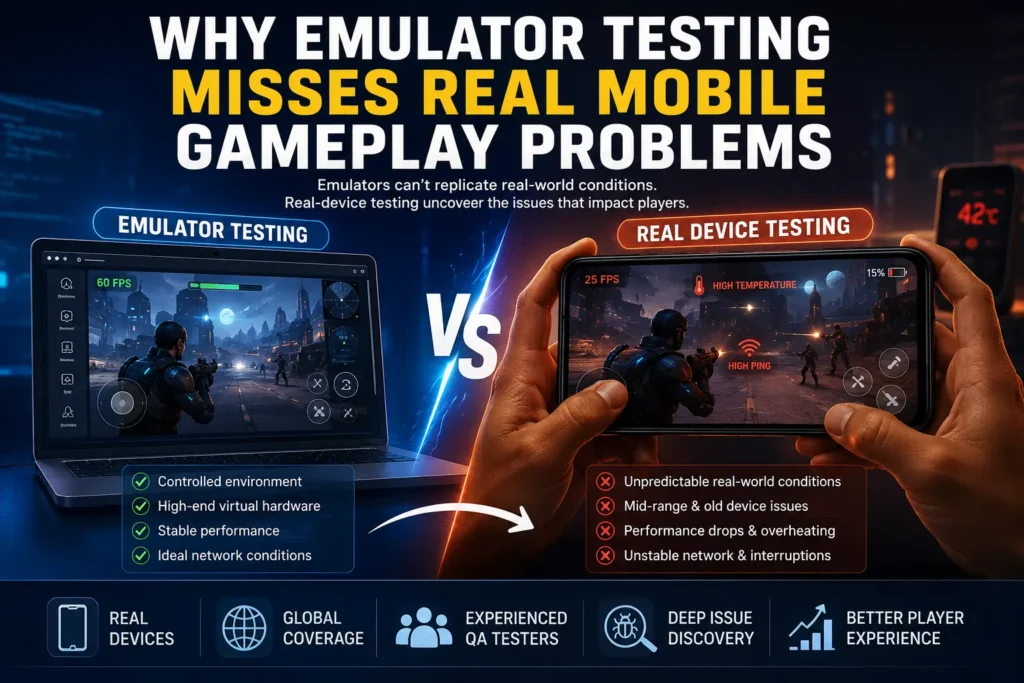
Because of this, gameplay behavior on real devices can differ significantly from emulator environments.
Therefore, relying only on emulator testing can create serious blind spots before launch.
This is one reason many studios now combine emulator testing with professional mobile game testing services before release.
Real Gameplay Problems Emulators Often Miss
1. Overheating and Thermal Throttling
One of the most common mobile gaming complaints is device heating.
A game may run perfectly for 10–15 minutes internally. However, during longer gameplay sessions on actual devices, players may experience:
- FPS drops
- overheating
- battery drain
- touch delay
- sudden lag spikes
This happens more frequently on:
- mid-range Android devices
- older phones
- low-memory devices
In many cases, emulators cannot accurately reproduce hardware limitations like thermal throttling or battery behavior.
As a result, studios may miss performance problems that directly affect real players.
Therefore, experienced game QA testing teams usually include long-session testing on physical devices instead of relying only on emulator coverage.
2. Touch Responsiveness Issues
Games that rely on fast reactions can feel completely different on real devices.
This is especially true for:
- shooter games
- racing games
- battle games
- PvP gameplay
Internally, controls may feel responsive during emulator testing. However, real users may experience:
- delayed swipes
- gesture conflicts
- inconsistent touch sensitivity
- inaccurate touch detection
Even small responsiveness issues can frustrate players quickly.
Additionally, players rarely describe these problems technically. Instead, they simply say:
“The gameplay feels bad.”
As a result, retention can drop much faster than expected.
This is why many studios hire game QA testers to validate gameplay responsiveness across multiple real devices before launch.
3. Network and Multiplayer Lag
Most internal testing happens on stable office WiFi.
Real players, however, use:
- mobile networks
- weak WiFi connections
- public internet
- unstable network environments
Because of this, multiplayer games can face issues like:
- lag spikes
- matchmaking delays
- reconnect failures
- desync problems
- frozen loading screens
Unfortunately, emulator environments struggle to simulate unpredictable real-world connectivity accurately.
Therefore, real-device testing becomes extremely important for multiplayer and live-service games.
4. Mid-Range Android Device Problems
Many studios unintentionally focus testing on flagship devices because they offer stable performance internally.
However, a large percentage of mobile gamers still use:
- budget Android phones
- older devices
- low RAM models
- region-specific smartphones
As a result, hidden issues may appear only after launch, including:
- frame drops
- texture loading delays
- UI overlap
- random crashes
- slow startup times
Some problems even affect only specific hardware combinations.
In many cases, these bugs remain invisible during emulator testing.
Therefore, professional mobile game testing services often prioritize real-device Android coverage to uncover compatibility problems earlier.
5. Background App and Battery Behavior
Real users rarely play games under ideal conditions.
Instead, they:
- switch between apps
- receive notifications
- answer phone calls
- enable battery saver mode
- play while charging
These real-world behaviors can expose:
- audio bugs
- black screens
- login failures
- app crashes
- progression loss
Meanwhile, emulator environments usually cannot reproduce these conditions realistically.
As a result, studios may launch games without realizing how unstable certain gameplay sessions become for actual users.
Launch Your Game With More Confidence
Indie studios often struggle with limited device coverage internally. Hire experienced game QA testers to validate gameplay across real Android and iOS devices before release.
Why This Impacts Player Retention
Modern game QA testing is no longer only about finding crashes.
Instead, it directly impacts:
- player retention
- gameplay satisfaction
- monetization
- app store ratings
- long-term engagement
For example, players may uninstall a game quickly if it overheats their phone or feels laggy during combat.
Similarly, inconsistent touch responsiveness can frustrate competitive players even if the game technically works.
As a result, some games achieve strong download numbers but still struggle with retention after launch.
Ultimately, the gameplay experience fails under real-world conditions.
Why Real Device Testing Matters More Than Ever
The mobile ecosystem has become increasingly fragmented, especially on Android.
Different devices behave differently depending on:
- chipset
- RAM
- GPU
- operating system
- thermal management
- refresh rate support
Because of this, testing only on emulators creates major coverage gaps.
Studios using professional game testing services often discover:
- device-specific crashes
- gameplay lag
- performance bottlenecks
- retention-impacting bugs
before players encounter them publicly.
Additionally, real-device testing helps studios improve launch stability and reduce negative reviews.
For indie studios, this can make a major difference in player retention during the first few weeks after release.
Final Thoughts
Emulators remain an important part of mobile game development because they help teams test builds efficiently during production.
However, they should never become the only layer of testing.
Real players interact with games under real-world conditions involving:
- unstable internet
- older devices
- overheating phones
- battery-saving settings
- background app interruptions
Because of this, studios that combine emulator testing with real-device game QA testing often identify gameplay and performance problems much earlier.
Ultimately, this helps reduce negative reviews, improve player retention, and deliver a smoother launch experience.
Improve Player Experience and Retention
Lag, overheating, crashes, and unstable gameplay can hurt retention quickly. Professional game testing services help uncover hidden gameplay issues that impact reviews and long-term growth.
Frequently Asked Questions
Why is emulator testing not enough for mobile games?
Emulators cannot fully replicate real-world device behavior such as overheating, battery drain, unstable internet conditions, or touch responsiveness. Therefore, real-device testing helps uncover gameplay issues that actual players may experience after launch.
What issues are commonly missed during emulator testing?
Commonly missed issues include:
FPS drops
overheating
touch latency
battery drain
network lag
device-specific crashes
UI scaling problems
These problems often appear only on physical devices under real-world conditions.
Why is real-device testing important for Android games?
Android has thousands of device combinations with different hardware and software configurations. Because of this, a game may work perfectly on one device but perform poorly on another. Real-device testing improves compatibility coverage significantly.
Can emulator testing affect player retention?
Yes. If gameplay feels laggy, unstable, or frustrating on real devices, players may uninstall the game quickly. As a result, retention, ratings, and monetization can suffer.
Do indie studios use external game testing services?
Yes. Many indie studios use external game testing services because maintaining large device coverage internally can be difficult and expensive. External QA teams help uncover real-world gameplay issues earlier.