Building a mobile app is an exciting milestone for any startup or SaaS business. However, releasing an app without proper validation often leads to crashes, negative reviews, and lost users within weeks of launch. This is exactly why mobile app testing services are no longer optional—they are essential.
In this article, I’ll explain how professional mobile testing helps startups reduce risk, what areas truly need attention before launch, and how the right QA approach can support long-term growth.
Why Mobile App Quality Directly Impacts Business Growth
Users judge mobile apps instantly. If an app feels unstable, confusing, or slow, users abandon it without hesitation. Even worse, they often leave poor reviews that discourage future downloads.
Unfortunately, many startups depend only on internal testing, which usually focuses on “happy paths.” Real users behave differently. They switch networks, interrupt sessions, use older devices, and interact unpredictably.
That’s where mobile app testing services make a difference—by validating how your app performs in real-world conditions before customers experience problems.
Common Mobile App Issues Found Before Launch
Based on real testing projects, these are some of the most frequent problems uncovered during mobile QA.
App Instability on Specific Devices
An app may function well on a developer’s phone but crash on other models or OS versions. Without testing across real devices, these defects remain hidden.
Revenue-Critical Flow Failures
Subscription setup, in-app purchases, and onboarding flows often fail under edge conditions such as poor connectivity or interrupted sessions.
UI and Interaction Problems
Small usability issues—misaligned buttons, unreadable text, or confusing navigation—can significantly reduce engagement and trust.
Unexpected Behaviour After Updates
New features can silently break existing functionality if regression testing is skipped or rushed.
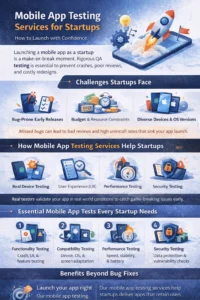
What Professional Mobile App Testing Services Include
Effective mobile app testing services focus on more than basic functionality. They examine the entire user experience.
Functional Validation
Ensures that every feature behaves as expected, including:
- App installation and first launch
- User authentication
- Core feature workflows
- Error handling and validations
Usability and Experience Review
This evaluates how intuitive the app feels to end users by reviewing:
- Screen layout consistency
- Navigation clarity
- Accessibility across devices
- Ease of completing key actions
Device and OS Compatibility Testing
Given the variety of devices in the market, compatibility testing verifies that the app works correctly across:
- Different screen sizes
- Multiple iOS and Android versions
- Brand-specific device behaviours
This step is especially critical for teams offering both iOS and Android app testing services.
Performance and Stability Checks
Performance testing identifies:
- Lag or slow response times
- Excessive battery or memory usage
- Stability issues during extended use
Exploratory and Scenario-Based Testing
Exploratory testing simulates real user behaviour, such as:
- Network switching
- App backgrounding
- Interrupted actions
- Unexpected input patterns
Many high-impact defects are found only during this phase.
iOS and Android Testing Require Different Strategies
Although both platforms serve mobile users, their testing requirements differ significantly.
iOS App Testing
- TestFlight build validation
- OS version compatibility
- Subscription and in-app purchase testing
- Compliance with Apple guidelines
Android App Testing
- Device fragmentation testing
- OS diversity coverage
- Manufacturer-specific UI behaviours
- Google Play policy validation
A reliable QA partner should be equipped to handle both environments.
Case Example: QA for a Subscription-Based iOS App (US Startup)
During a recent engagement, our QA team tested a subscription-driven iOS application for a US-based startup preparing for launch.
Testing Focus
- Subscription flow validation
- UI testing across multiple iPhone models
- Session handling and background behaviour
- Edge-case exploration
Issues Identified
- Subscription failures during unstable network conditions
- Layout inconsistencies on smaller devices
- Session timeouts after app interruptions
Result
After fixes were applied, the app launched with improved stability, reduced crash risk, and a smoother user experience for early adopters.
When Should Startups Use Mobile App Testing Services?
Professional mobile QA is recommended when:
- Launching an MVP or public release
- Preparing major feature updates
- Experiencing unexplained user complaints
- Scaling to a wider user base
- Lacking internal real-device coverage
In short, if app reliability affects user trust or revenue, structured testing is critical.
Why Startups Work with Testers HUB
Testers HUB provides independent mobile app testing services tailored for startups and SaaS teams across the US, UK, UAE, and Australia.
Our approach includes:
- Real-device testing (no emulator-only testing)
- Experienced QA professionals
- Clear, actionable defect reporting
- Flexible testing models aligned with agile teams
We focus on identifying real user risks—not just ticking test cases.
Frequently Asked Questions – Mobile App Testing Services
What are mobile app testing services?
They involve validating a mobile application’s functionality, performance, and usability across real devices and operating systems to ensure a reliable user experience.
Why is mobile app testing important before launch?
Testing helps identify defects early, reduces negative reviews, and prevents costly post-launch fixes that can impact brand credibility.
Do mobile app testing services support both iOS and Android apps?
Yes. Professional QA teams test apps on both platforms, covering device variations, OS versions, and platform-specific behaviors.
How long does mobile app testing usually take?
Timelines vary by app complexity. MVPs may require a few days, while feature-rich apps often need one to two weeks of testing.
How can I start mobile app testing with Testers HUB?
You can begin by sharing your app details and testing requirements. Our team will recommend the most suitable QA approach.
Final Thoughts
Fast launches may create momentum, but quality sustains growth. Mobile app testing services help startups release stable products, build trust with users, and scale confidently.