Launching an MVP is exciting. However, when testing coverage is limited, hidden device issues can quietly turn into lost revenue and frustrated users. This case study shows how structured mobile app testing services helped a US-based startup identify critical cross-device issues before they damaged growth.
The Challenge: “It Works on Our Phones”
A US startup launched its MVP after validating the app internally on:
- One iPhone
- One Pixel device
During internal testing, core flows appeared stable. Payments processed successfully. Navigation worked smoothly. Everything looked ready for scale.
However, within weeks of launch, user complaints began surfacing:
- “Payment button doesn’t work on my phone.”
- “I can’t scroll on the pricing page.”
- “Dark mode text is unreadable.”
- “Checkout form is blocked by the keyboard.”
At first, the founders assumed these were isolated issues.
Then analytics revealed the real problem:
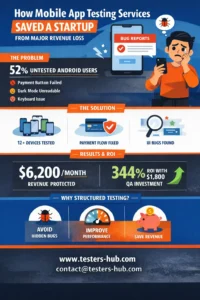
- 34% of users were on Samsung devices
- 18% were on Xiaomi devices
In total, 52% of active traffic was coming from Android devices that had never been tested.
What seemed like minor bug reports was actually a major compatibility blind spot.
The Root Cause: Limited Device Validation
The app had not been validated across:
- Samsung One UI variations
- Xiaomi MIUI customizations
- Android gesture navigation settings
- Different screen resolutions and OS versions
Although the iOS version performed well during internal checks, relying on one device is never enough. Structured iOS app testing services typically validate compatibility across multiple iPhone models and system versions.
Similarly, professional Android app testing services are designed to handle device fragmentation across OEM brands.
Without broader testing, more than half the user base was exposed to issues the founders couldn’t even see.
The Solution: Structured Testing by Testers HUB
The startup partnered with Testers HUB to implement structured and affordable QA packages tailored for growing product teams.
Our mobile app testing services included:
- Real-device testing across 12+ iOS and Android devices
- Payment flow validation under different OS environments
- UI rendering checks across screen sizes
- Dark mode compatibility testing
- Keyboard and gesture navigation validation
- Regression testing after each fix
Instead of relying on ad-hoc debugging, we focused on revenue-critical user journeys first.
Critical Issues Identified
During structured testing, we uncovered four high-impact issues:
1️⃣ Payment Failure on Xiaomi (MIUI)
On specific Xiaomi devices, the payment confirmation process failed silently.
Estimated monthly revenue risk: $2,800
2️⃣ Samsung Keyboard Overlay Blocking Checkout
The Samsung keyboard overlapped key input fields, preventing users from completing transactions.
Estimated monthly revenue risk: $3,400
3️⃣ Bottom Navigation Hidden by Gesture Controls
Gesture navigation settings caused partial UI obstruction.
4️⃣ Dark Mode Rendering Issue
White text displayed against white backgrounds on certain Android themes.
These bugs were invisible during internal testing but directly impacted paying customers.
Financial Impact and ROI
Instead of continuing with limited testing, the startup invested in a structured QA engagement.
Testing investment: $1,800
(Through one of our affordable QA packages)
Potential monthly revenue protected: $6,200
Estimated First-Month ROI: 344%
Importantly, this calculation only reflects direct payment flow protection. It does not include:
- Prevention of negative reviews
- Improved App Store ratings
- Reduced churn
- Brand credibility preservation
The cost of structured mobile app testing services was significantly lower than the cost of leaving bugs live.
Why This Case Matters
Internal validation confirms expected behavior.
Professional mobile app testing services validate real-world behavior.
That distinction is critical.
While internal testing covered two devices, structured testing uncovered issues affecting over half the active user base.
Through targeted iOS app testing services and Android app testing services, Testers HUB helped the startup move from reactive troubleshooting to proactive quality assurance.
The Bigger Lesson for Growing Apps
Many startups assume:
“We’ll fix issues after launch.”
However, users rarely return after failed payment attempts or broken flows. Early-stage apps depend heavily on first impressions.
Affordable QA packages allow startups to:
- Expand device coverage
- Validate revenue-critical flows
- Prevent compatibility blind spots
- Scale confidently
The cost of testing is predictable.
The cost of missed bugs is not.
Frequently Asked Questions
Q1. Why are mobile app testing services important for startups?
Mobile app testing services help identify compatibility, usability, and payment flow issues before they impact real users. Structured testing protects both revenue and app ratings.
Q2. Do Android apps require broader testing coverage?
Yes. Android app testing services are critical due to device fragmentation across brands such as Samsung and Xiaomi.
Q3. Is iOS app testing necessary if the app works on one iPhone?
Yes. iOS app testing services validate compatibility across multiple iPhone models and OS versions.
Q4. Are affordable QA packages suitable for MVP launches?
Yes. Affordable QA packages provide focused validation that helps startups detect high-risk issues before scaling.
Final Takeaway
Before your next release, ask: Have you tested beyond your own device?
If not, hidden compatibility issues may already be affecting your users.
Structured mobile app testing services from Testers HUB can help you validate performance across real devices and protect revenue before it’s too late.