You’ve built the app. The design looks polished, the core features work, and your team is preparing for launch. However, before you submit to the App Store or Google Play, one question matters more than most founders realize:
Who is going to test the app properly?
Many teams depend only on internal checks. Although that may feel enough, bugs often appear after launch. As a result, users leave poor reviews, uninstall the app, and lose trust quickly.
Therefore, startups now compare in-house QA with outsourced mobile app testing services before release.
If you want a smooth launch, this guide will help you decide what works best for your product.
Why Mobile App Testing Matters Before Launch
Even a well-designed app can fail if testing is weak. In many cases, the problem is not development quality—it is limited real-world validation.
For example:
- Login may fail on older devices
- Push notifications may behave inconsistently
- Payment flows may break under weak networks
- UI may shift on smaller screens
- Performance may drop on low-memory devices
Because of this, quality assurance should never be the final checkbox.
👉 Instead, strong mobile app testing services protect your launch, brand image, and user retention.
What In-House Mobile App Testing Usually Looks Like
In-house testing often means developers, product managers, or one internal QA person checking flows before release.
This setup can work well in some situations. After all, your internal team understands the product deeply.
They know:
- Intended user flows
- Business logic
- Priority features
- Known risk areas
However, familiarity also creates blind spots.
Developers usually test the “happy path.” Real users do not.
They may:
- Skip onboarding steps
- Enter unexpected data
- Use poor internet connections
- Switch devices mid-session
- Use outdated Android phones
As a result, internal teams may miss real-world issues without realizing it.
Where In-House QA Works Best
Internal testing can be effective when:
- Your app is small and simple
- You are validating an MVP concept
- You already have experienced QA staff
- Daily dev-QA collaboration is essential
- You need quick smoke testing after updates
Therefore, in-house QA still has value—especially during active development.
Where In-House QA Starts to Struggle
Although internal teams are valuable, several challenges appear as apps grow.
Limited Device Coverage
Most internal teams test on only a few devices. Meanwhile, users may access your app from hundreds of models.
For example, a layout that looks perfect on a flagship device may break on a budget phone.
Rising Fixed Costs
Hiring full-time QA staff adds recurring salaries, benefits, tools, and management time.
Bias Toward Expected Behavior
Your team built the product. Naturally, they know how it should work.
However, fresh users do not.
Regression Often Gets Delayed
Teams plan automation and structured regression. Yet release pressure often pushes testing down the priority list.
Need Launch-Ready QA Support?
What Outsourced Mobile App Testing Services Actually Provide
Outsourced testing means partnering with a dedicated mobile app testing company that focuses entirely on quality assurance.
Unlike internal teams, outsourced testers approach the app with fresh eyes and no assumptions.
That difference matters.
A professional QA partner typically provides:
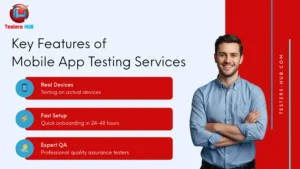
Real Device Testing
Testing across multiple iPhones, Samsung devices, Pixel devices, tablets, and various OS versions.
Independent User Perspective
Because testers are new to the product, they often find friction internal teams overlook.
Faster Setup
Many projects can start quickly once builds and scope are shared.
Flexible Cost Structure
Instead of paying full-time salaries, you pay based on scope, cycles, or packages.
Scalable Coverage
Need one tester this month and three next month? Outsourced teams can adapt faster.
Why Startups Often Outsource Mobile App Testing
Startups move fast. However, speed without QA creates expensive mistakes.
Therefore, many founders choose to outsource mobile app testing because it helps them:
- Launch faster with confidence
- Avoid hiring overhead early
- Access wider device coverage
- Catch issues before paid acquisition starts
- Focus internal teams on product growth
As a result, outsourced QA becomes a smart business decision—not just a testing decision.
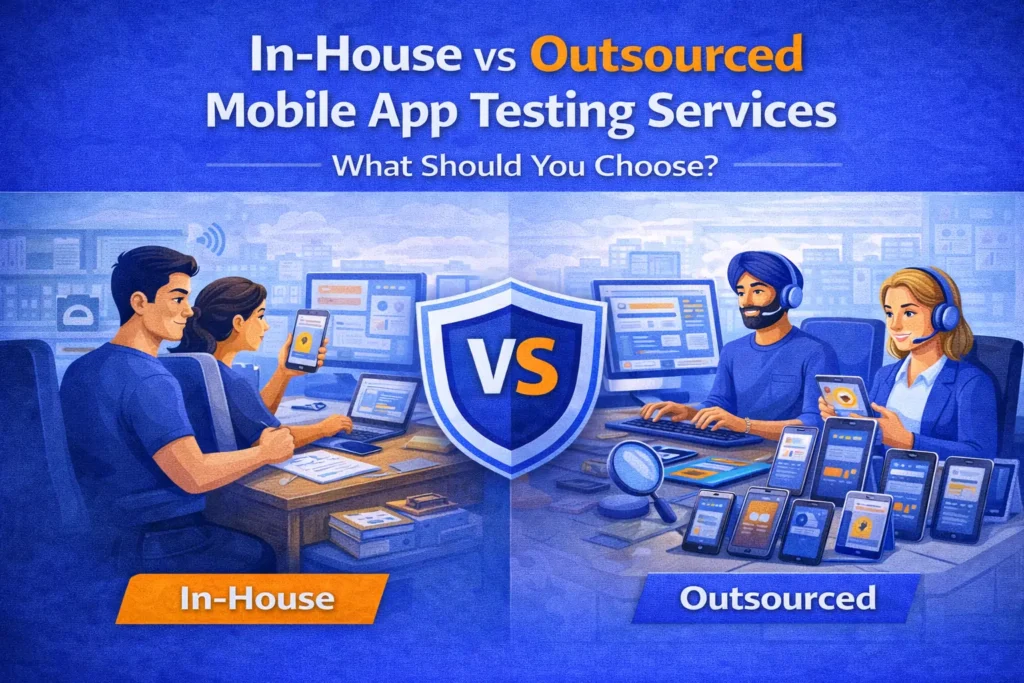
In-House vs Outsourced Mobile App Testing Services: Quick Comparison
| What Matters |
In-House QA |
Outsourced QA |
| Cost Model | Fixed monthly overhead | Flexible project-based |
| Device Coverage | Usually limited | Broad real-device coverage |
| Fresh Perspective | Low | High |
| Speed to Start | Hiring/onboarding needed | Fast setup |
| Scalability | Slower | Easy to scale |
| Specialized QA Skills | Depends on hires | Dedicated testers |
| Regression Support | Internal bandwidth dependent | Structured cycles |
Why iOS and Android Need Separate Testing
Many founders assume one round of testing is enough. However, iOS and Android behave differently.
That is why serious teams invest in both iOS app testing services and Android app testing services.
iOS Testing Focus
- Device model variations
- Permission flows
- App Store readiness
- OS-specific UI behavior
Android Testing Focus
- Device fragmentation
- Performance differences
- Background behavior
- Multiple screen sizes
Therefore, platform-specific testing prevents costly surprises after launch.
What a Proper Test Cycle Should Cover
A quality test cycle should go beyond “does it open?”
It should include:
Functional Testing
Login, onboarding, payments, subscriptions, navigation, notifications.
Usability Testing
Tap targets, readability, gestures, dark mode, intuitive flow.
Compatibility Testing
Different phones, tablets, OS versions, and screen sizes.
Performance Testing
Low battery, poor network, memory pressure, slower devices.
Regression Testing
Ensuring new updates did not break existing flows.
Hire Mobile App Testers If…
You should hire mobile app testers when:
- Launch is approaching
- Users reported bugs previously
- New features were added quickly
- Internal bandwidth is low
- Paid marketing campaigns are planned
Because once traffic starts, bugs become far more expensive.
Mid-Launch Reminder
👉 Planning a release this month? Hire mobile app testers now instead of fixing one-star reviews later.
Who Should Use Outsourced Mobile QA Most?
Outsourced QA is ideal for:
- Startup founders launching first apps
- SaaS companies expanding to mobile
- eCommerce brands needing stable checkout flows
- Fitness and healthcare apps where trust matters
- Gaming apps requiring performance coverage
Final Verdict: What Should You Choose?
There is no one-size-fits-all answer.
Choose In-House QA If:
- You already have skilled testers
- Product is early-stage
- Scope is small and changing daily
Choose Outsourced Mobile App Testing Services If:
- Launch quality matters now
- Device coverage is limited internally
- You need speed and flexibility
- You want independent testing depth
For many startups, the best solution is actually hybrid:
Internal team handles daily checks, while an external mobile QA company manages structured pre-launch testing.
Ready to Launch With Confidence?
Don’t let avoidable bugs cost you users, ratings, or developer time.
👉 Work with a trusted mobile app testing company
👉 Flexible testing packages available
👉 Free QA consultation offered
Frequently Asked Questions
Is it better to outsource mobile app testing?
Yes, especially for startups needing fast setup, wider device coverage, and expert QA support.
What do mobile app testing services include?
They usually include functional, usability, compatibility, regression, and performance testing.
Do I need separate iOS and Android testing?
Yes. Both platforms behave differently, so dedicated
iOS app testing services and Android app testing services improve quality.
How much does a mobile app testing company cost?
Costs depend on app complexity, devices, timelines, and scope. Many teams start with package-based plans.
When should I hire mobile app testers?
Before launch, after major updates, or when bug reports start increasing.
Can in-house and outsourced QA work together?
Absolutely. Many companies use a hybrid model for speed and deeper coverage.