Introduction
If you’re building an app or a game, you’ve probably asked this at some point:
“How much testing do we actually need?”
It’s a fair question. Start too late, and bugs slip into production. Overdo it, and you burn time and budget.
So instead of guessing, it’s better to approach QA effort in a structured way — based on your product, users, and risk level.
If you want a quick starting point, you can also try a software testing cost calculator to get a rough estimate before diving deeper.
1. Start With What You’re Building
Not all products need the same level of testing.
For example, a simple app with login and basic flows is very different from a real-time app with integrations. Similarly, a casual game is far easier to test than a multiplayer or progression-heavy one.
👉 As a rule of thumb:
- Simpler products → less QA effort
- Complex systems → significantly more testing
This is usually where teams decide whether to hire mobile app tester or bring in external help for game QA.
2. Devices and Platforms Change Everything
This is where estimates often go wrong.
Testing on one device is easy. Testing across multiple Android devices, iPhones, screen sizes, and OS versions? That’s where effort multiplies quickly.
The same applies to games — especially if they run across mobile, PC, or different environments.
👉 In many cases, teams switch to structured mobile app testing services or game testing services at this stage because manual estimation becomes unreliable.
3. It’s Not Just Functional Testing
A common mistake is assuming QA is just “checking if things work.”
In reality, proper testing includes:
- Functional flows
- UI/UX consistency
- Performance under load
- Compatibility across devices
- Regression after every update
For games, this expands even further into gameplay balance, progression, and real-user behavior.
👉 That’s why experienced QA teams often catch issues that internal teams miss.
4. Timing Matters More Than You Think
When you start testing has a direct impact on effort.
- Early-stage (MVP): lighter, focused testing
- Mid-development: growing effort
- Pre-launch: intensive QA cycles
- Post-launch: continuous validation
👉 Starting early usually saves time overall, even if it feels like an extra step at the beginning.
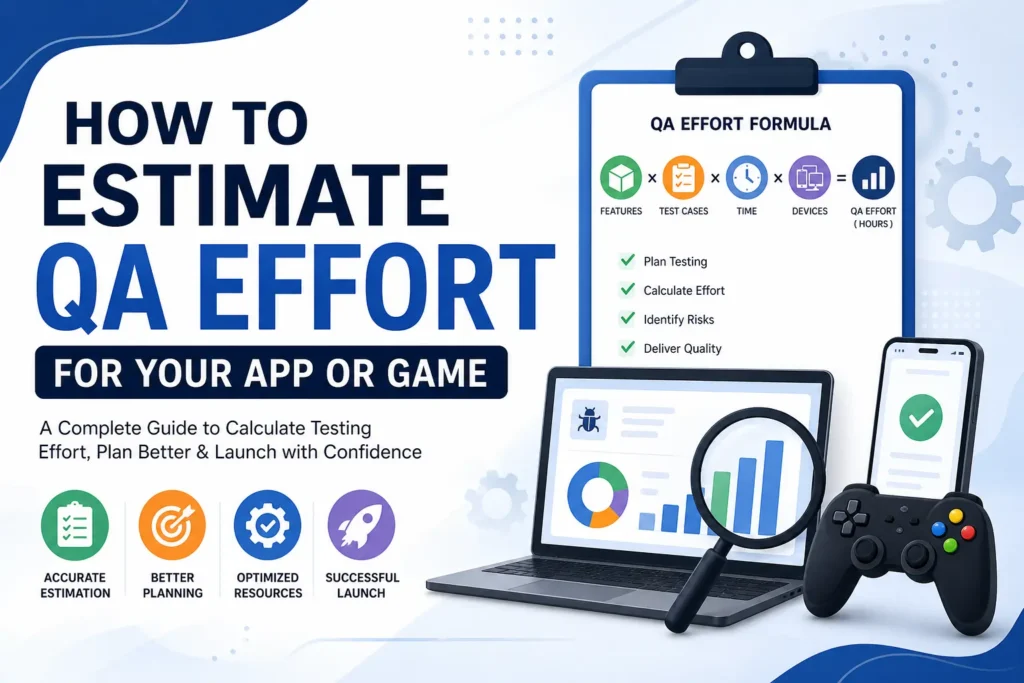
5. A Simple Way to Estimate QA Effort
You don’t need a complex model to get a baseline.
Think in terms of:
- Number of features
- Test cases per feature
- Time per test
- Number of devices/platforms
Multiply these, and you’ll get a rough estimate.
However, real-world projects always add extra effort for:
- Retesting bugs
- Regression cycles
- Edge cases
👉 That’s where using a software testing cost calculator can help validate your assumptions quickly.
6. In-House vs External QA
At some point, you’ll need to decide how testing is handled.
In-house QA works well when:
- You have a stable product
- Your team is experienced
- Scope is predictable
External QA makes more sense when:
- You need to scale quickly
- You’re close to launch
- Your product has high complexity
👉 Many startups and studios mix both approaches to stay flexible.
7. Where Most Teams Go Wrong
Even with planning, a few patterns show up again and again:
- Underestimating device coverage
- Leaving testing too late
- Skipping regression after updates
- Testing only ideal scenarios
These issues don’t show up immediately — but they almost always surface after release.
Conclusion
Estimating QA effort isn’t about getting a perfect number.
It’s about understanding:
- What you’re building
- Where the risks are
- How much testing is enough before launch
A simple estimate, combined with real-world validation (and sometimes expert help), usually gives the best results.
If you’re still unsure, tools like a software testing cost calculator or consulting experienced testers can give you a clearer direction before you commit resources.
Frequently Asked Questions
How early should QA start?
Ideally, as soon as core features are stable. Early testing reduces overall effort later.
Is QA effort higher for games?
Usually, yes — because of gameplay, interactions, and edge cases.
Can I estimate QA effort without a QA team?
You can get a rough idea, but validation from experienced testers improves accuracy.
What impacts QA effort the most?
Complexity, device coverage, and frequency of updates.
Do startups need external QA?
Not always, but it helps when timelines are tight or the product is complex.