Launching a mobile application without proper testing can create serious problems. Users may experience crashes, broken navigation, or payment failures. When this happens, negative reviews appear quickly, and recovering from those early impressions can be difficult.
Because of this, many startups and product teams choose to work with professional mobile app testing services before releasing their apps. However, not every testing provider delivers the same level of quality. Some simply run quick checks, while others perform deep testing across multiple devices and real user scenarios.
If you are evaluating a testing partner, the following features can help you determine whether a provider can properly support your product.
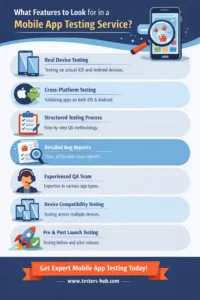
Real Device Testing
A strong QA team should test your application on actual smartphones, not just simulators.
Simulators are useful during development, but they cannot reproduce real-world behaviour. For example, hardware performance, network interruptions, and screen responsiveness often behave differently on physical devices.
Testing on real devices helps reveal problems that developers may not notice during development. As a result, businesses can fix these issues before the app reaches real users.
Planning to launch a mobile application soon?
The QA specialists at Testers HUB test apps on real Android and iOS devices to identify compatibility issues before your users encounter them.
Coverage Across iOS and Android
Mobile applications usually need to function on both Android and iOS platforms. Each platform has unique operating system behaviour and device configurations.
Testing across both environments ensures that features behave consistently. Navigation, login systems, notifications, and other workflows should work smoothly regardless of which platform a user chooses.
Without cross-platform validation, apps may appear stable on one platform while showing problems on another.
A Clear Testing Process
Professional QA teams follow a structured testing process instead of random checks.
A typical workflow may include planning the testing scope, identifying important user journeys, executing tests, and validating fixes after issues are resolved. This systematic approach helps teams evaluate both common scenarios and unexpected edge cases.
Because of this organized process, product teams receive reliable feedback about the application’s overall stability.
Detailed Issue Reports
When bugs are discovered, developers need clear information to understand what went wrong. Good QA providers create detailed reports that explain the issue clearly.
These reports often include steps to reproduce the problem, screenshots or short videos, and information about the device used during testing. This level of detail helps developers locate the problem faster and implement fixes efficiently.
Need structured bug reports that developers can fix quickly?
Our QA team provides clear defect reports with screenshots, steps, and device details.
Experience With Different Mobile Apps
Mobile applications differ significantly in how they operate. A SaaS platform, for example, requires different testing scenarios than an eCommerce app or a mobile game.
A testing partner who has worked with multiple application types can identify potential risks faster. Their experience allows them to understand how users interact with different app features and where issues are most likely to appear.
Compatibility Testing
Another major challenge in mobile development is device diversity, especially within the Android ecosystem.
Phones vary widely in screen size, hardware capability, and operating system versions. Because of this variation, an app may work correctly on one device but behave differently on another.
Compatibility testing across multiple devices helps prevent these issues and ensures the app works for a broader range of users.
Testing Before and After Release
Quality assurance should continue beyond the first release of an application. Updates and new features can sometimes introduce unexpected problems.
A reliable testing partner supports both pre-launch validation and regression testing after updates. This ongoing process helps maintain the application’s stability as the product evolves.
Want to release a stable and reliable mobile app?
Testers HUB helps startups and product teams identify issues early and deliver high-quality applications through structured mobile app testing services.
FAQ
Why should mobile apps be tested before launch?
Testing helps identify bugs, compatibility issues, and usability problems before users experience them.
Do mobile app testing services use real devices?
Yes. Professional QA teams normally test applications on both Android and iOS devices to simulate real user environments.
How long does mobile app testing take?
The timeline depends on the application’s complexity and the number of devices involved in testing.