A common moment arrives in almost every startup’s product journey.
The application is finally built. The development team has completed the core features. Internal testing looks promising. Everything seems ready for launch.
But before releasing the product to real users, founders often face an important question:
Is the app truly ready for the market?
Many mobile applications appear stable during internal testing but behave very differently once thousands of users install them on different devices. Small issues that seem minor during development can become major problems after launch.
Because of this risk, many startup teams look for professional mobile app testing services before releasing their product.
However, choosing the right mobile app testing company requires more than simply comparing prices.
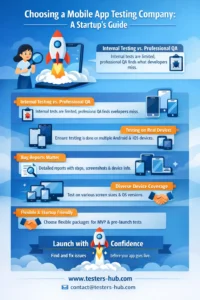
Why Internal Testing Is Often Not Enough
In early-stage startups, developers usually test the application themselves as they build features. While this approach works during development, it has clear limitations.
Developers typically test the application on only a few devices. They are also deeply familiar with the product, which means they may unintentionally avoid unusual usage patterns.
External QA teams approach the application differently. Their goal is not to build the product but to challenge it. Testers explore the application from the perspective of real users and intentionally seek weaknesses in the system.
This different perspective often reveals issues that internal teams may overlook.
Device Diversity Creates Unexpected Issues
Mobile ecosystems are incredibly fragmented.
Even two devices running the same operating system can behave differently because of hardware differences, screen resolutions, and memory limitations.
For example, a feature that works smoothly on a flagship phone may perform poorly on a mid-range device. Layout elements may appear perfect on large screens but overlap on smaller displays.
Professional mobile app testing services address this challenge by testing the application across multiple real devices.
Testing in varied environments helps ensure that the product behaves consistently for a wide range of users.
Understanding the Testing Workflow
When startups hire a mobile app testing company, the testing process usually follows several stages.
First, testers analyze the application and understand the user journey. This includes onboarding, navigation, and core feature usage.
Next, testers explore the application thoroughly to identify functional problems, usability issues, and unexpected behaviors.
Each discovered issue is documented with clear steps and visual evidence so developers can reproduce it easily.
After the development team fixes the issues, testers verify the fixes and ensure that the changes did not introduce new problems.
This cycle continues until the product becomes stable enough for release.
The Importance of Clear Bug Documentation
One of the most valuable outcomes of professional testing is detailed defect reporting.
A good bug report does more than simply mention that something is broken. It explains exactly how the issue occurs and under what conditions it appears.
Typically, a defect report includes:
- a clear description of the issue
- step-by-step reproduction instructions
- screenshots or screen recordings
- device model and operating system version
This structured information allows developers to fix issues quickly without spending hours reproducing them.
Flexibility Matters for Startup Teams
Unlike large enterprises, startups rarely require continuous QA teams during the entire development cycle.
Instead, they often need testing support during specific phases such as MVP validation, beta testing, or pre-launch stability checks.
Testing companies that offer flexible engagement models allow startups to run targeted QA cycles when needed. This approach helps maintain product quality while keeping testing costs manageable.
Launching With Confidence
The first release of a mobile application plays a major role in shaping user perception.
Users who encounter bugs, crashes, or broken flows are unlikely to return to the app. In competitive markets, even small issues can result in negative reviews and lost users.
Working with experienced mobile app testing services helps reduce these risks by identifying problems before they reach real users.
At Testers HUB, we support startups by testing mobile applications across real Android and iOS devices. Our QA specialists focus on functionality, compatibility, and usability to help teams launch stable mobile products.
👉 Need help validating your mobile app before launch?
FAQ
Why should startups consider external mobile app testing?
External QA teams provide an unbiased evaluation of the application and help detect issues that internal teams may overlook.
When should mobile app testing begin?
Testing usually begins once the MVP or functional build of the application is ready.
Do mobile apps need testing on multiple devices?
Yes. Device diversity makes cross-device testing essential to ensure a consistent user experienc