Mobile applications today are expected to work flawlessly, regardless of device, network condition, or user behaviour. However, ensuring that level of quality is only possible when mobile app testing is done properly and systematically.
In fact, many app failures are not caused by missing features, but rather by poor testing under real-world conditions. Therefore, investing in professional mobile app testing services is no longer optional; it is essential for long-term success.
Why Structured Mobile App Testing Is Critical
Mobile app testing goes far beyond checking whether features work. Instead, it validates stability when users interact in unexpected ways or when device conditions change suddenly.
Testers actively verify:
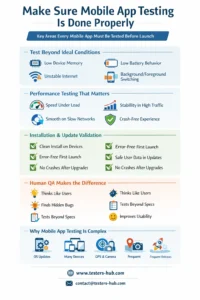
- App behavior during slow or disconnected internet sessions
- Stability when device memory reaches critical limits
- Usability when battery levels drop significantly
By addressing these situations early, teams protect user experience and product credibility.
Performance Testing in Real Usage Scenarios
Performance testing measures how an app responds under pressure. While builds may appear fast in development environments, real users often expose hidden delays and crashes.
Key performance checks include:
- App stability during low-memory usage
- Behavior during low-battery operation
- Responsiveness on weak or unstable networks
- Load handling during traffic spikes
Experienced QA engineers combine structured test cases with exploratory testing to reveal performance gaps before users encounter them.
Installation and Upgrade Testing Still Deserve Attention
Installation and upgrade flows strongly influence first impressions and long-term retention. Yet many teams overlook them.
Installation testing confirms that:
- The app installs cleanly across supported devices
- First launch completes without errors
- Permission prompts behave correctly
Upgrade testing verifies that:
- User data remains intact after updates
- New releases do not disrupt existing features
- Updates do not introduce unexpected crashes
Why Tester Experience Changes Outcomes
Mobile apps allow countless testing paths. As a result, tester judgment plays a major role in finding meaningful issues.
A strong mobile app tester:
- Thinks like an actual end user
- Explores beyond documented flows
- Recreates real-life usage patterns
- Detects edge cases early
This human-driven approach often uncovers issues that tools alone cannot identify.
Growing Complexity of Mobile App Testing
Mobile app testing continues to evolve due to:
- Frequent Android and iOS updates
- Expanding device and screen combinations
- Hardware-dependent features like GPS and cameras
- Faster release cycles with continuous updates
Although no process eliminates all defects, a clear testing strategy significantly lowers risk and improves reliability.
Frequently Asked Questions
What does proper mobile app testing include?
It covers functional, performance, installation, upgrade, usability, and real-device testing.
Why should teams test on real devices?
Real devices expose hardware, network, and performance issues that emulators often miss.
Does manual testing still add value?
Yes. Manual testing identifies usability gaps, edge cases, and real-user behavior.
When should teams test mobile apps?
Testing should happen before launch, after major updates, during OS changes, and after bug fixes.
Can testing reduce negative app store reviews?
Yes. Stable apps generate fewer complaints and better ratings.
Do small apps also require professional testing?
Absolutely. Even simple apps fail if core flows break.
Final Note
Mobile app testing works best as a continuous process, not a one-time task. Teams that validate apps across real devices and conditions deliver products users trust.