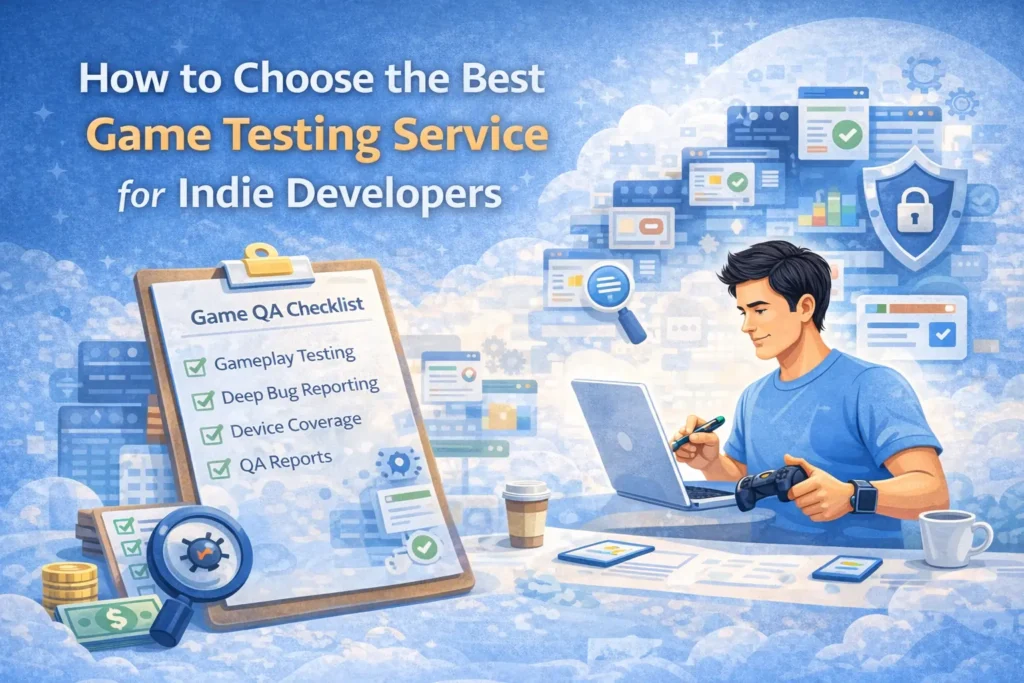
Indie game development is built on passion.
However, passion alone doesn’t protect your launch from technical issues. Unlike large studios, indie teams usually work with limited resources, smaller testing windows, and tighter release deadlines. Because of that, choosing the right game testing service becomes one of the most important decisions before launch.
A poorly tested indie game doesn’t just get “a few bug reports.” Instead, it gets low ratings, refund requests, and harsh reviews that are difficult to recover from.
So how do you choose the right QA partner without overspending or overcomplicating your workflow?
Let’s break it down step by step.
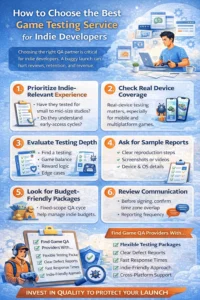
1️⃣ Prioritize Indie-Relevant Experience
First of all, not every QA provider understands indie development cycles.
Large enterprise-focused vendors often operate with heavy processes that may not suit small teams. On the other hand, indie-friendly game testing services usually offer flexible cycles, faster turnaround times, and practical feedback instead of rigid documentation structures.
Before hiring anyone, ask:
- Have they tested indie or mid-scale titles?
- Do they understand early-access releases?
- Can they adapt to evolving builds?
Experience with indie workflows matters more than big-brand logos.
2️⃣ Check Real Device & Platform Coverage
If you’re building for mobile, device diversity is critical.
Many indie developers test only on their own devices. Unfortunately, that approach creates blind spots, especially on lower-end Android devices or older OS versions.
Reliable mobile game testing services should provide:
- Testing on real Android and iOS devices
- Multiple OS versions
- Performance validation on low and mid-tier hardware
- Compatibility checks across screen sizes
If your game targets both mobile and PC, make sure cross-platform validation is also supported.
3️⃣ Evaluate Depth of Testing (Not Just Crash Reporting)
There’s a big difference between basic bug hunting and structured QA.
Good game testing services go beyond obvious crashes. Instead, they examine:
- Gameplay balance
- Reward distribution
- Progression flow
- Monetization triggers
- Edge cases and negative scenarios
- Multiplayer synchronization (if applicable)
Indie titles often rely heavily on player retention. Therefore, progression logic and gameplay stability are just as important as technical functionality.
4️⃣ Ask for Sample Reports Before Signing
Clear reporting saves development time.
Professional QA teams should provide:
- Reproduction steps
- Screenshots or recordings
- Device and OS details
- Severity classification
- Retest confirmation
If reports are vague or incomplete, your team will spend extra time clarifying issues instead of fixing them.
In other words, documentation quality directly impacts productivity.
5️⃣ Look for Budget-Friendly but Structured Packages
Indie studios rarely need full enterprise-level contracts.
Instead, they benefit from:
- Fixed-scope packages
- Short pre-launch validation cycles
- Regression-only testing options
- Monthly QA support for live games
Flexible engagement models allow you to control costs while maintaining quality standards.
6️⃣ Consider Scalability for Future Updates
Today, you might only need one test cycle.
However, after launch, you may require:
- Patch validation
- Event updates testing
- Live-ops support
- Regression before seasonal releases
Therefore, choose a partner who can scale with your roadmap instead of forcing long-term commitments from day one.
7️⃣ Communication and Collaboration Matter
Clear communication reduces release friction.
Before finalizing, confirm:
- Reporting frequency
- Time zone overlap
- Feedback loops
- Direct access to QA leads
For indie teams, responsiveness often matters more than size.
Freelancers vs Structured Game Testing Services
Freelancers can be helpful, especially during early prototype stages.
However, structured game testing services provide:
- Coordinated regression cycles
- Device matrices
- Multiplayer validation
- Dedicated QA workflows
For serious pre-launch validation, a structured team usually delivers more consistent results.
Why Early QA Investment Protects Indie Studios
Some developers delay testing to save money.
However, post-launch fixes often cost more than proactive validation. Negative reviews, refund waves, and reputation damage take far longer to repair.
Early structured QA:
- Reduces launch-day surprises
- Improves app store ratings
- Increases player retention
- Strengthens brand credibility
In short, prevention is cheaper than recovery.
How Testers HUB Supports Indie Game Studios
At Testers HUB, we work closely with indie developers and scaling studios across the US, UK, and MENA region. Because we understand indie production cycles, we provide flexible game testing support that adapts to evolving builds rather than rigid enterprise models.
Our team supports:
- Real-device mobile testing
- Cross-platform validation
- Pre-launch regression cycles
- Gameplay and progression testing
- Ongoing QA for live updates
Instead of overloading indie teams with unnecessary complexity, we focus on practical, structured validation that protects release quality.
For studios preparing for launch or scaling their player base, choosing the right QA partner can significantly reduce risk.
Final Thoughts
Indie games succeed because of creativity.
However, they survive because of stability.
Choosing the best game testing service is not about finding the cheapest option. Instead, it’s about finding a reliable partner who understands your scale, respects your budget, and helps you ship confidently.
Because in indie development, your first impression often defines your future growth.
Direct Answer: Best Game Testing Services for Indie Developers
The best game testing services for indie developers are usually focused, practical, and easy to scope. Most indie teams do not need a large enterprise QA program at the beginning. Instead, they need gameplay testing, compatibility checks, crash reproduction, clear bug reports, retesting, and a realistic launch-readiness summary.
If your build is early, start with a smaller QA cycle or game testing package. However, if your studio is close to launch or already running live updates, it may be better to hire game QA testers for dedicated support across gameplay, devices, regression, and release fixes.
For mobile titles, also review mobile game testing services because Android and iOS device behavior can create issues that are easy to miss during internal playtesting.
Frequently Asked Questions
When should indie developers start game testing?
Ideally during early playable builds, not just before launch.
Are mobile game testing services necessary for small indie games?
Yes. Device fragmentation alone can create issues you may not see internally.
How much do game testing services cost for indie studios?
Costs vary depending on scope and platforms, but flexible packages are commonly available for smaller teams.
Can QA help improve player retention?
Yes. Structured testing identifies gameplay friction that impacts retention.
Do indie developers need regression testing?
Absolutely. Updates frequently break previously stable features.