Launching and scaling a startup is already challenging. However, dealing with bugs, crashes, and unhappy users makes it even harder. While quality assurance is critical, hiring a full-time QA team early on often feels expensive, slow, and inflexible.
That’s exactly where QA on demand for startups becomes a game-changer.
Instead of maintaining an in-house QA team, startups can access expert testers only when required, ensuring quality without long-term commitments. As a result, teams move faster, release confidently, and control costs more effectively.
What Is QA on Demand?
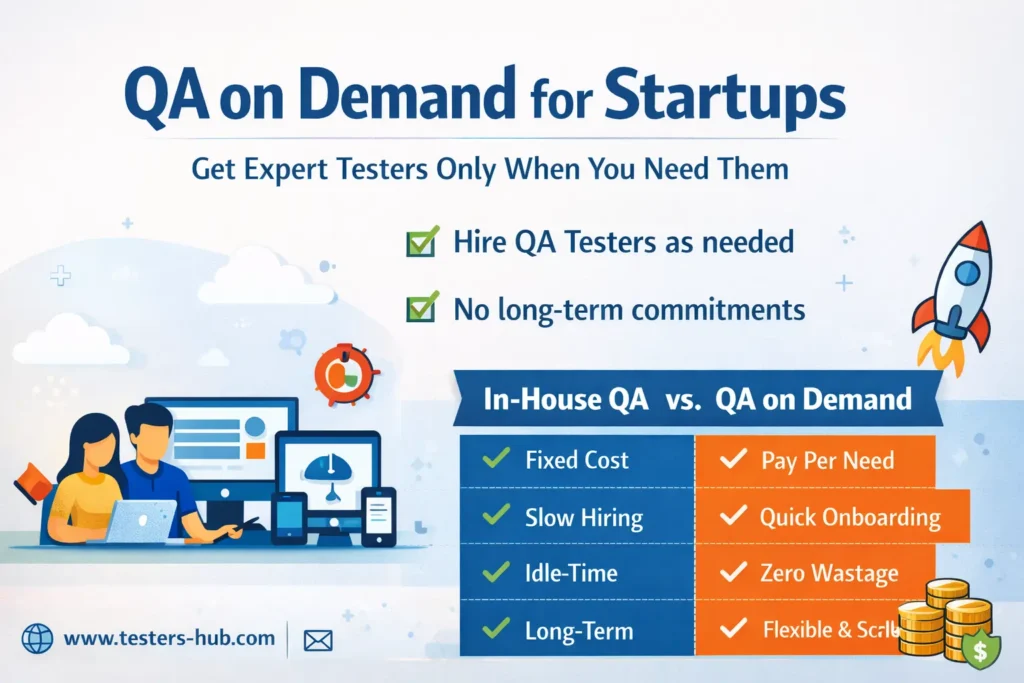
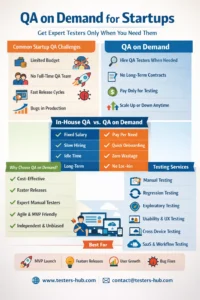
QA on demand is a flexible testing model that allows startups to hire QA testers only when testing is actually needed. In other words, you get professional QA support during releases, major updates, or critical sprints—without keeping testers on payroll.
Unlike traditional QA outsourcing, QA on demand enables startups to:
- Scale QA resources up or down instantly
- Pay only for actual testing effort
- Avoid long onboarding cycles
- Access experienced manual testers quickly
Because of this flexibility, QA on demand fits perfectly with startup environments, MVP launches, and agile teams.
Why Traditional QA Models Don’t Work Well for Startups
Although QA is essential, traditional models often slow startups down.
High Fixed Costs
Hiring full-time QA engineers involves salaries, tools, and management time. Therefore, for early-stage startups, this becomes a heavy and often unnecessary expense.
Inconsistent Testing Needs
Testing demand usually spikes before releases. As a result, full-time QA resources remain underutilised between cycles.
Developer-Only Testing Isn’t Enough
While developers test basic flows, they often miss usability issues, edge cases, and real-user behaviour. Consequently, bugs still slip into production.
That’s why many startups shift toward QA outsourcing services—and increasingly adopt QA on demand for better flexibility.
How QA on Demand Works for Startups
The QA on demand process is simple and startup-friendly:
- Define the testing scope
For example: manual testing, regression testing, exploratory QA, or release testing. - Engage QA testers on demand
This could be one tester for two days or a small dedicated QA team for a sprint. - Execute testing quickly
Testers use real devices, real scenarios, and proven QA practices. - Receive clear deliverables
Bug reports include steps to reproduce, screenshots, videos, and test summaries. - Scale or stop anytime
No lock-in, no long-term commitment.
As a result, startups get reliable quality checks without slowing development.
Key Benefits of QA on Demand for Startups
Pay Only When You Need Testing
With QA on demand, startups avoid paying idle salaries. Instead, they invest in QA only during active testing phases—making it a highly cost-effective model.
Faster Releases with Confidence
Because testers are available quickly, startups don’t delay launches waiting for internal resources. Moreover, professional QA ensures fewer post-release issues.
Access to Experienced QA Testers
QA on demand provides access to skilled manual testers, usability testers, and SaaS QA experts—without the effort of hiring full time.
Perfect Fit for Agile & MVP Development
Since startups iterate rapidly, QA on demand aligns smoothly with agile sprints, MVP testing, and frequent updates.
Independent & Unbiased Testing
Because testers are independent, they review the product objectively. As a result, usability gaps and business logic issues are caught early.
QA on Demand vs In-House QA vs Full QA Outsourcing
Aspect |
In-House QA |
Full QA Outsourcing |
QA on Demand |
| Cost | High fixed cost | Medium–High | Pay per need |
| Flexibility | Low | Medium | High |
| Speed | Slow hiring | Moderate | Immediate |
| Commitment | Long-term | Contract-based | No lock-in |
| Best for | Enterprises | Large teams | Startups |
Explore flexible QA packages designed for startups, SaaS teams, and fast releases
When Should Startups Use QA on Demand?
QA on demand is especially useful when:
- Preparing for MVP or beta launch
- Releasing major features
- Running regression after fixes
- Receiving user-reported bugs
- Scaling users rapidly
- Validating usability and UX
In short, whenever quality matters, but full-time QA doesn’t make sense.
Types of Testing Covered Under QA on Demand
Most QA on-demand services typically include:
- Manual testing services
- Functional and regression testing
- Exploratory testing
- Usability and UX testing
- Cross-browser and cross-device testing
- SaaS workflow validation
- Smoke testing before releases
Because manual testing adapts quickly, it remains the most effective approach for startups.
QA on Demand for SaaS & Startup Products
For SaaS startups, QA on demand is particularly effective. Since SaaS products release frequently and involve complex user roles, independent testers help catch subscription issues, onboarding friction, and workflow errors early—before they impact customers.
How to Choose the Right QA on Demand Partner
When selecting a QA on demand provider, startups should look for:
- Experience with startups and SaaS products
- Flexible engagement models
- Strong manual testing expertise
- Real-device testing (not just simulators)
- Clear defect reporting with screenshots and videos
- Fast turnaround time
An independent software testing company is often the best choice because their focus remains purely on quality.
Final Thoughts: QA on Demand Is Built for Startups
Startups don’t need permanent QA teams. Instead, they need quality at the right time.
That’s exactly what QA on demand for startups delivers—expert testers, flexible engagement, and reliable results without long-term commitment. Whether you’re launching an MVP or scaling a SaaS product, QA on demand helps you release with confidence.
FAQs – QA on Demand for Startups (Short)
What is QA on demand?
QA on demand allows startups to hire expert QA testers only when testing is required, without long-term commitments.
Is QA on demand suitable for early-stage startups?
Yes. It is ideal for MVPs, beta launches, and startups with limited budgets.
How long can I hire QA testers on demand?
You can hire testers for a few days, a sprint, or a single release cycle.
What testing is included in QA on demand?
It usually includes manual testing, functional testing, regression testing, exploratory testing, and usability testing.
Is QA on demand more affordable than in-house QA?
Yes. Startups pay only for actual testing effort, making it far more cost-effective.
Can QA on demand support agile teams?
Absolutely. QA on demand works seamlessly with agile and fast release cycles.