Startups move fast. New features ship quickly, timelines remain tight, and budgets are often limited. However, even small website issues—such as broken forms, browser inconsistencies, slow-loading pages, or confusing user flows—can quickly damage credibility and reduce conversions. Because of this, many startups eventually ask an important question: where can we hire professional website QA testers without slowing down growth or overspending?
Fortunately, startups today have several practical hiring options. The key, however, is choosing the right model based on speed, quality, and flexibility, while still maintaining high testing standards.
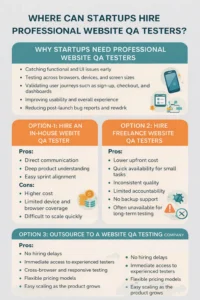
Why Startups Need Professional Website QA Testers
Although founders and developers often test their own websites during early stages, internal testing usually misses critical issues. After all, developers already understand how the product works, so they rarely experience it the way real users do. As a result, usability gaps, edge cases, and browser-specific bugs often slip through unnoticed.
That’s where professional QA testers add value. They help startups by:
- Catching functional and UI issues early, before users encounter them
- Testing across browsers, devices, and screen sizes for consistency
- Validating critical user journeys such as sign-up, checkout, and dashboards
- Improving overall usability and user experience
- Reducing post-launch bug reports and costly rework
Need expert QA eyes on your startup website? Even small bugs can negatively impact user trust and conversions.
Option 1: Hire an In-House Website QA Tester
In some cases, startups choose to hire an in-house QA tester once their product becomes stable and requires continuous daily testing.
On the positive side, this approach offers direct communication, deeper product understanding, and easy sprint alignment.
However, it also comes with challenges.
Pros:
- Direct collaboration with the development team
- Long-term product knowledge
- Easier coordination during sprints
Cons:
- Higher cost due to salary, tools, and onboarding
- Limited browser and device coverage
- Difficulty scaling testing efforts quickly
Not ready for full-time hiring yet? Outsourced QA provides flexibility without long-term commitments.
Option 2: Hire Freelance Website QA Testers
Alternatively, many startups turn to freelance QA testers for short-term or one-time testing needs. Platforms such as Upwork or Freelancer make this option easily accessible.
While freelancers can be helpful, the experience often varies.
Pros:
- Lower upfront cost
- Faster availability for small or urgent tasks
Cons:
- Inconsistent testing quality
- Limited accountability
- No backup support
- Often unavailable for ongoing testing
Therefore, while freelancers may work for quick checks, they usually struggle with complex workflows or continuous releases.
Freelancers can help—but consistency matters. If your website includes complex flows or frequent updates, a dedicated QA team delivers better long-term results.
Option 3: Outsource to a Website QA Testing Company (Best for Startups)
For most startups, outsourcing to a professional website QA testing company offers the best balance between cost, quality, and scalability.
Most importantly, this approach removes hiring overhead while giving immediate access to experienced testers.
Why this works well for startups:
- No recruitment or onboarding delays
- Immediate access to skilled QA professionals
- Cross-browser and responsive testing coverage
- Flexible pricing models
- Easy scaling as the product evolves
Looking for startup-friendly website QA services? Get reliable testing without the overhead of hiring.
What Startups Should Look for in a Website QA Partner
Before choosing a QA partner, startups should carefully evaluate several key factors. Otherwise, mismatched expectations can lead to wasted time and budget.
Look for:
- Experience with startup or SaaS websites
- Strong manual and exploratory testing skills
- Comprehensive cross-browser and responsive testing
- Clear, actionable bug reports
- Flexible engagement models
Unsure how to evaluate a QA partner? We help startups choose the right testing approach from day one.
Why Many Startups Choose Testers HUB
Testers HUB supports startups and growing companies that need reliable website QA without long-term commitments. Over time, many startups choose us because we adapt to fast-changing requirements while maintaining quality.
Startups work with us because we provide:
- Experienced website QA testers
- Functional, usability, and responsive testing
- Real-device and cross-browser coverage
- Clear bug reports with screenshots and videos
- Flexible hourly, weekly, and monthly plans
Ready to test your website with confidence? From MVPs to complex SaaS dashboards, we adapt to your workflow.
How Startups Typically Engage Website QA Testers
Most startups begin with flexible engagement models. Initially, this keeps costs under control. Later, it allows scaling as the product matures.
Common approaches include:
- A small pilot (10–20 hours)
- Part-time QA during active development
- Sprint-based testing for each release
- Ongoing QA once the product stabilizes
As a result, startups maintain quality without overspending.
Want to start small and scale later? Choose a QA model that grows with your startup.
Final Thoughts
Startups don’t need large QA teams to deliver high-quality websites. Instead, they need the right testing partner—one that understands speed, budget constraints, and evolving requirements. While in-house and freelance options may work in limited scenarios, outsourcing to a professional website QA team consistently delivers better quality, flexibility, and peace of mind.
Frequently Asked Questions
When should a startup hire website QA testers?
Ideally before launch and during active development so issues are caught early.
Is outsourced QA affordable for startups?
Yes. Flexible pricing models make professional QA more cost-effective than full-time hiring.
Do website QA testers check mobile responsiveness?
Absolutely. Responsive and cross-device testing is a core part of website QA.
Can QA testers work with agile startup teams?
Yes. Professional QA teams regularly work in sprint-based, fast-paced environments.
How quickly can testing start?
Most QA teams, including Testers HUB, can start within 24–48 hours.